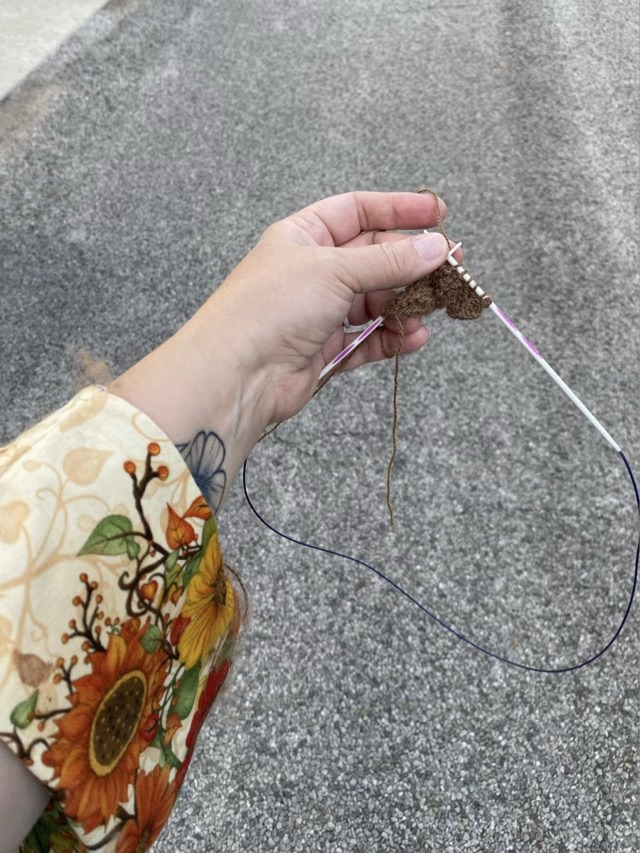
I made four example swatches from my spun soybean fiber: knitting, crochet, weaving, and nålbinding.
Photo description: swatches before blocking, clockwise from top right: stockinette knitting, plain weave, nålbinding Dalarna stitch, and crocheted lace round
The knitting swatch tells the most about the yarn, the obvious skew is because my singles have more twist than my ply. This bias does not have a significant impact on the other swatches. The nålbinding has several small knots because I could not get the fiber to felt together. I used a 1.75mm hook for the crocheted coaster, which was on the small side because the stitching is dense and stiff. The soy yarn is incredibly strong; I can’t break a single strand with my hands, but it is also incredibly soft even with the amount of twist I put in the single. There is good reason that it also carries the name vegetable cashmere. It also blocks well. It was very easy to shape when wet, and kept that shape when dry.
Photo description: same swatches after blocking
I was able to square up the knitting, and give the woven swatch some more twist in the fringe. The nålbinding swatch stitches opened up, but the crochet didn’t have much change, probably due to the density of the stitches.
The next step is to mount the swatches in my fiber book.
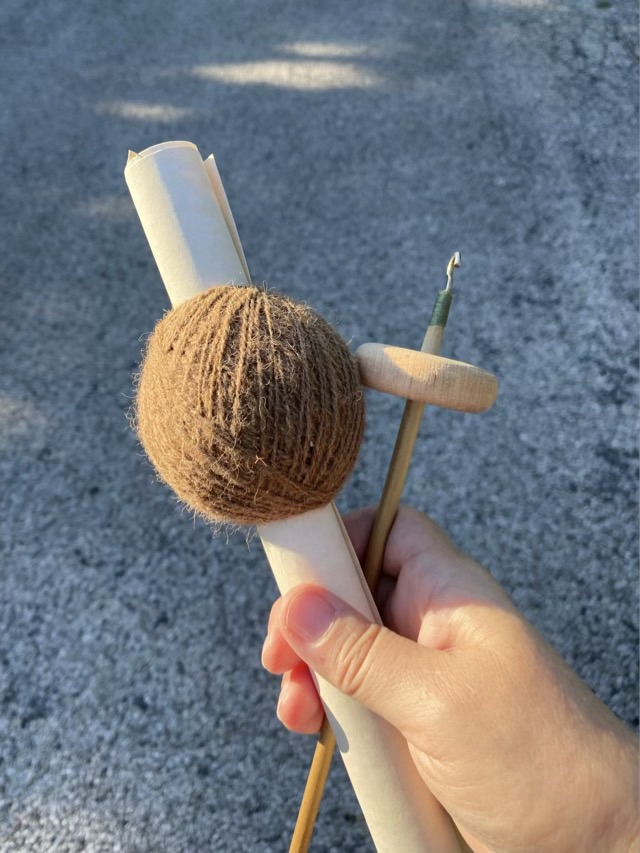
When spinning on a Turkish Spindle, the ball of yarn created on the arms of the spindle is called a turtle rather than a cop as it is for other drop spindles. My theory is that the ball of yarn looks like a turtle shell, complete with four leg holes, when the spindle shaft and arms are removed. The useful part as that the turtle is a center-pull ball, and doesn’t have to be rewound before it can be used. If you were ever curious on what a ball of yarn from a Turkish spindle looks like when it has been pulled from the center, I have provided catharsis below.
Photo description: hollowed out ball of yarn from a Turkish spindle.
The over two, under one wrapping used to make the turtle provides a surprisingly stable structure when a layer is complete. In the photo above, the inside of the turtle looks woven. I didn’t press my luck and the potential collapse of the turtle shell storing it with the middle missing, rather I rewrapped it nostepinne style before tucking it in my bag. This yarn was spun from soybean fiber, then 2 plied.
My wrapping on a Turkish drop spindle is getting better. This is two plied soy fiber on a flexible filament 3D printed Turkish spindle that I bought at a fiber festival.
Photo description: geometric patterns created by the over two, under one, wrapping pattern on the yarn “turtle” around the arms of the Turkish spindle.
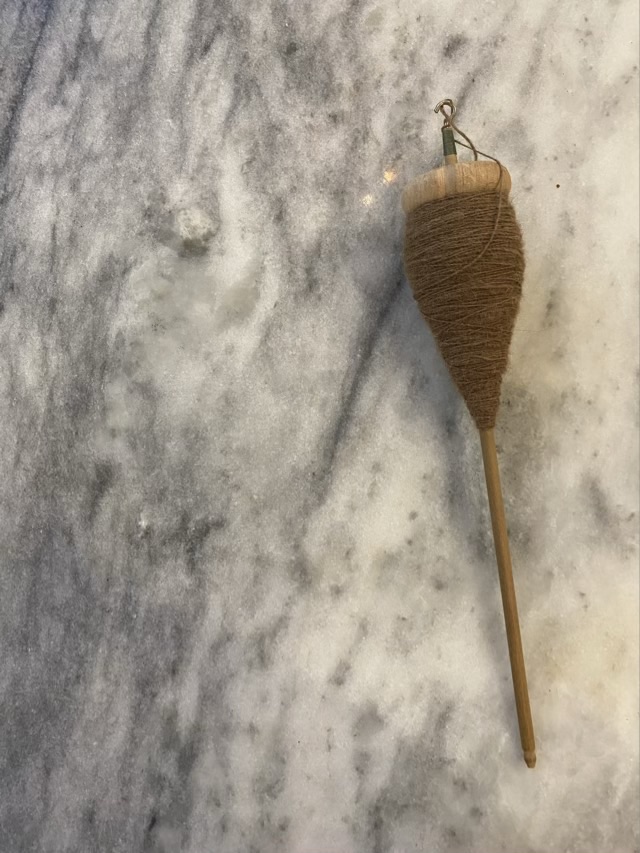
I’ve finished spinning the singles for my soybean fiber. It has quite the halo. I think if I had used water to wet it as I spun, as is done with flax, it might have less fly away fibers. I’ll mark that as a future experiment.
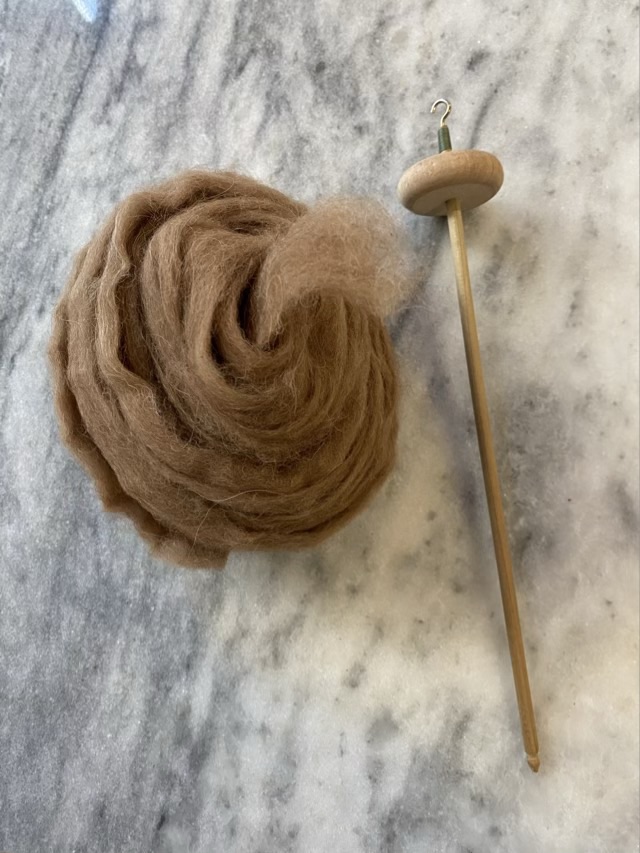
Photo description: Soybean fiber before spinning, the fibers really like to expand and float.Photo description: Soybean fiber after spinning, wrapped nostepinne style around a prototype Phase Spindle. Many fuzzy ends visible along the edges of the yarn cop.
Soybean fiber was developed by Henry Ford around 1937 in his push to promote soybeans in the marketplace. He also developed a soybean plastic and produced a limited number of soybean cars, with plastic body parts and soybean fabric door panels. The fiber is now gaining in popularity and obtaining soybean combed top for spinning is easy. It is also referred to as vegetable cashmere, which fits with that soft fuzzy halo I obtained with my yarn.
I have decided to name my 3D printed spindle design a “Phase Spindle”. It takes on many aspects of traditional spindle and tool design and combines them to increase the functionality. The barrel shape of this whorl-less spindle comes from the Scottish dealgan, and is used to create a center pull ball as you spin. Where the dealgan has a flat base, this has a point so it can be used as a supported spindle as well as a drop spindle. The head of the spindle has grooves to bring the yarn closer to the center of the spin and stabilize the spindle. There are two grooves so they work spinning clockwise or counterclockwise. The center of the spindle is hollow to reduce weight. As a bonus, the cavity is large enough to add beads if the user wishes to add weight to the spindle. The spindle is made of Tough Resin, which resists breakage when dropped, better than wood.
This project has been on the shelf for a while because I needed to reevaluate the head design. The printed spindle had a convex head, which didn’t give enough finger tip contact for flicking the spindle into action. I sanded each head into a straight to slightly convex curve to make spinning it easier.
Photo description: two black Phase Spindles, the one on the left has the head re-contoured with a concave tip, the one on the right shows the convex curve.
One side of the spindle has the lovely chatoyancy created by the precise parallel lines 3D printers make, but the other side had artifacts from the support structures. I sanded these smooth and used a stencil that I designed and cut out of removable vinyl to paint on a moon graphic.
Photo description: removable vinyl stencil applied to the barrel of a small Phase Spindle, my favorite weeding tool to the right.
To seal in the paint and protect it, I finished each spindle with a double coat of micro crystalline wax. The wax helps enhance the color of the resin as well.
Photo description: small Phase Spindle with moon graphic in iridescent silver and sealed with microcrystalline wax. Bottles of pearlescent paint and wax in the background.
I quite like the way the moon graphic came out. As a bonus, I also have moon phase stickers weeded from the stencil.
Photo description: three large Phase Spindles and six small Phase spindles with moon graphics applied. Bonus moon phase stickers shown in the foreground.