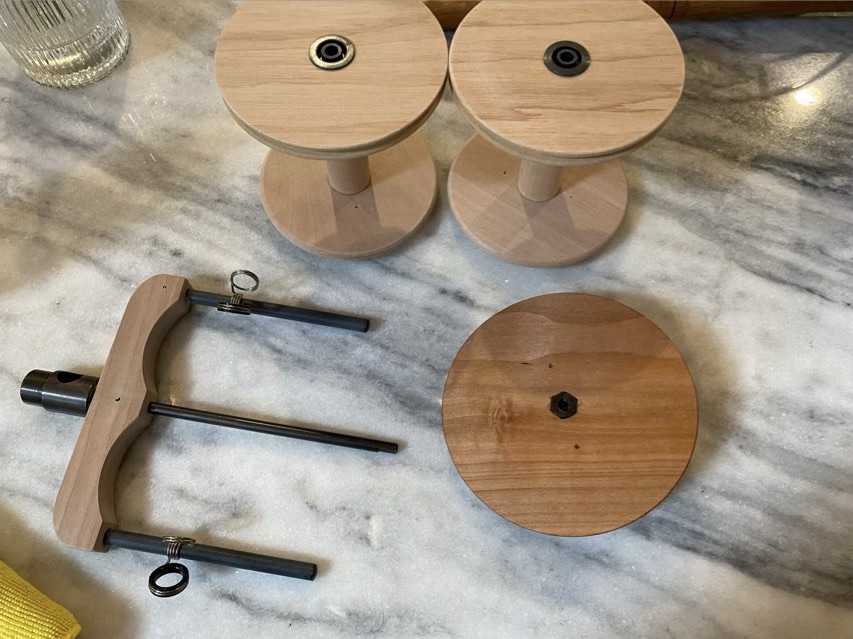
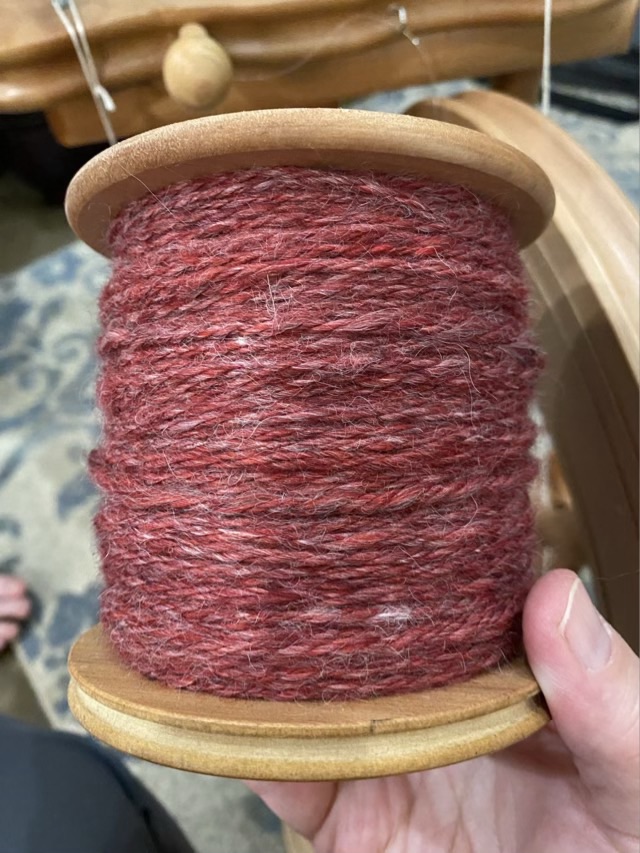
I’m developing my skills with the Ashford Traveller spinning wheel. I’ve found it helps me evenly distribute the yarn on the bobbin if I separate up my roving into thinner strips and switch hooks on the flyer after I spin each strip.
Photo description: four strips of roving laid out on my knee as I prepare to spin
Some spinners pre-draft their roving to make spinning easier, I find tearing off about 8-10 inches, then separating out sections has a similar function. Commercial roving is quite thick, and when spinning directly from a large bundle of fiber there is a tendency for the fibers to tangle, making it harder to spin consistently. Joining in a new strip is easier for me than untangling a mess of looped fibers, or managing a thick bundle.
Photo description: Ashford Traveller built-in Lazy Kate holding three evenly filled bobbins of single spun yarn
I now have three full bobbins of yarn and am ready to try plying with the wheel!
My neighbor was looking for a good home for her Ashford Traveller Double Treadle Double Drive spinning wheel. She bought it used from another crafter, but has her hands full of other projects and doesn’t have time to spin wool. She gave it to me and I took it home and gave it a good once over, wiping down parts and oiling bearings. I set it up as a single drive, Scotch tension, because I can with this wheel. As we get to know each other better, I’ll try out the double drive mode.
Photo description: back side of an Ashford Traveller Spinning Wheel with double drive and double treadle, produced between 1996-2012, drive band shown with tension released
I did make some adjustments to the drive path, which is super easy with two screws and slotted hinges inside the mother-of-all, which is the bar that holds the bobbin, flyer, maidens, and tensioners. This aligned the drive string with the wheel and made it easier to treadle. I tried out a bit of merino and alpaca blended roving, then found some more, and proceeded to spin on the wheel all day. (I did get up to take breaks, and actually address things in my to-do list.)
Photo description: mother-of-all opened to show the adjustable hinges on an Ashford Traveller spinning wheel
My Befra Willy spinning wheel has Irish tension (the brake is on the flyer instead of the bobbin), so the two wheels can live harmoniously together producing different kinds of yarn. My drop spindles are not jealous because they get to go on outings and are not dependent on a stable floor. Every item gets to keep its given name because that is the way I roll (I haven’t renamed a pet in over 20 years.) I know some spinners give their wheels individual names, as do some treadle sewing machine owners, as do boat owners if we get down to it. I’m rubbish at naming.
I’ve posted before about Howard Feed-n-Wax and how much I love it for the ease of use and beauty it imparts to wood. Here is another testimonial with my Befra Willy Spinning Wheel.
Photo description: Befra Willy spinning wheel before application, showing the wheel functional, but the finish is dullPhoto description: same spinning wheel after application of Howard Feed-n-Wax, the color deepened to a rich brown, the grain of the wood is more evident, and there is pleasant shine
I did replace the hooks on the flyer assembly as well. They weren’t broken, but I have an idea about how to wind the spun yarn more smoothly and larger hooks may help. More on that later.
Photo description: new hooks on the flyer assembly, old smaller hooks on the counter
I finally combed and single spun the last of an alpaca fleece that I purchased and washed in 2020, and started spinning on my Befra Willy Spinning Wheel in 2022. I haven’t been spinning consistently over the last two years; there were many months that the fleece and the wheel were tucked away out of sight and definitely out of mind.
Photo description: Befra Willy Spinning Wheel with a bobbin full of single spun fawn colored alpaca fiber
To free up my bobbin, because the next step is to give the wheel some TLC, I wound the yarn into a cake using my wool winder. I ended up with 196g of spun alpaca (the cardboard tube in the middle weighs 4g).
Photo description: cake of single spun alpaca fiber sitting on a scale reading 200g
I put the cardboard tube in to keep the yarn under more tension. Single spun yarn is not balanced, and I wanted to reduce the chance of kinks and tangles. I’m not sure how I want to ply this fiber, so it will sit until I have an idea. I did pull the start of the yarn and the end to compare thickness, and I did a fair job keeping a consistent spin over the two year span. There are some thinner and thicker sections, but not a wide spread.
Photo description: yarn pulled from the center (newest) and the outside (oldest) showing very similar thicknesses
This definitely counts as a forever project. I’m really getting my crafting money’s worth from this alpaca fleece.
I started on a new fiber sample from my stash: Tencel. Tencel is derived from wood pulp, and the manufacture is reported as an “environmentally friendly closed loop process”. To save you some googling, I looked up what closed loop manufacturing means, and it is essentially that an item can be recycled over and over again. The Tencel sample I have from Hearthside Fibers has a long staple length and a high luster.
Photo description: unspun Tencel fiber held fanned out in my hand in the sun showing a high shine
The fibers are almost slippery, and I’m having trouble spinning consistently. I’m dropping the spindle even more than usual.
Photo description: the beginning of a cop of Tencel single spun yarn on a drop spindle held in the sun to show off the sheen
This sample is going to take me awhile to spin. Not only is it tricky, it is horribly hot outside still, with highs over 100 all week and lows over 80. Yuck.
Oh and yeah, the hook came off my spindle again. Next step is to epoxy the thing in.