Egyptian cotton 3-ply

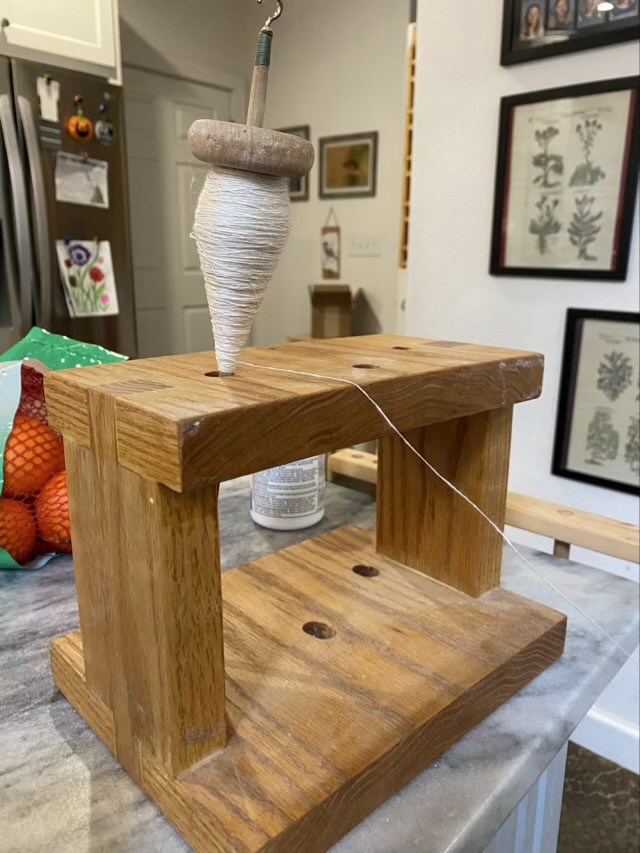
I finished spinning Egyptian cotton single spun yarn onto three bobbins on an Ashford Traveller spinning wheel (Yes! I spun cotton on a wheel using a high speed whorl.) I found the largest diameter on the high speed whorl, the one that matches the bobbin end diameter, worked best for me. The smaller diameter gears went too fast and I over spun. I also had the wheel set up with Scottish tension with a very light take up on the bobbin. I prefer to dictate the amount of spin in my yarn rather than have it controlled by the wheel.

Photo description: three wood bobbins with cotton singles on the lazy Kate built in to the Ashford Traveller

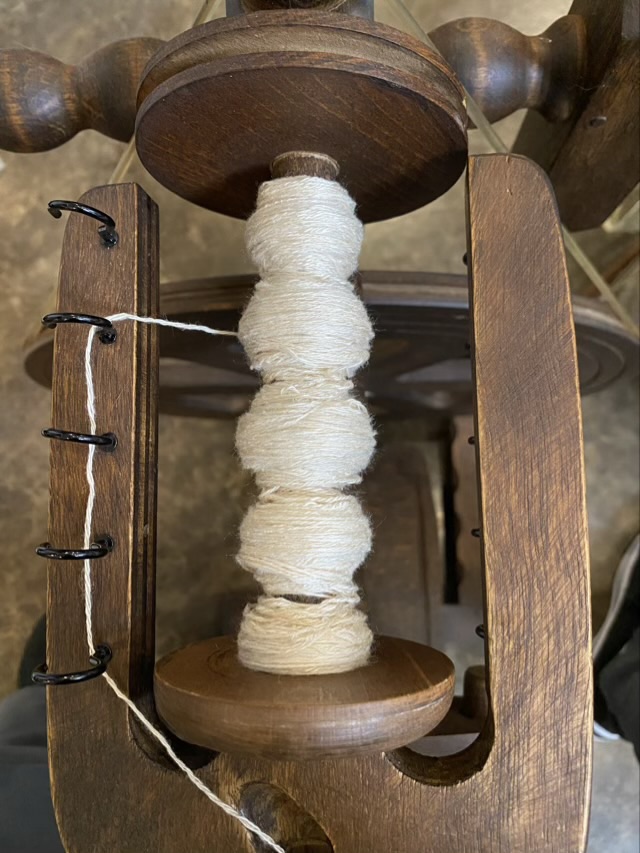
The next task was to ply the cotton. I was nervous about this because the singles had a high degree of twist, and liked to kink up. If a strand broke I would also be dealing with the rapid unwinding of the single, which results in a whole sale unbinding of a large section of yarn (ask me how I know). I did let the singles sit on the bobbin for a few days to set the twist a little. Remarkably, I was able to ply the yarn from the three bobbins with no breakage and only a few missed kinked knots.

Photo description: three ply Egyptian cotton yarn on a wood bobbin of an Ashford Traveller spinning wheel

My spinning definitely looks like homespun, but as I practiced, my technique improved and there were some sections of smooth and even spun yarn.

Toothy

When picking a new fiber to spin as I walk, I wanted something easier to spin than Tencel. I had a “Mint Top” sample in my stash, gifted to me by my sister that looked like it had some nice texture. I started spinning it on a drop spindle and it is dreamy, and the descriptive word “toothy” keeps coming into my head. The fibers grab each other with the help of the twist, but don’t clump up, and it drafts nicely.

Paradise Fibers gives it this description:

“A very new Biodegradable cellulose fiber which is infused with Mint powder extracted from Peppermint Leaves. Contains natural cooling and antibacterial properties. This is a very soft and lustrous fiber that is a natural off-white/golden color. The fiber gives a natural smooth and cooling feeling with excellent moisture absorption.”

Photo description: mint infused cellulose fiber sticking to my hand, spinning into fine single spun on a wood drop spindle, calico cat in the background waiting for pets

It doesn’t smell minty to me. It will be interesting to see if the products made with the yarn feel cool.

One of these things is not like the others

When I switched to the jumbo flyer on my new-to-me Ashford Traveller spinning wheel I noticed the spin was much smoother and quieter, and the flyer fit better. Some further investigation revealed that the socket in the jumbo whorl was different than the socket in the other whorl. Hm. I ordered a high speed whorl that is supposed to fit the Ashford Traveller, and it had the same socket as the jumbo, which leads me to believe that the whorl that was on the spinning wheel when I received it was not original. I ordered a regular whorl, and it fit! I know the previous owner used it as-is, and was frustrated trying to learn to spin on it, and I wonder if the owner before also bought it second hand and gave it up because it was difficult to spin. How many people give up on something they want to learn because the tool is difficult, and because they are beginners, they can’t spot what’s wrong and they think it is their own inability?

Photo description: collection of spinning wheel whorls, clockwise from the bottom left: Ashford high speed whorl, Ashford regular whorl, Ashford jumbo whorl, mystery whorl
Photo description: underside of the same whorls with the mystery whorl on the bottom right with a subtly different socket

I do have to admit that I love spinning for the joy and quiet of it. It is not a fast craft, and there are small moments of immediate gratification (when the fiber takes up the twist), but it is making a supply, rather than a finished wearable or gift-able object. Not everyone loves it. Everyone is different. I’m glad I learned on drop spindles, because it made learning to spin on a wheel easier for me.

Spinning Tencel

It is shiny, sleek, and has a little sparkle, but I had a rough time spinning the Tencel fiber sample. I think I dropped my spindle more than with any other fiber. The fibers like to clump, but did not like to evenly draft, and my single spun yarn came out uneven with thin and thick randomly spaced.

Photo description: single spun Tencel fiber on a wood drop spindle in the sunlight, asphalt in the background
Photo description: notepinne style wound ball held in my hand in the sunlight to show the luminosity
Photo description: the side of the ball of single spun yarn held in the sunlight to show the shine

I chain plied the single from the center of the ball and added twist using my Ashford Traveller spinning wheel.

Photo description: chain plied Tencel yarn on a wood bobbin
Photo description: three ply Tencel yarn on a PVC niddy noddy, which really shows the unevenness of the spin

As much as I love the idea of using fiber made from waste tree products, I would not choose to spin Tencel again, the frustration wasn’t worth it. I was glad it was a 25 gram sample.

Fiber Page: Ramie

I completed the fiber page for my spindle spun Ramie top fiber from Hearthside fibers. Ramie was pleasant to spin and has a cottony feel but with a long staple length. I experimented with three and four ply yarns.

Photo description: 12 x 13.5 inch fiber page with (clockwise) a sample of macrame on a bamboo stick, the card from Hearthside Fibers that says “Ramie Top Developed in China about 4,000 BC Non-stinging member of the nettle family”, paper bobbins containing single spun, 3-ply, and 4-ply yarn, finger woven sample, crocheted basket weave swatch, plain weave swatch, knitted swatch, unspun fiber in a clear topped drawer
Photo description: sample fiber page with the swatches flipped up to show the descriptions written in white ink on the blue card stock