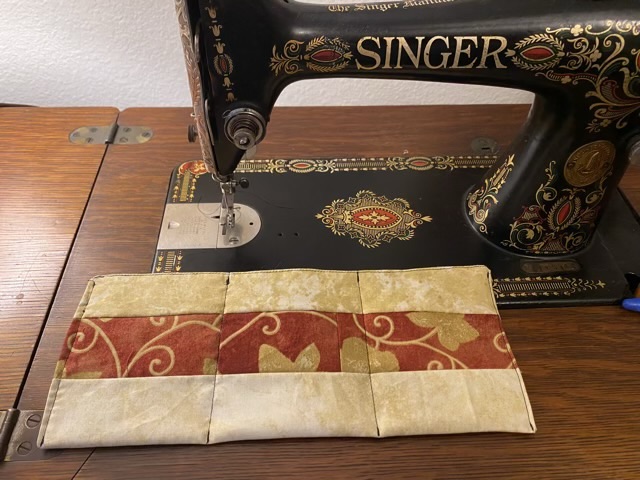
I tried a few different ways to organize my headphone and charging cords in my purse, but they all ended up in a tangled snarl. I thought what I might need is more pockets. (Pockets!) I exercise my antique Singer treadle machine by sewing together scraps of quilting fabric, making larger bits of scrap. I took two of those pieces and made a three pocket strip by sewing the right sides together, turning it right side out, folding it in half, and stitching the sides and pocket dividers.
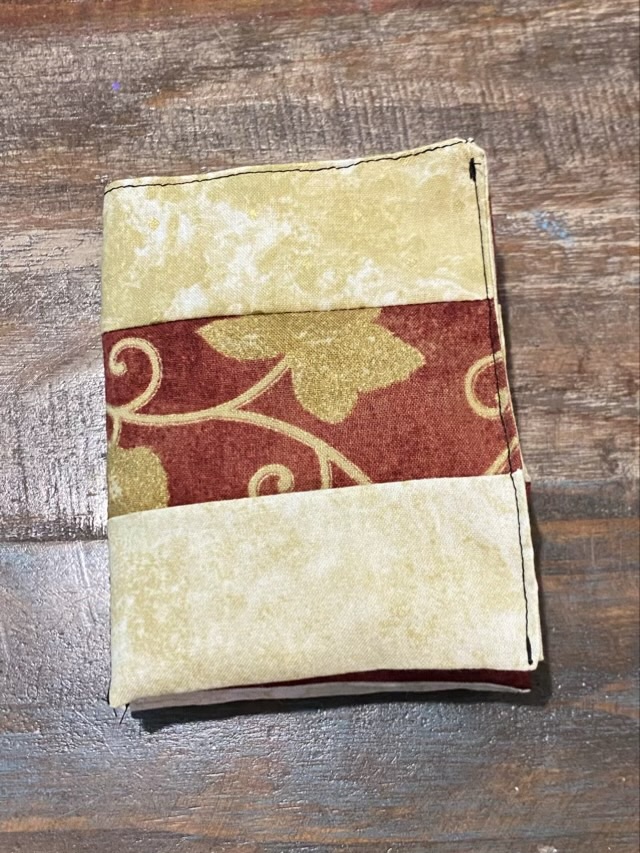
Photo description: three connected pockets sewn from scraps of quilting fabric on a model 66 Singer Sewing machinePhoto description: other side of the pockets shown with headphones, charging battery, and charging cords sticking out of the pockets.Photo description: view of the top of the filled and folded three pockets Photo description: view of the side of the three pockets when they are accordion folded into a wallet
I did not put a zipper or closure on the pockets, because folding the wallet does a good job of keeping the cords in place, and the wallet goes in my purse upright, so there is a low possibility of getting turned upside down. So far the wallet works well because I have not reached into my purse and encountered a tangled mess.
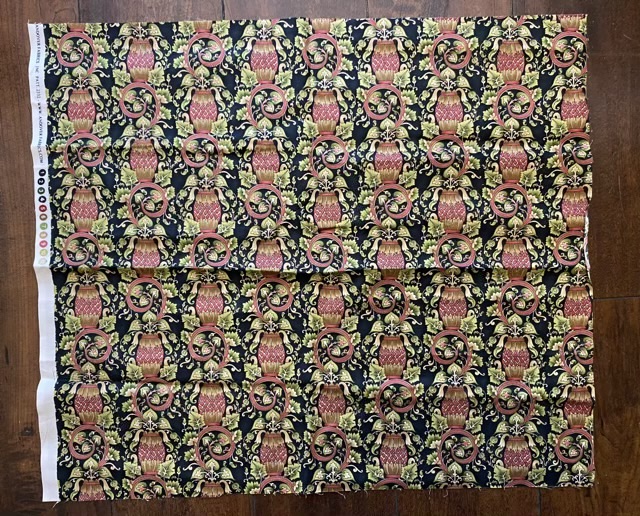
I don’t like the U shaped travel pillows. I’ve tried several, and the bulk pressing against the back of my neck (really anything around my neck) drives me nuts. So I made a different kind of pillow. It is ideal for reclining chairs because it has two side pillows so my neck doesn’t twist too far, and no stuffing behind my head. The best part is that I made it with one fat quarter, some thread, and poly fil stuffing.
Photo description: fat quarter (18”x21”) of quilting fabric with a pineapple motif
To make the pillow, fold a fat quarter in half lengthwise, right sides together (9” x 21”, doubled). Sew along the edges, leaving two 4” gaps on the outside thirds of the long edge (for stuffing later).
Photo description: fat quarter folded in half and sewn with two gaps on the far edge, on a model 66 treadle sewing machine
Clip the corners and turn the pillow right side out. Fold the case in thirds, mark the line, then sew seams along the lines. This divides the pillow into three parts.
Photo description: pillow case divided into thirds and being sewn using the fold as a guide
Fill the outside sections with stuffing, then sew the gaps closed. I usually do this by hand, but the foot on my model 66 has such a nice tiny toe, I thought I would try on the treadle sewing machine. It worked well.
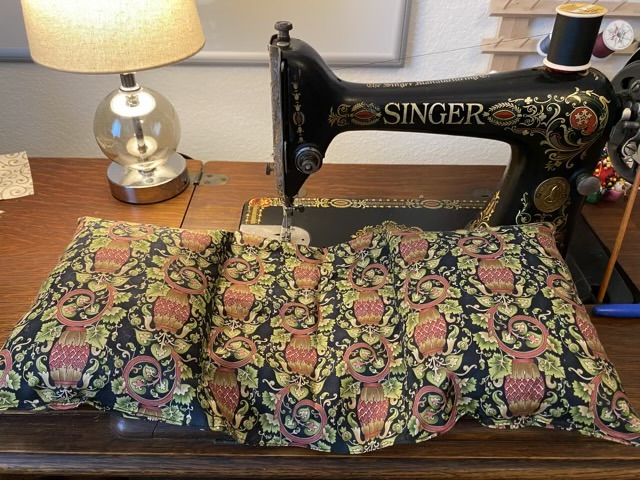
Photo description: sewing the pillow gap closed using a treadle machine fitted with a standard footPhoto description: finished travel pillow laying on the work surface of a 1916 Singer treadle sewing machine
It amuses me that the fabric coordinates with the “red eye” decals on the sewing machine. I can report that the pillow works great, especially for naps.
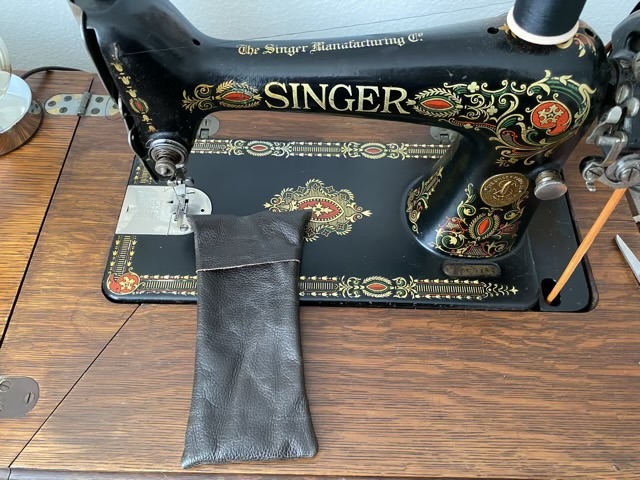
I had the chance to sew some reclaimed leather on my antique Singer 66 treadle sewing machine. This leather is thin and flexible so was easy to sew, I suspect that a modern machine would be able to handle it as well. (There are tales out there that these old machines are great for sewing leather, but the truth is much more complicated.) I did crank the machine by hand rather than risk the speed of the treadle, and I used upholstery thread (and found my purchased bobbins don’t fit, sigh.)
I wanted an envelope style pocket with the flexibility to thread on a belt, or hang from belt loops with carabiners.
Photo description: sewing thin soft leather on a Singer 66 sewing machine Photo description: pouch turned right-side out Photo description: pouch with carabiners through the central hole in the belt pass through
The design needs work. I like the hole in the belt loop and the flexibility it gives, but the flap makes it difficult to get the phone in. I ended up clipping the edges of the flap so it still helps the phone stay put, but is easier to get the phone inside. Not ideal, but experiments will continue.
I made an experimental pouch for my phone for when I’m wearing pants with inadequate pockets. It strings onto a belt, has quilted sides and an open top. I made it with two pieces of quilting fabric and polyester batting using my model 66 Singer Treadle machine, including the quilting.
Photo description: quilted phone case with golden ivy on a cream background sitting on the table with of a Singer treadle sewing machine from 1916
I like that I made the pocket for the belt with the seam in the back. I like that it is quilted. I’m not sure how I feel that is it open on top. So far I haven’t dropped the phone out of the pouch, but it would ease my mind if there were a small retention flap in there somehow. Hm. I shall contemplate… I think I have an idea. I’ll make another test case.
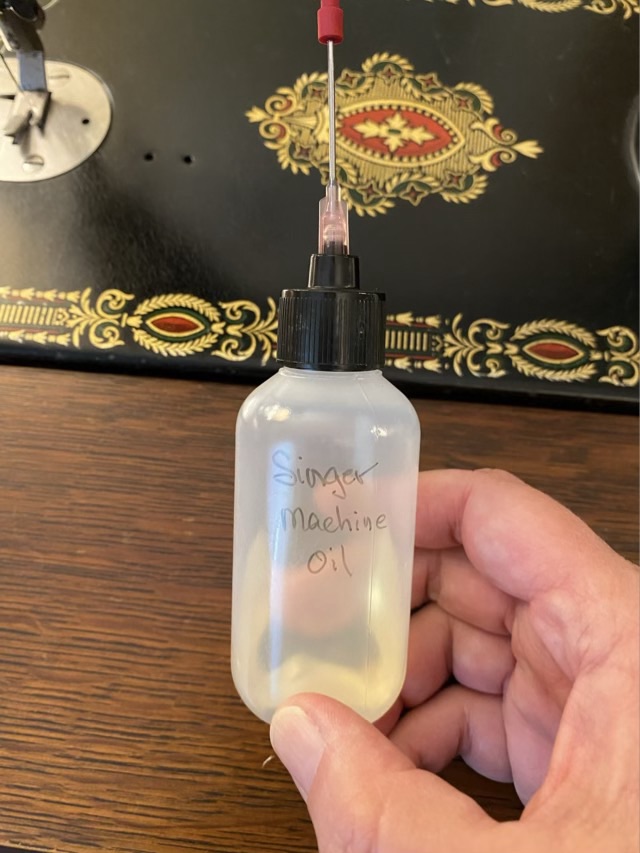
If you start following treadle sewing machine groups, you’ll see frequent use of the acronym SMO, which stands for Sewing Machine Oil. This lubricant is vital, especially for older machines. Of course Singer recommends using Singer SMO, but I find the applicator to be clunky, so I took the advice of several treadle machine bloggers and purchased squeeze bottles with a stainless steel tube to facilitate precise oil placement.
Photo description: 2 ounce plastic squeeze bottle with 1.5” stainless applicator, filled with Singer Machine Oil
I purchased my bottles on Amazon, and it was a little tricky because the name is awkward: plastic squeeze bottle with stainless applicator. Accurate, but hard to search without all the words. Any how, I found them, filled one with SMO, and love how much easier it is to apply the oil without overshooting. I did worry about light getting through the bottle and degrading my oil, but after researching, it is better to be able to see the oil to check for changes (darker, cloudy). I might still keep the bottle in the dark, because some things are deeply ingrained.








 Critters and Craft