I started on the swatches for Jacob’s wool, and then finished them all in a day, even the nålbinding. I must have thirty other projects I’m not working on. Hm.
Photo description: four squares made from hand spun Jacob’s wool: knit (top left), crochet (top right), cut open nålbinding (bottom left), woven (bottom right)
I had two large cakes of yarn, and two small nostepinne balls, so I used the smaller amounts to make the swatches. I hope to make something wearable out of the larger cakes of yarn.
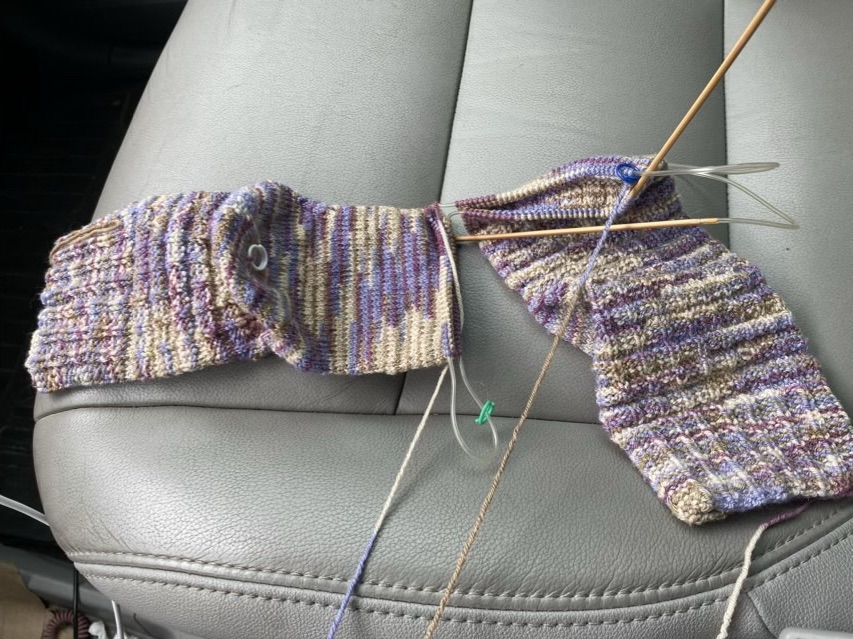
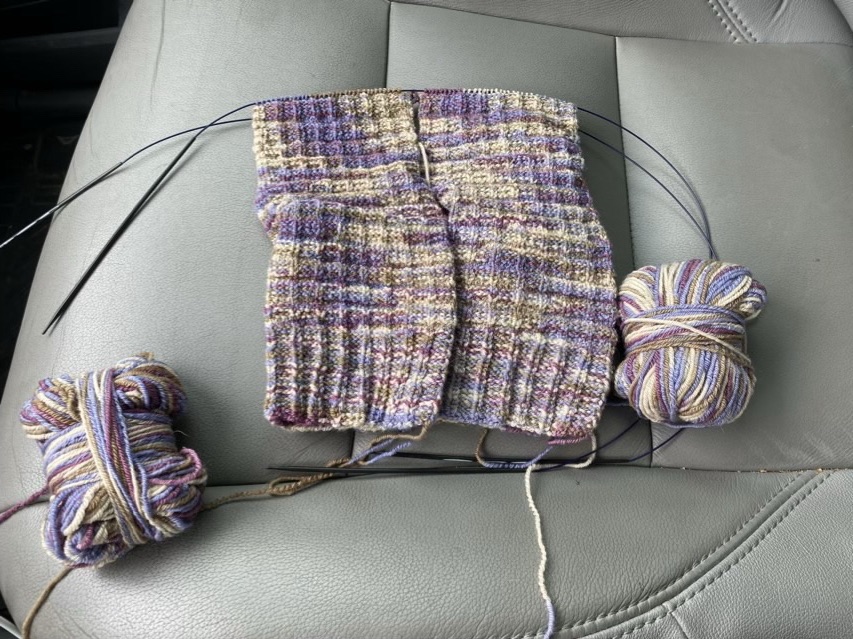
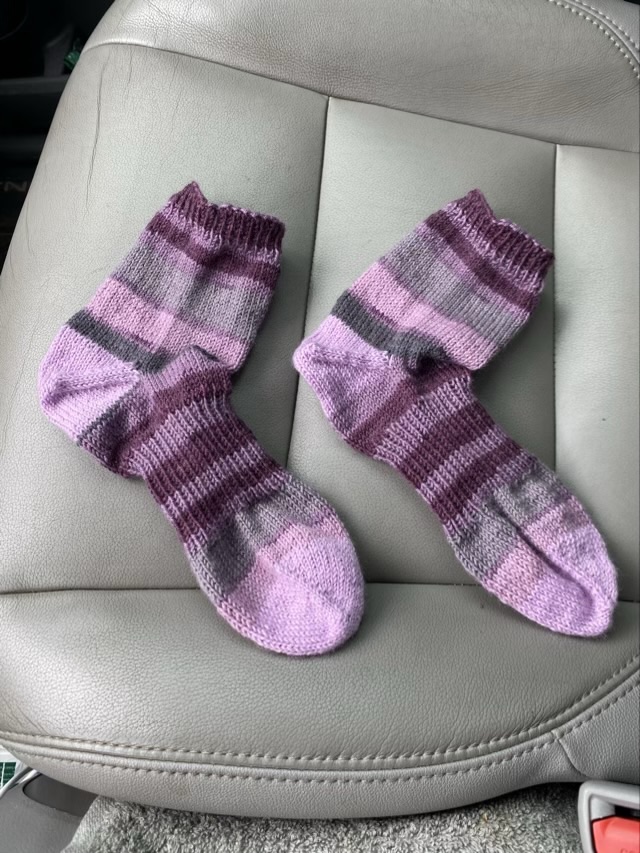
I cast on a new pair of socks the day after I finished the previous pair (that took me 13 months to knit). This time, though, I’m using self striping yarn, and an after thought heel to minimize fuss. I knit the toes individually with a solid color yarn, then I set them up on two circular needles and joined in the self striping yarn. Now all I have to do is knit, well, and some purls since I want some ribbing on the arch and top. When I get to the heel, I’ll knit in a piece of scrap yarn, then finish the sock. The heels will be last and knit individually.
Photo description: two striped purple socks partially knitted on two circular needles
I’m already making better progress, and I avoid the project less (although I’m not completely all in, I do have a few other projects in process.)
I cast these socks on in April, 2024. I called them finished 13 months later. My eldest graciously said they could end below the calf (phew).
Photo description: crew length black, orange, and yellow hand knit socks shown on feet
The Singularity pattern by Jeny Staiman is amazing. The instructions laid out in a spreadsheet format are so much easier to follow and mark off than traditional written instructions. The pattern itself is elegant. My issue was personal: I chose mostly black yarn, knitted with black needles, and am not a fan of following a pattern line by line. I would rather have a general idea and knit for many rows, or maybe have a repeating pattern that I can memorize. It is a shame that the yarn also doesn’t show off the pattern. You can’t see the beautiful sweep and contours created by all those paired increases and decreases.
I have cast on a new pair of socks using a different sock method. This set shouldn’t take me over a year to finish (fingers crossed, but not while knitting.)
My youngest gifted me two skeins of yarn last December. I cast on with size 11 knitting needles at the end of February, thinking that a nice wide scarf would be cozy. Hm. Two skeins does not make a very long, wide scarf.
Photo description: knitted rectangle with purple and teal stripes (yarn was self-striping)
So the scarf became a shrug. Sewing the ends together for a few inches formed short sleeves, which help keep the shrug in place.
Photo description: knitted shrug with now vertical stripes
It works! It is now a garment that gives a little extra warmth, and as a bonus, doesn’t wrap around the neck. This isn’t the first time, and won’t be the last, where I have had to pivot the purpose of a project. This one definitely came out better than the original idea.
Photo description: rose top card from Hearthside Fibers top left, single spun, two ply, and cable ply yarns top right, unspun fiber middle left, twined swatch middle right, crochet cables swatch bottom left, knitted cables swatch bottom right
The Rose Top fiber sample was nice to spin, and working up the swatch projects was satisfying. Even though this fiber is produced in a similar way to Tencel, only using rose stems and leaves rather than wood pulp, I found this easier to handle.