Singularity Shadow’s Embrace socks

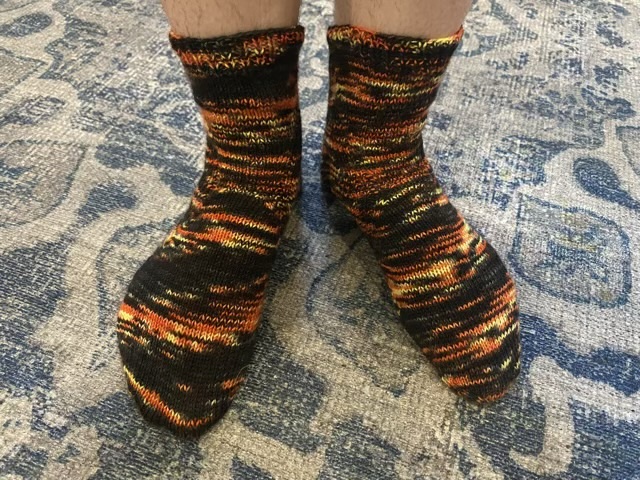
I cast these socks on in April, 2024. I called them finished 13 months later. My eldest graciously said they could end below the calf (phew).

Photo description: crew length black, orange, and yellow hand knit socks shown on feet

The Singularity pattern by Jeny Staiman is amazing. The instructions laid out in a spreadsheet format are so much easier to follow and mark off than traditional written instructions. The pattern itself is elegant. My issue was personal: I chose mostly black yarn, knitted with black needles, and am not a fan of following a pattern line by line. I would rather have a general idea and knit for many rows, or maybe have a repeating pattern that I can memorize. It is a shame that the yarn also doesn’t show off the pattern. You can’t see the beautiful sweep and contours created by all those paired increases and decreases.

I have cast on a new pair of socks using a different sock method. This set shouldn’t take me over a year to finish (fingers crossed, but not while knitting.)

Not a scarf

My youngest gifted me two skeins of yarn last December. I cast on with size 11 knitting needles at the end of February, thinking that a nice wide scarf would be cozy. Hm. Two skeins does not make a very long, wide scarf.

Photo description: knitted rectangle with purple and teal stripes (yarn was self-striping)

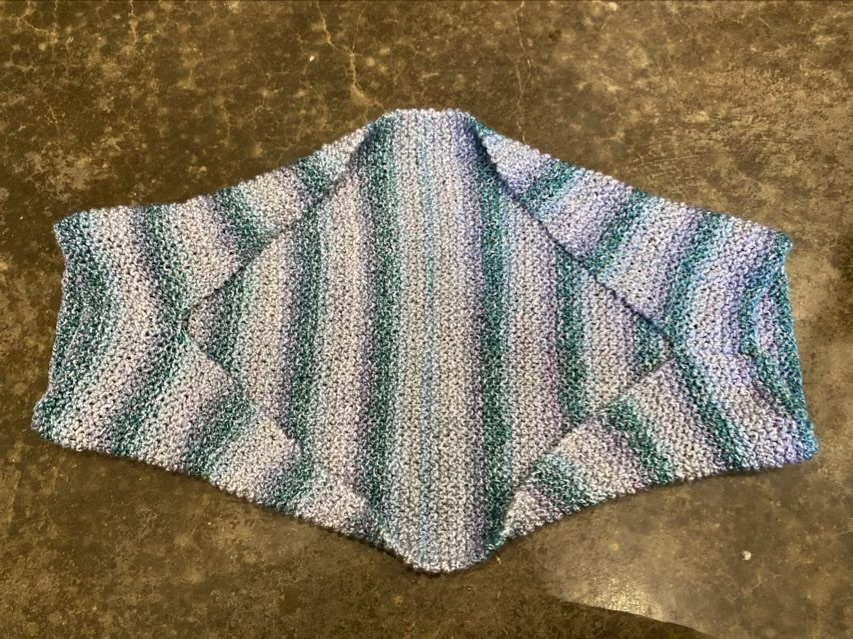
So the scarf became a shrug. Sewing the ends together for a few inches formed short sleeves, which help keep the shrug in place.

Photo description: knitted shrug with now vertical stripes

It works! It is now a garment that gives a little extra warmth, and as a bonus, doesn’t wrap around the neck. This isn’t the first time, and won’t be the last, where I have had to pivot the purpose of a project. This one definitely came out better than the original idea.

Rose top fiber page

Photo description: rose top card from Hearthside Fibers top left, single spun, two ply, and cable ply yarns top right, unspun fiber middle left, twined swatch middle right, crochet cables swatch bottom left, knitted cables swatch bottom right

The Rose Top fiber sample was nice to spin, and working up the swatch projects was satisfying. Even though this fiber is produced in a similar way to Tencel, only using rose stems and leaves rather than wood pulp, I found this easier to handle.

Egyptian cotton fiber page

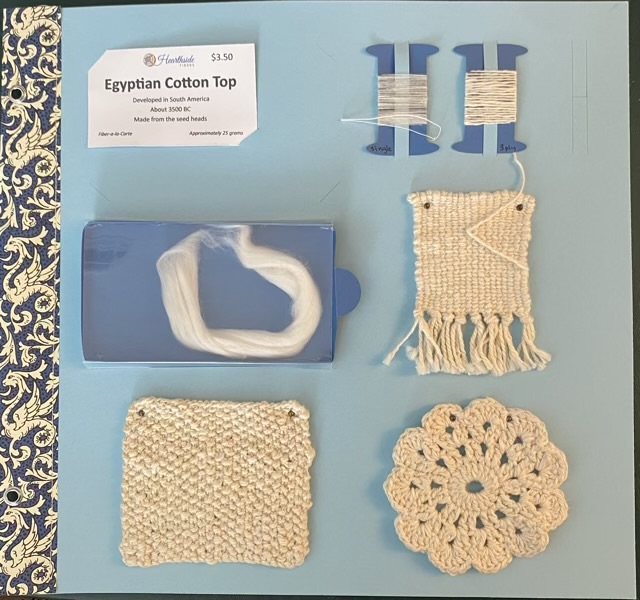
Photo description: scrap book page with an Egyptian cotton card from Hearthside Fibers upper left, single spun and chain ply yarn upper right, unspun fiber middle left, twined weaving swatch middle right, knit moss stitch swatch bottom left, crochet lace round bottom right

I spun this Egyptian cotton sample on an Ashford Traveller spinning wheel fitted with a high speed whorl. Egyptian cotton has a longer staple length so is less inclined to form pills. It was nice to spin and worked up into the swatches well.

I enjoy spinning cotton, but is definitely a sitting activity, either on a wheel, or with a tahkli spindle. I also avoid wearing black, as the small fibers accumulate everywhere.

Tencel top fiber page

Photo description: scrap book page with a Tencel Top card from Hearthside Fibers upper left, single spun and chain plied samples upper right, unspun fiber middle left, plain weave swatch middle right, stockinette knit swatch lower left, and crocheted lace round lower right

The next completed fiber study page is for Tencel. Tencel is made from wood pulp and the combed fiber is shiny and silky looking, but it is not easy to draft consistently. I want to like it because it is made from waste product, but it fought me when I was spinning. Maybe it would be better if it were blended with something. Blending fibers is another whole rabbit hole.

Despite the difficulties spinning, my swatches are more rectangular and less skewed than with other fibers. I block most of my swatches, but the Tencel really benefitted from being wet and reshaped.