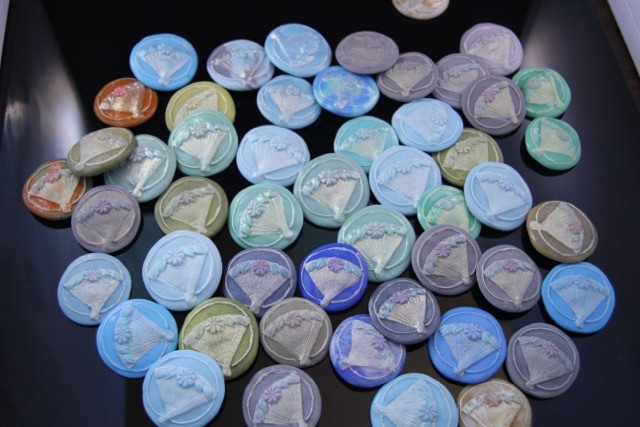
In March 2012 I had a custom order for glass clay buttons for the Kansas State Button Society. I designed the button with input from my grandmother’s button group, made a silicone mold into which I pressed the glass clay, hand built the button shank, hand painted each button, and fired them in batches in my kiln.
Photo description: multiple colors of flower and fan glass clay buttonsPhoto description: close up of the buttons with a ruler showing each button about an inch and three quartersPhoto description: one button mounted on the card that was given out during the Spring 2012 meeting
Making larger batches is a completely different animal than designing a single component. The glass clay was fun to play with, but was brittle, so the buttons were decorative more than functional.
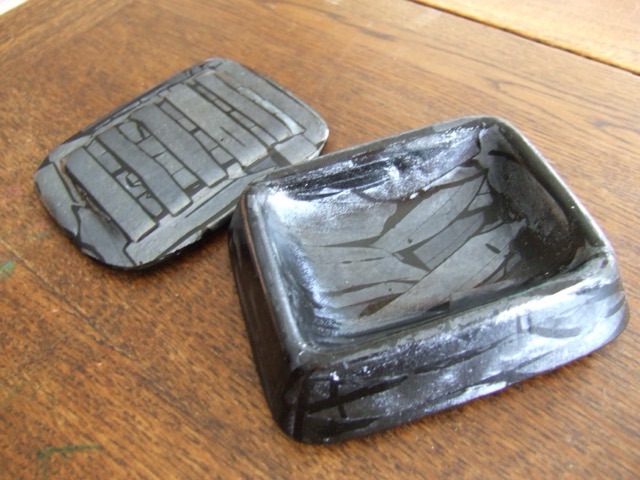
Sliding back to June of 2010, here is a fused glass box with lid that I did in my small Paragon kiln. The lid and base are made with separate molds, so I put strips of glass in the mold, put them in the kiln, and let it fuse together.
Photo description: fused glass box showing the outlines of the shards used to fill the mold
It is a cute little box, but I didn’t make many. (This is the first and might have been the last.) It took a large amount of shards.
This throwback goes to September 2009, and makes me a little sad. I was fusing images into glass using fusible film printed with a laser printer. The film would burn off leaving the image in a sepia tone. The method only works with high iron oxide content toner, which of course is getting rare. I had to resource the transfer paper I was using twice, retesting each time the previous brand stopped making it. Then when I invested in a large stack of paper that worked, my printer died. I found a backup printer at a garage sale, but the print quality was poor. Investing in a printer that may or may not work was risky, and I wasn’t getting enough orders to justify the expense. So production stopped. The photo below is line art that I produced a batch of for my grandmother for a reunion. I also did portraits and sketches.
Photo description: wire wrapped glass pendants with iron oxide fused image on silicone cords in multicolored mesh bags
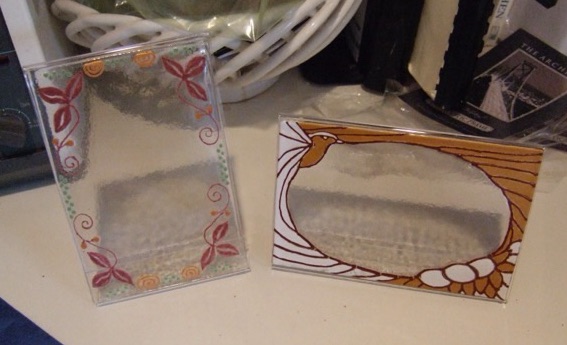
Back in February of 2009 I was doing glass fusing in a small Paragon kiln. I was experimenting with fusible glass paint, which is applied with a bottle fitted with a thin steel tube. Colored ground glass is suspended in a liquid medium and placed on the glass, rather than painted with a brush. It is an interesting technique and one that requires a steady hand, a pin to clear the nozzles, and a wipe to clear up the mistakes. I like that these pieces reflect my preference for the Art Nouveau style. After I fused the paint to the clear glass in the kiln, I mounted the glass on acrylic photo frames. (I don’t know why I went this direction, it seems counterintuitive to glue glass to plastic rather than just use a frame. I’m sure there was a reason.)
Photo description: two clear fused glass panels with red, orange, and white designs done with fusible glass paint
Here is something from July 2008 that reflects most of the crafts I was involved with at the time: crochet, wire work, and glass fusing.
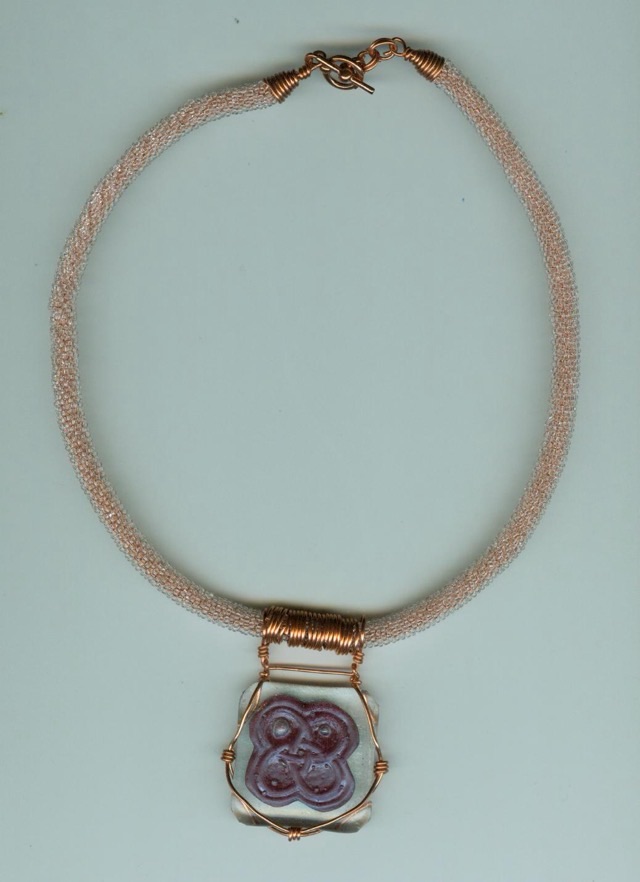
Photo description: copper and glass necklace from 2008
The rope was crocheted with copper lined seed beads (I think, I may have crocheted copper wire with clear seed beads, but the rope looks too even with a nice drape, which tells me I probably used silk cord, rather than wire, and the the copper color may come from a lined seed bead). I finished the rope with hand made wire cones and a purchased copper toggle clasp. The pendant is fused glass with a hand made chased copper inclusion in the shape of a four loop Celtic knot. I was experimenting with fused glass using a small kiln because I could set it up, let it run its program overnight, and check on it in the morning in my own time, very important when dealing with a young child and another on the way.
I attached the glass pendant using copper wire, and added five independent coils of copper around the rope. I must have done this for flexibility reasons, it would have looked better with a single longer coil, but that would have changed the drape.
These seed bead crocheted ropes do make me nostalgic for the times I could wear necklaces. They have a comforting feel in the hand.




 Critters and Craft