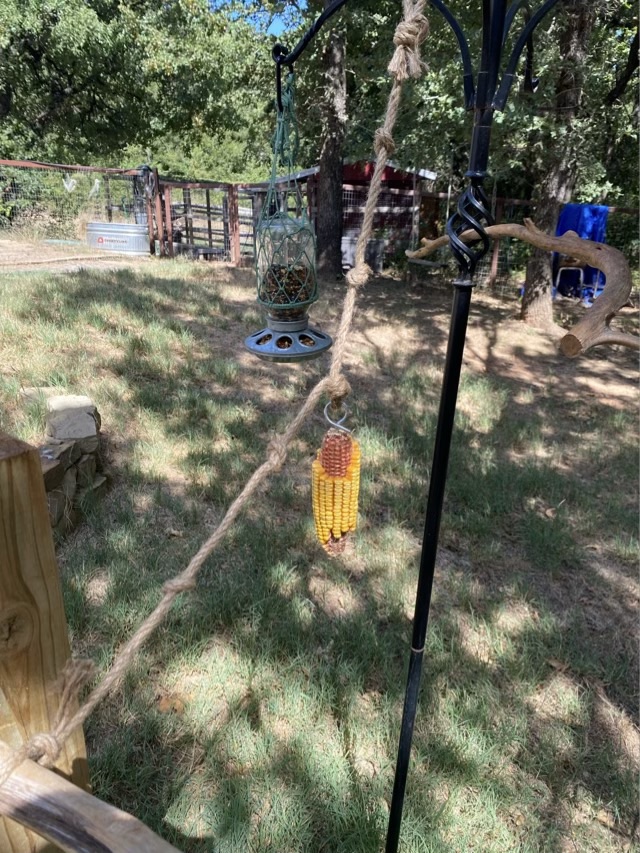
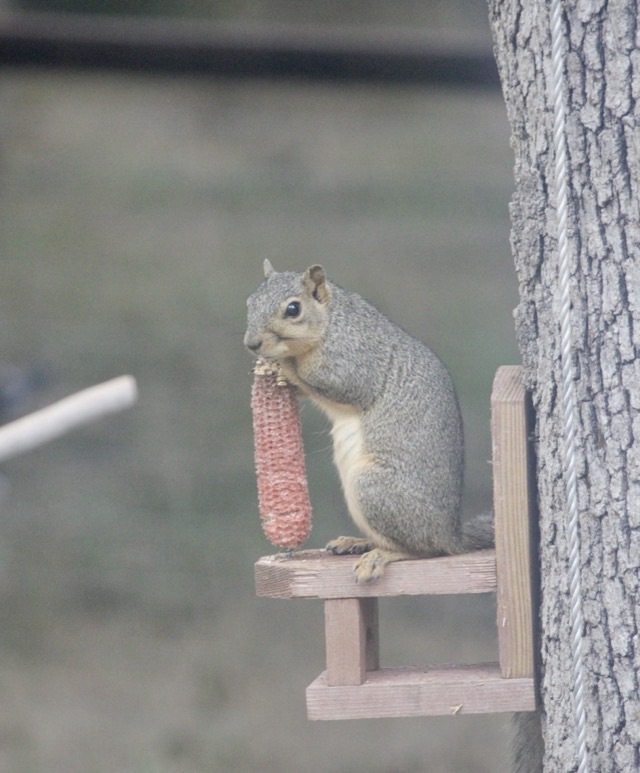
The squirrels really appreciate that I put out dried ears of corn, but they go through one ear in a day. I added an obstacle, so they have to work harder for the corn by tying knots in a 1/2” hemp rope and adding a screw eye. The corn is twisted onto the screw and hangs in the middle of the rope.
Photo description: Rope tied from the bird feeder stand to to railing with an ear of dried corn hanging from the middle
The squirrels have figured out how to get one kernel at a time off, but prefer the birdseed. We have a four squirrel family, so maybe one will figure this out while the others are gorging on seed.
I added a few more twined bracelets made from different natural materials and had a whole wrist full of test subjects.
Photo description: six twined bracelets with labels: Bark, Daylily, Corn, Daffodil, Iris, Grass
The daylily is the oldest at 12 days, corn a close second at 11 days, then daffodil, bark, grass, and iris all at 6 days. The bark knot didn’t want to stay tied, but they all survived showers and regular wear. What they didn’t survive was my sensory overload. It felt like they were getting tighter around my wrist, although photographic evidence doesn’t really show a difference.
Photo description: same bracelets six days later
Because the bracelets were bothering me, I subjected them to a pull test. The surprising result was that the daylily bracelet did not break. The others all ceased to be connected. The bark, grass, and iris all had the stop knot pull open, the corn leaf and daffodil broke along the length of the twining.
Photo description: twined bracelets broken from pulling
The lone daylily bracelet was allowed to remain on my wrist. I made this of dead and partially dried daylily leaves that were lying near the base of the plants. Because the leaves were not completely dried they were easy to twine without breakage, but they also had some shrinkage which causes the twine to separate and be a little spring-like. We’ll see how long it lasts on my wrist. It is light and not biding with a little give, so it has a chance.
I saw another crafter post in my Wild Basketry group about making twined bracelets and wearing them as a durability test. Yes, please, and thank you Marijke!
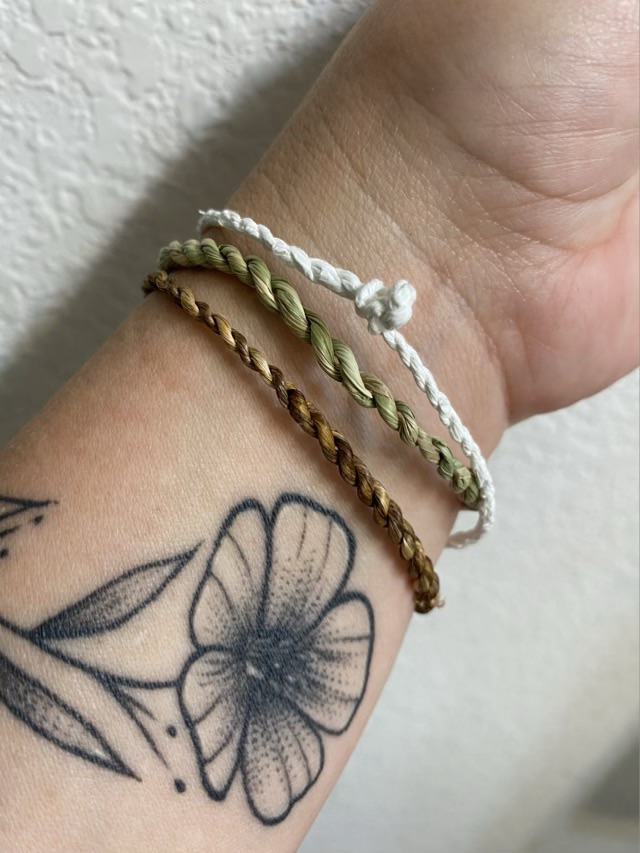
Twining has become my go-to fidget when I’m waiting or wandering. The brown bracelet on my wrist is daylily leaf gathered from the ground where they were dead and dried, but still pliable. The green bracelet is dried and rehydrated leaf strips from corn that I gathered on a countryside road. The white bracelet was twined out of the paper packaging on restaurant straws while waiting for lunch.
Photo description: my wrist with three twined bracelets, daylily, corn leaf, and paper packaging
To connect the bracelet, I untwist the start, which is a loop, and slide it over the end knot. The twist in the twine keeps the loop locked behind the knot. I have been wearing the bracelets at all times, so unsurprisingly the paper bracelet did not survive the shower test. The paper soaked up the water and separated at the weakest point: the untwisted loop.
Photo description: twined paper bracelet broken at the connecting loop
The daylily leaves have shrunk some, leaving gaps in the twine. Since I gathered them when they weren’t completely dry, the separation is expected. When crafting with plant fiber, most crafters recommend letting the material dry completely, then rewet, but not soak, the material to make it pliable. This method reduces shrinkage in the finished product.
The corn leaf was completely dry, and I did gently rehydrate by wrapping it in a wet towel. The twine has held together without gaps.




 Critters and Craft