Fiber Study: Banana

I assembled my banana fiber study page with yarn made from the stems of banana plants and purchased as combed top from Hearthside fibers.
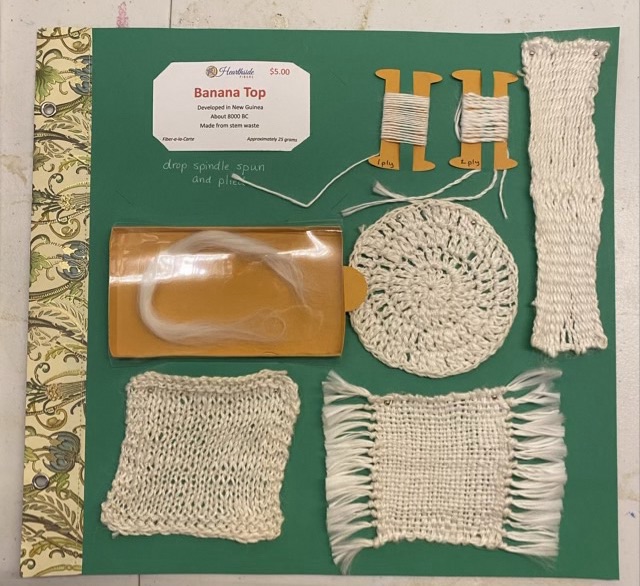
Photo description: counterclockwise from top left: card from Hearthside fibers that reads “Banana top, Developed in New Guinea, about 8,000 BC, made from stem waste”, unspun fiber, knit swatch, woven swatch, crocheted swatch, sprang swatch, two ply yarn, and single ply yarn

Bananas are believed to have been first cultivated in New Guinea around 8,000 years ago and used for both fruit and fiber. The staple length of the combed top is long, about 8 inches, and the fiber is strong.

Photo description: banana combed top next to a ruler showing around an eight inch length

The fiber was pleasant to spin. I did challenge myself to spin thicker than my default spin, which resulted in more thickness variation, and also subsequently less length. I used up all my two ply yarn in my swatches, and had to piece together bits for my bobbin on the page because I forgot to set aside some at the beginning.
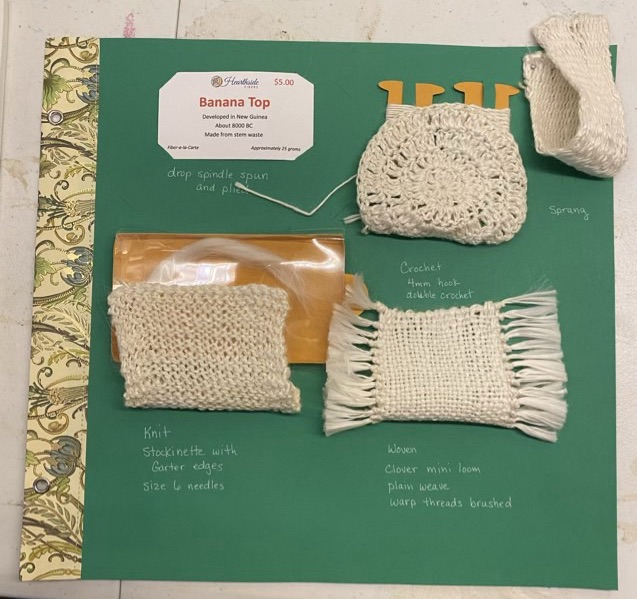
Photo description: same fiber page with the swatches flipped up to show the hand written descriptions

I made unadorned swatches to show the texture in the yarn that was also a result of the variations in thickness. My sprang swatch blocked well and has a lovely horizontal stretch.
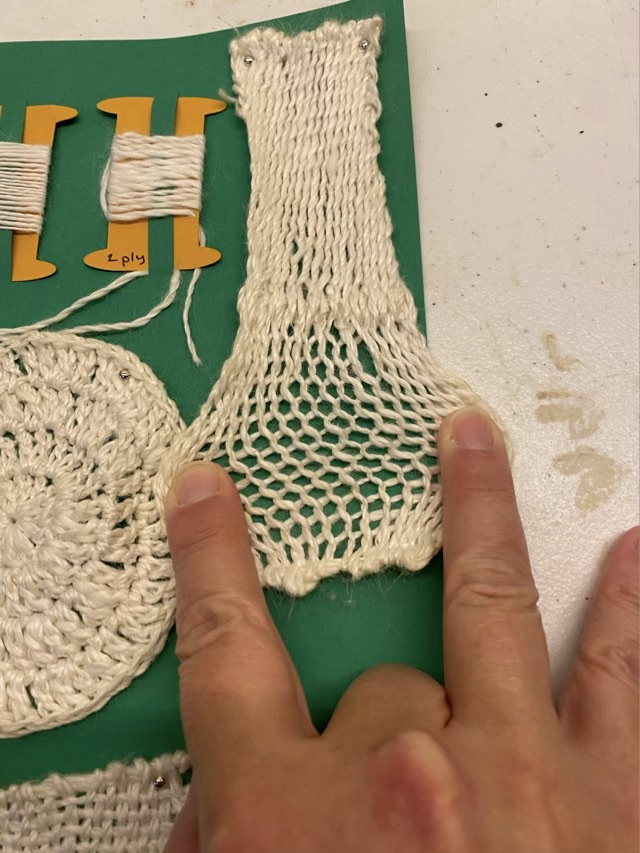
Photo description: sprang swatch held expanded with my fingers to show the interlinking between the strands

I would absolutely spin banana fiber again, but I think next time, I would spin thin.
Banana fiber

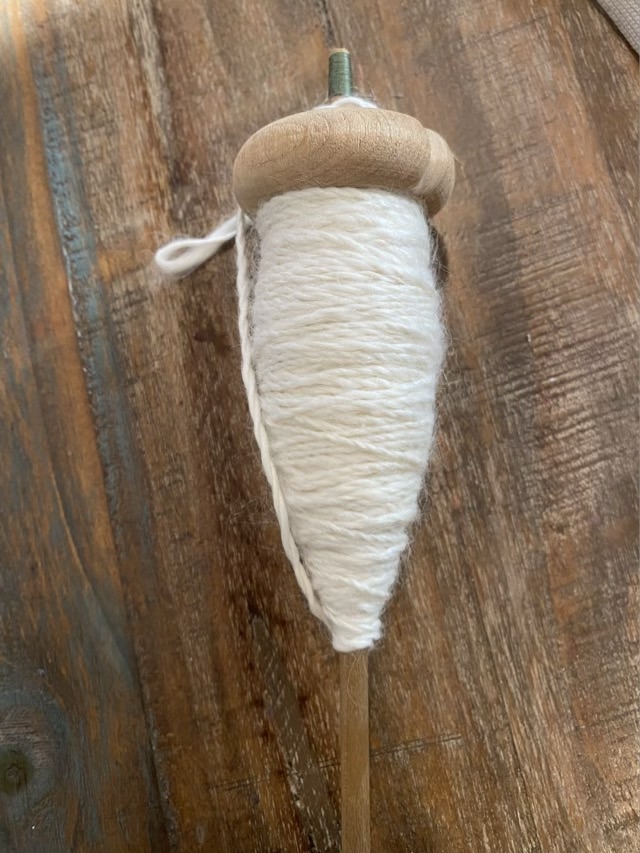
I have finished spinning and plying my banana fiber sample from Hearthside Fibers. I’m still using the drop spindle with the lost hook because I haven’t had the spindle and a new hook in the same room yet. The yarn came out less even than usual because I was trying to spin thicker and push myself out of my comfort zone. It should give some interesting texture once it is worked up, though. The texture of the yarn is cottony, even though it is a long stapled plant fiber (cotton has a short staple, or fiber length).

Photo description: banana fiber (made from banana leaves) two ply yarn on a well used drop spindle

Spinning: banana fiber

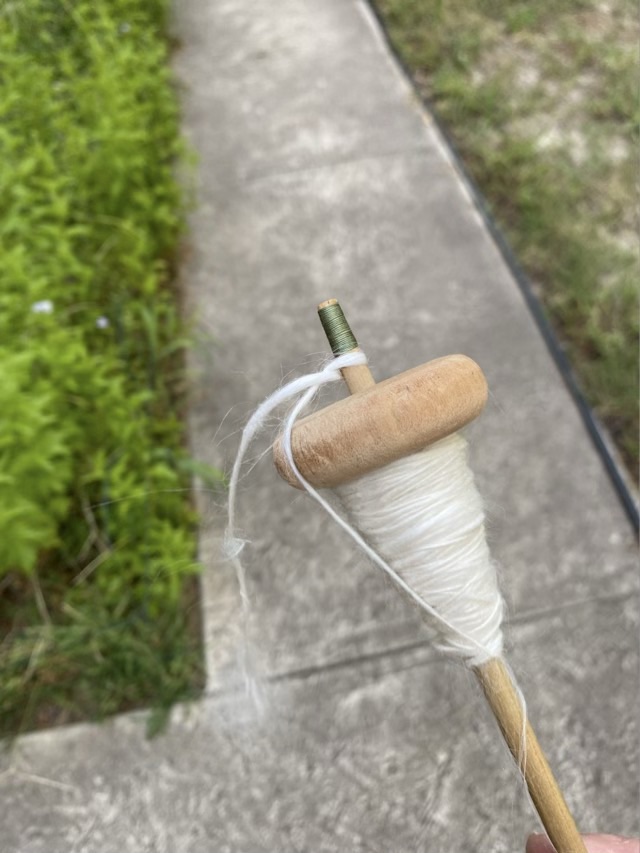
For my next spinning adventure I selected banana fiber (made from banana leaves) from my stash. It was already in my mind to consciously spin thicker singles, because my default spin size has been getting quite fine. It was a double challenge with the banana fiber which has about an 8 inch staple length (the length of individual fibers). Spinning fine would not be a challenge, spinning thicker was! To add to my challenge my fingers decided to spin the singles counterclockwise, opposite to how I usually spin. (Probably because I ply counterclockwise when I’ve spun clockwise, so my hands were already in ply mode.) The counterclockwise twist did not make the hook on my spindle happy, and it unscrewed in the middle of the walk and flew off into the grass. Hm. Undeterred, I switched to making a half hitch to secured the spun yarn.

Photo description: white banana fiber on a top whorl spindle secured with a half hitch below the silk cord lashing

I was pleased that the silk lashing I do on the top of my spindle shaft also serves as a security measure for the half hitch. Not only did I finish the walk still spinning, I continued to use the half hitch method for the rest of the spin over the next few walks.

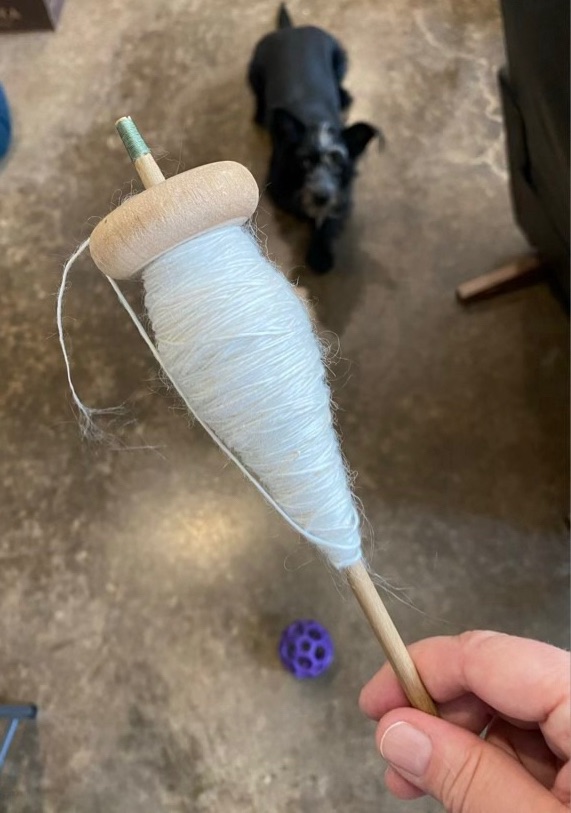
Photo description: all the banana fiber from my sample spun up on the spindle still missing the hook, Missy the dog and her ball in the background because it is hot in Texas and my last leg of the walk was around the kitchen counter inside

I managed to spin slightly thicker, we’ll see how it plies up. The banana fiber has a stiffness to it, more like flax, and doesn’t need much twist to make viable yarn. It had a cottony feel to it, despite the long staple length. It was easy to spin, but I think if I spin it again I will load the fiber on a distaff rather than pull off sections of combed top roving.