Magic the hen is still in isolation while her foot heals from whatever happened to it. She is shuffling around more, and doesn’t need to be moved in order to reach her food and water anymore. Apparently the special treatment caught Twilight’s attention, and when I opened the cage after taking this picture, she hopped in with Magic. She was back out again when she realized I was putting in fresh shavings, not handing out treats!
This is one of Missy’s favorite toys; a farting bear. She wiggles the mechanism out of position, then someone in the house with opposable thumbs fixes it, then she happily makes it emit gaseous noises until the tube slips again. Rinse and repeat. I’m shocked that the rubber has held up. And since she can, she brings it up to the top of the couch. She has started to nap up there too. Cats do it, so it must be a good spot.
Missy on the back of the couch with her farting bear
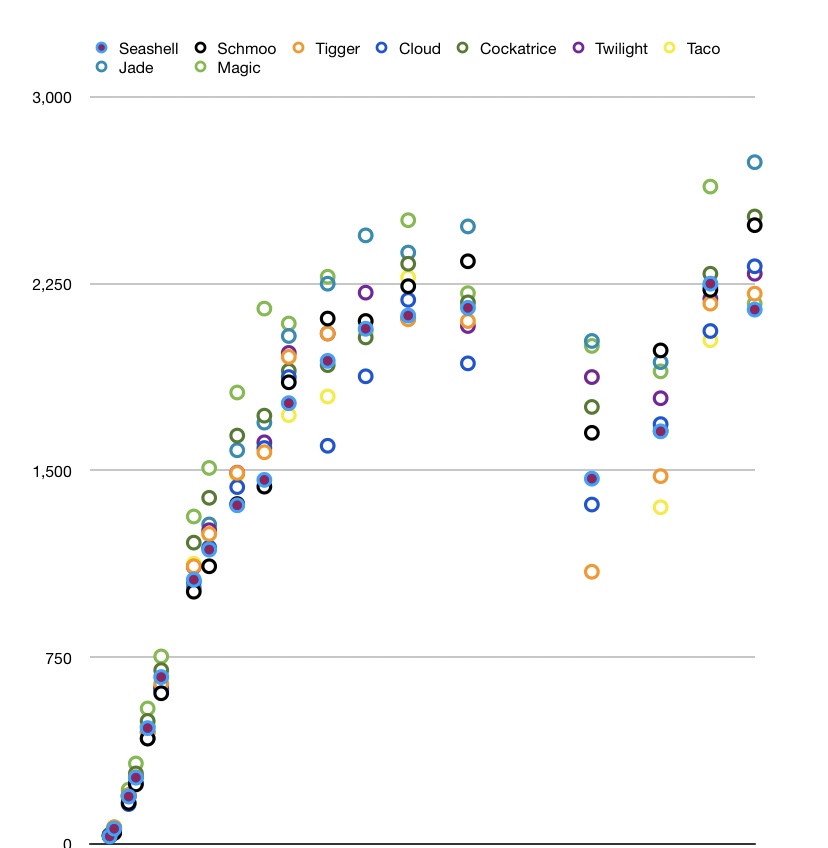
My eldest and I did another chicken check, where we check under wings for mites, check their vents, check their feet, and get a weight. Most of the chickens’ weight is still recovering from the winter, however Magic’s has gone down, which is not surprising since she is still in isolation with a healing foot. She is starting to shuffle around her enclosure, so I hope she is on the mend. Seashell also had a drop in weight. Turns out she had an infected foot, which we cleaned out and bandaged. Her feet are particularly prone to infection and bumbles. It probably doesn’t help that they are put together a little differently than the other chicken’s feet. Faverolles are supposed to have five toes, and the “extra” toes protrude from inside the foot. When they walk, they have to negotiate not only the terrain, but also those toes. Seashell’s legs are a little shorter, her feet rotate out a bit, and she has an extra nail on one of her extra toes. Makes for more scrapes and injuries to her feet.
Chicken weightsThis is a picture of Seashell’s feet when she was younger. It was the only photo I have showing all her toes because all her foot feathers are wet.
I bought a splash guard for keeping the oil splatter down when I was pan cooking. I use it more as a strainer to drain my rice when I make it! (I can never get the ratio of water to rice right, so I go traditional and use a lot of water, cook for 12 minutes, then drain off the excess and rinse in hot water.) I have recently discovered that it also makes a good pizza peel for lifting the pizza on and off the pizza stone (once it is mostly cooked). I really like multi-use utensils.
Returning the take and bake pizza to its tray after finishing baking on a pizza stone.
I’ve started to reread the book that started me spinning “Respect the Spindle” by Abby Franquemont. I don’t reread books often (Terry Pratchett excepted), and usually use books on craft as quick reference, but since I’m really enjoying spinning, and have been spinning daily, I thought I might understand the text better now. And I do.
The half hitch on my bottom whorl spindle has been giving me trouble, slowing down the production and acting a a frustrating bubble in an otherwise smooth flow (for a relative beginner). In her book, Ms Franquemont mentions many different methods for securing the yarn before adding twist, including using a notched shaft. I don’t have any notched shafts. So I made one. Rather than notch the shaft of my thin olive spindle, I started with a scrap of dowel from the garage. I shaped it using my belt sander, started the notch with a small saw, and refined the shape first with needle files, then with folded sandpaper.
Drop spindle shaped from a dowel
I kept the dowel thickness in the middle to try making yarn balls as one would with a nostepinne (yup, that is new to me too, but so cool!) The shaping is like a Russian supported spindle (roughly, the pictures I’ve seen are more elegant), but I’m using it also as a drop spindle (so I can walk and spin). I had to start spinning to test the notch, so my yarn may have a bit of wood dust as I refined the shape, spun, and refined some more.
View of notch grooves from the top of the spindle
My goal with the notch was to get the yarn closer to the center of spin as well as be functional for spinning clockwise or counterclockwise. The cone tip helps with flicking the spindle to spin, and the grooves actually help with grip. I have not applied any finishing oil as I may still tweak the shape. Sanding down to 400 grit though keeps the yarn from catching on the wood.