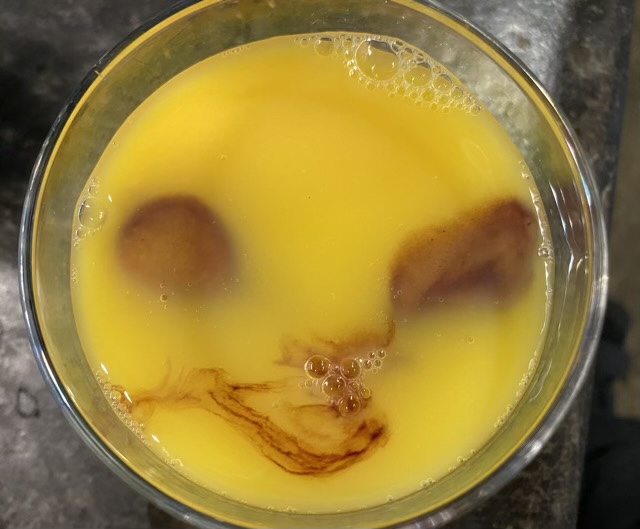
I add a bit of Elderberry syrup to my morning orange juice (just a little of both, to get some more Vitamin C). When the dark purple syrup hits the orange, it makes very interesting patterns, which are different every morning. It feels like the patterns could be read, much like tea leaves, but unlike tea leaves, the liquid swirls and changes rapidly. There isn’t much time to let the brain make up images. Except one day, when my OJ smiled at me. Surely that would be a positive sign? Unfortunately that day was quite traumatic, and the next day was worse. So maybe it wasn’t a smile, but a leer. Beware the grinning breakfast drink.
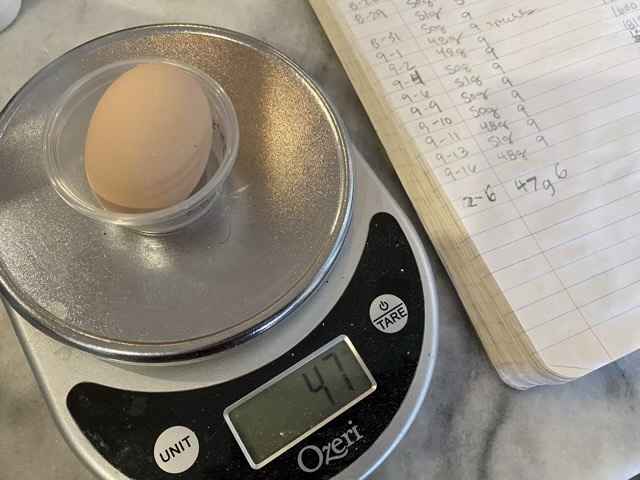
And we have an egg! My eldest went out to check the chickens, and they have started laying again after almost 5 months. Phew! I still have powdered egg in the freezer, so the experiment to see if we could last without fresh eggs was successful, but I don’t think we will repeat it next year. I may save some powdered eggs, and I may try glassing some, but I’m not above buying fresh eggs when the hens have their hiatus.
Now where is the rest of her body? Oh, curled up in the hammock directly behind her. Camera angles are amazing tricksters. No photoshopping here. She does love her hammocks.
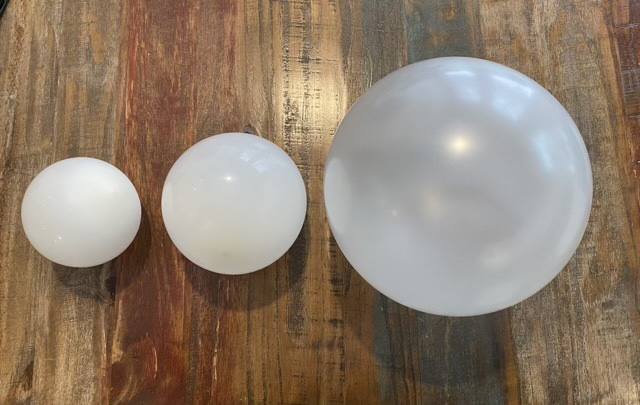
I’ve been baking more bread since I discovered that Heritage Wheat doesn’t bother my digestive system. Recipes cavalierly throw around “rise until double” and I have been bumbling along hoping I wait long enough (but not too long) for the dough to rise to “double”. So what is double? To see, I blew up three balloons, one 5” in diameter, one that was double the first in volume (6.3” in diameter), and one that was double the first in diameter (10” in diameter). Hm. The double in volume seems smaller than my successful proofs, and I have never achieved the size of double in diameter.
Balloon (5”), Balloon double in volume, Balloon double in diameter
So I went looking for an explanation and found this article. The author goes much farther into mathematical models, but at the end, suggests a better method: the finger poke method. With practice, one should be able to tell how long to prove dough by pressing on it with a finger and seeing how the dough reacts. If the dough springs back, it needs more proving. If the dough stays depressed, it is over-proved. Somewhere in the middle is the right time.
I now can’t get the Pillsbury Doughboy image out of my head. If this method is correct, he was under-proved, by the way. (Don’t know what I’m talking about? Here you go.)
Trail cam caught the image of a wild rabbit! I haven’t seen one of those in awhile. I was afraid the local cat population had taken them all out. I’m glad they are still around.