My poor spider plant has been neglected for a while, and left to its own devices for everything but water (I do water it twice weekly). I got a bee in my bonnet and finally gave it a good clean up, including trimming dead leaves and separating out the babies.
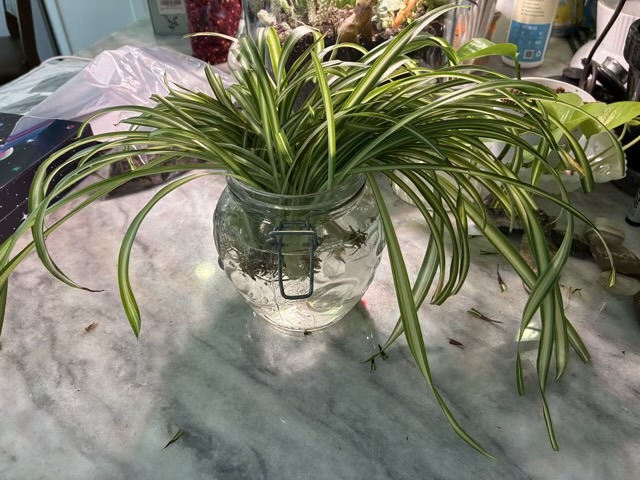
Photo description: the aftermath of my spider plant cleaning frenzy, a tangle of leaves and stalks on the floorPhoto description: cleaned up spider plant hanging in the windowPhoto description: old canning jar filled with water and spider plant babies
When the spider plant babies root out, I’ll plant them in another hanging pot. I did select the longest leaves from the pile of discards and are letting them dry so I can attempt to make some twine from them eventually.
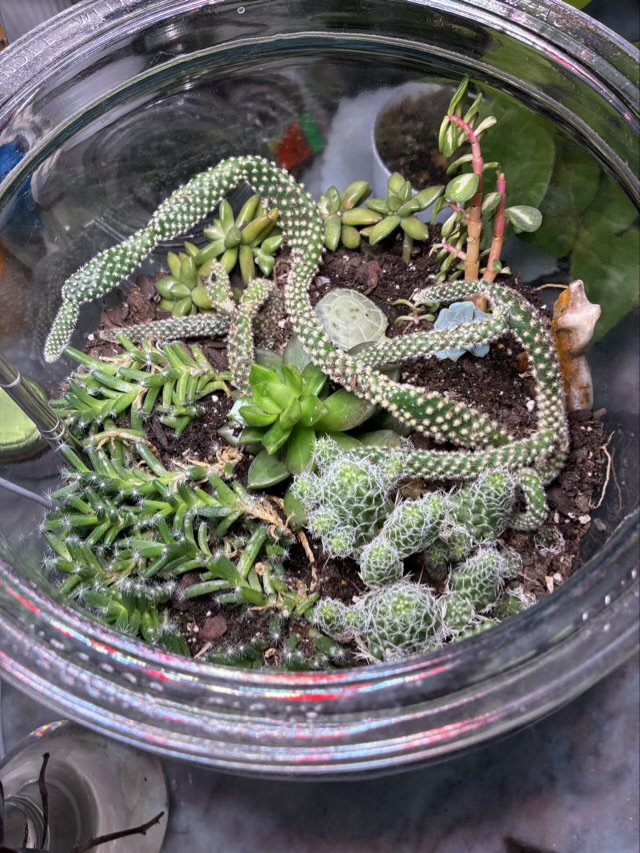
Of the original planting of my tea jar terrarium, I had three varieties survive. It was looking rather sparse, so I added succulents from another pot we had hanging in a window.
Photo description: top down photo of my tea jar terrarium with six varieties of succulents and two carved stone figurines
I’ve increased the artificial light from 9 hours to 12 to see if that makes the cactus happier.
I changed almost everything on the last felt cat for my Bucilla kit. I took felt from my stash, cut new parts, cut different pieces from the pattern, altered the angle of the head and feet slightly, and mixed up the sequins so that I could have a black, orange, and white calico cat.
Photo description: felt calico cat with one orange leg and one black leg, and one orange ear and one black ear and a white belly and pawsPhoto description: in progress Bucilla House Cats Wreath made from felt and sequins with five cats, that deviate from the pattern
I have had two calico cats with one orange leg and one black leg, Shadows and Izzy. Izzy was born after Shadows passed and we joke about reincarnation.
Photo description: Shadows the calico cat with a black right front leg and an orange left front legPhoto description: Izzy the calico cat with a black left front leg and an orange right front leg
I have a few more things to finish on the wreath: a large bow and some bells. I don’t think there will be much more deviation in the sewing.
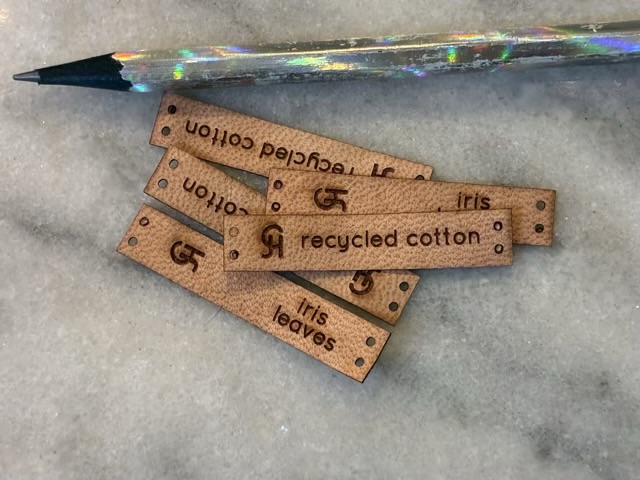
I wanted to add labels to my handmade items, so used the laser cutter to make some from thin leather. I added pairs of holes to the edges so they could be sewn on, my signature mark, and the primary material used for the item.
Photo description: labels cut from leather with a blue laser cutter, pencil for scale
I’m really pleased with how these came out. I’m getting better at estimating laser cutter and engraving settings; I had only one test cut before dialing in to settings that gave me my desired result. For the cut I had a speed and power of 100, and the fill engrave was power 30, speed 100, line density 100. The labels are 1cm by 5cm, which is just about as small as I can go and still sew them into a circle.
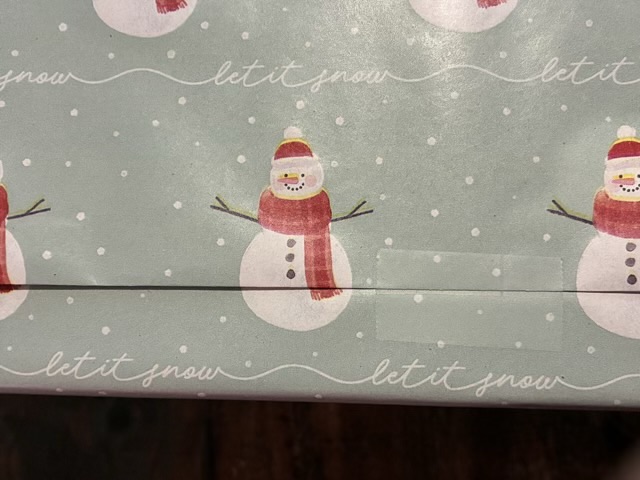
Sometimes, not very often, when I’m wrapping presents the paper pattern and the box size coincide and the fold at the back is a perfect continuation of the pattern. Ah.
Photo description: “let it snow” wrapping paper that has been wrapped around a box with the two ends meeting up to complete the snowman pattern




 Critters and Craft