How to make knitting needles from common parts

In a pinch, or if you need a bunch of needles for teaching a class, you can make knitting needles from dowels you can find in a hardware store. Making your own needles not only gives you a greater connection to your knitting, it is a much cheaper way to have wood needles, which I find more pleasing than plastic or aluminum when knitting (these are cheaper than those too).

To make these needles I picked up 3/8″ poplar dowels, which are about 68 cents each, at my local hardware store. I also used 120 and 320 grit sand paper. I cut the dowels to 14.5″ (I used a chop saw, but a hand saw would also work). You can use the 120 grit sandpaper to sharpen one end of the dowel. Make a slightly more slanted angle than a sharpened pencil. Blunt the end slightly, so that it is still easy to pick up a stitch, but is harder to split the yarn.

Sharpening the dowel using sandpaper

Sand the whole needle with 320 grit paper so the yarn slides nicely, but isn’t slick. Rub your hands along the needle; the oils from your skin will help the yarn slide on the needle, and the needles with continue to improve with use.

From left to right: 3/8” dowel, cut dowel, shaped end, sanded end

I used wooden beads with a 3/8″ hole to put a stop on the end of my needle. Alternatively you could use a fancier large hole bead, air dry clay, or Sculpy clay on the end to make a stop. A drop of glue will help keep the stop in place.

Wood bead with 3/8“ hole
End stop

If you knit with a tight tension on your yarn, you may break the needle, but you can always make more needles. And learn to ease up the tension without breaking one of the fancy turned needles from the specialty yarn shop (ouch).

Happy knitting! And May the Fourth be with you.

Batten down the hatches

or the hardware cloth, as you wish. I finished installing the hardware cloth around the base of the coop and used batten boards to secure them.

I then backfilled with dirt most of the way around. Some of the areas we are going to line with landscaping fabric and fill with rock to help divert water flow. I also filled the front area with more dirt trying to make it a little higher than the surrounding terrain so the rain runoff goes somewhere other than by the door. We’ll see soon if it works.

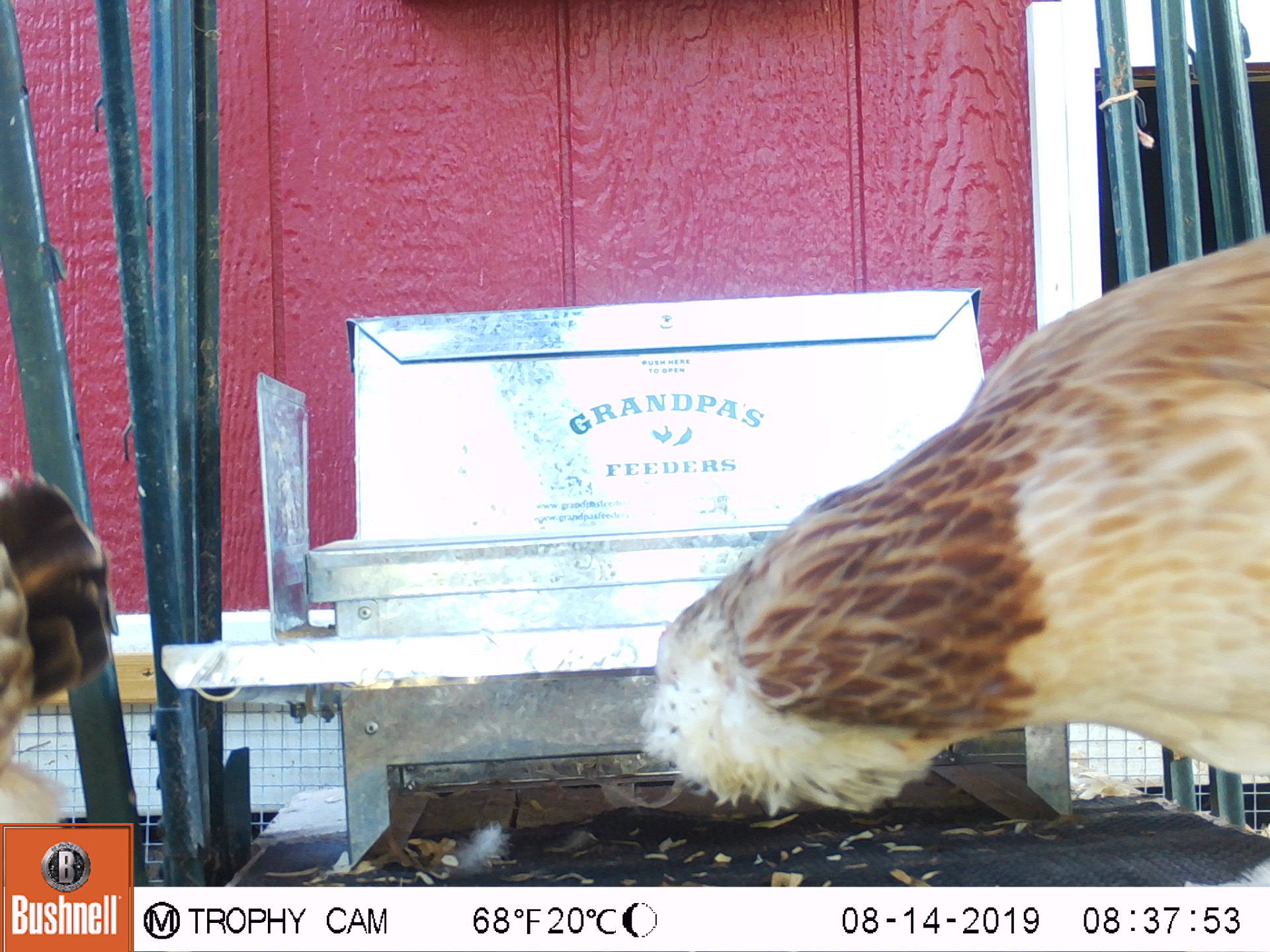
The chicks are still growing like little weeds. Today I tried getting them to eat out of my hand. No problem.

We are having a cold front and I am concerned about the temperature of the coop. They have two Ecoglow heaters and both the food and water are nearby. Here’s hoping it doesn’t get too cold.

Bucolic

Texas Longhorn

bu·col·ic adjective

  1. relating to the pleasant aspects of the countryside and country life.

Country life, Texas style.

Not my cow. It is my picture. And every time I hear the word bucolic, I think cows in a field. Since we are in Texas, it has to be a long horn standing in the field observing her domain.

Sun and Moon

Digital composite image

Last week there was a beautiful moon near the horizon and a stunning sunrise, in opposite directions. I couldn’t photograph them in the same shot. I thought that if I had a mirror, I might be able to capture both with some experimentation with angles, but alas, I had no mirror and the minimal focal distance of my lens is longer than my arm. So I put a composite image together in Photoshop. I think it came out nicely, and it was certainly fun to experiment!

Steps

One step at a time. Baby steps. It’s a big step. Stepping stones.

But in this case, it is steps for the back door of the coop! Dad and I made a step and a small porch out of treated lumber, with a rail to keep the door from going open too far (my husband’s good idea). They came out well! And when it started to sprinkle (darn it weather!), we put away the electric tools, got out the hand tools, and kept working under the front overhang. Yay!