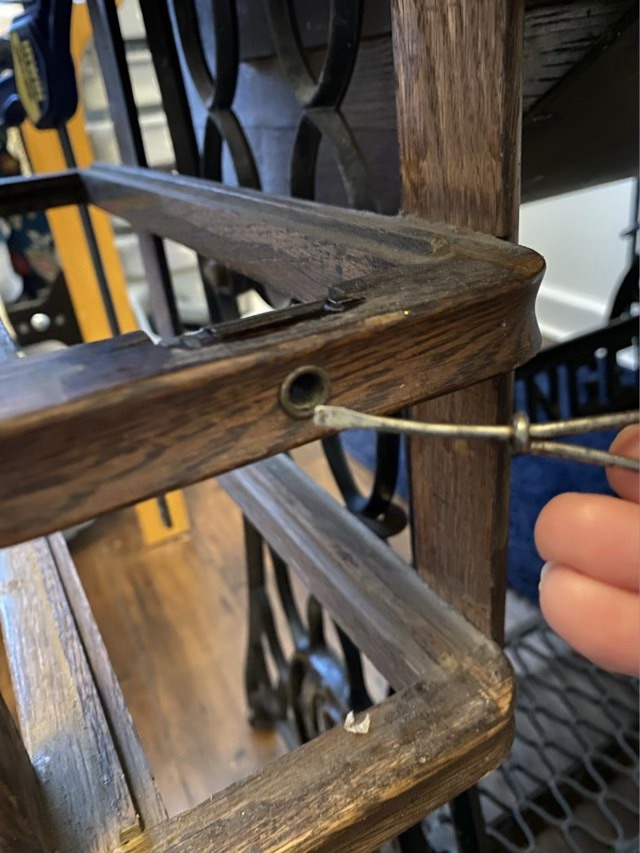
In the drawers of the Singer Model 66, that just recently came from my husband’s aunt’s house 206 miles away, I found wood plug that looked very familiar. I popped it into the open hole in my vintage side table. It fit and is a near color match. I purchased this table at an antique store in Houston TX, but my grandmother had its twin in South Dakota, and that one now resides at my Mom’s house. So it was a popular piece of furniture in the mid-1900s. Wood plugs are also common screw hole covers and furniture manufacturers would use the same size wood plug on various pieces.
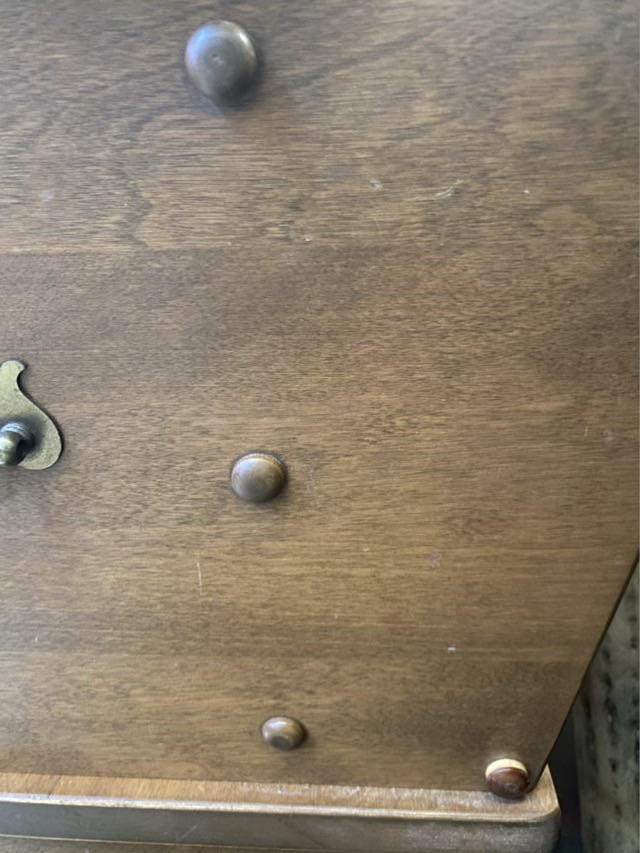
Photo description: The side of a wooden end table showing four wood plugs, the bottom right is the “new” plug, not fully inserted.
So it is random but not surprising to find a plug that fits the hole in a cabinet that was around at the time this furniture was in vogue. It also shows that those devilish fat pegs like to fall out and go a-hiding across the nation. Although this one has found its home. I put it in the hole lightly, but it stuck tight, so the only thing to do was tap it all the way in. Serendipity is the word I’ve been trying to find.
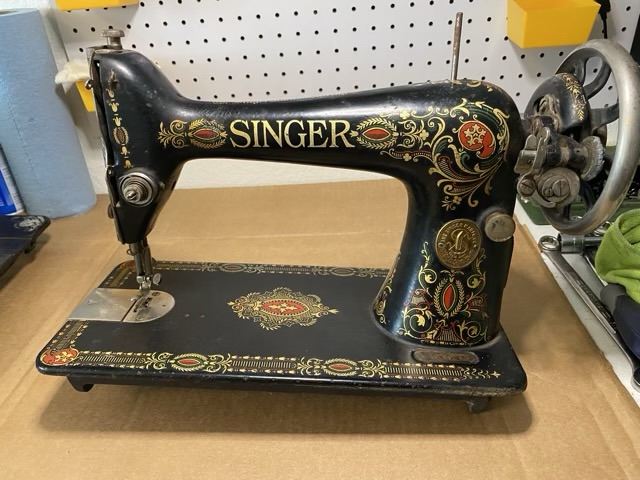
Here is my big news to start off the year: I have another treadle sewing machine! This one is a family heirloom. It was my husband’s great-grandmother’s, a Singer model 66 from 1916 with the “red eye” or “red scroll” decals. The decoration on this machine is in much better condition than my model 27, which is only 9 years older than the model 66, but saw considerable barn time. The 66 only saw some garage time and was mostly in normal household conditions.
Photo description: Singer model 66 “Red Eye” sewing machine head, sitting on cardboard on my work bench.
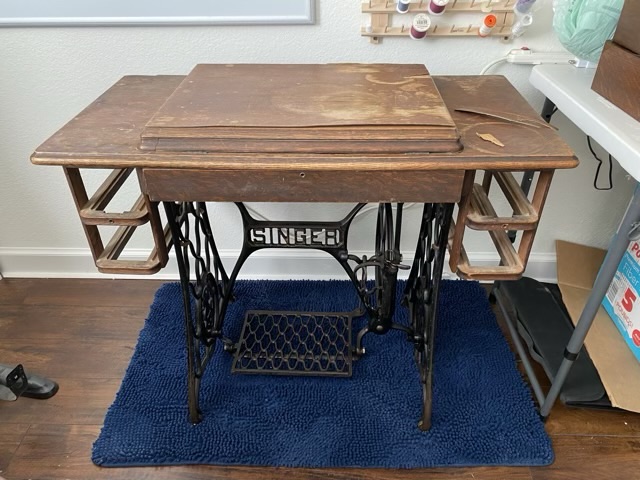
Ironically, the treadle base is almost identical to the other base, except it hasn’t been painted over (thank goodness).
Photo description: Singer treadle base cabinet, the four drawers are on the table just off camera. I had just scrubbed down the cast iron parts with PB Blaster and a wire brush. I have not started on the wood parts, but have taken some broken laminate from the back to use on the surface chips.
My goal is to get it back to working condition. It is pretty, but seized. The model 27 I’ve almost completely disassembled except for the main shaft, but with this model 66 I’m going to only take apart what I need to.
I’m still picking away at the model 27 sewing machine, removing small bits of dried on oil and dirt.
Photo description: Singer Manufacturing Company trademark in bronze, covered with a thick patina of oilPhoto description: Same seal after cleaning with a bamboo stick and sewing machine oil, with only a slight patina left in the crevices. Photo also shows a shiny stitch regulator knob.
My friends and family are probably getting tired of hearing a “scritch, scritch” noise when I’m on the phone. But it helps me focus. I’m not cleaning all the patina off; getting it back on in artful amounts can take years. I did figure out that I can clean the parts that are stuck in place, and continue to soak them in oil until the threads release. A thin strip of nylon netting is great for getting into the screw threads.
Photo description: Top of the machine, one hand is holding a dirty length of nylon netting along the threads of the pressure foot tension knob.
I’m not sure what I am going to do about the gold decals. They are quite delicate and are already flaked off to the silver base, or rubbed off entirely in areas. I do feel I need to remove all the loose paint, because I don’t want it flaking off onto my fabric. Experiments continue.
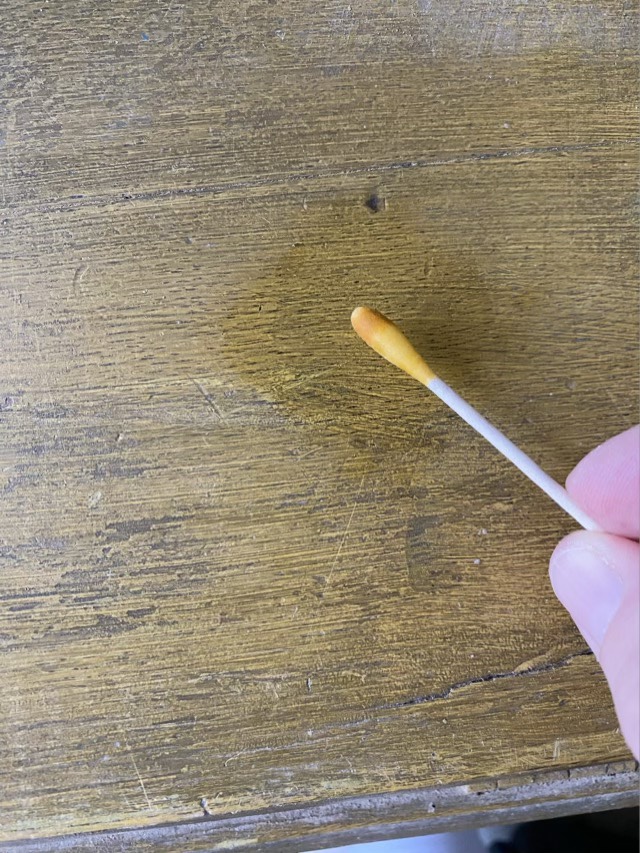
The cabinet of my 1907 model 27 Singer Sewing Machine is yellow. Hm. Pinging online groups, there is a general consensus that they didn’t come in yellow. Prompted, I looked at the hinges, and yes, the hinges and screws also had yellow paint, so someone, during the life of the machine, had thinly painted it yellow. Sigh. The next question, how long ago? Was there lead in the paint? I purchased a lead test kit, followed the directions, and happily, no pink. If the swab or surface turns pink or magenta, it indicates the presence of lead. Since it isn’t lead paint, and it is not original, when the weather cools off here I’ll strip the paint and refinish.
Photo description: Antiqued yellow wood surface showing a wet round area and a yellow swab.
My husband and I removed the sewing machine head from the base (there were two small set screws that were not seized) of my Singer model 27-3 sewing machine so I could start the cleaning process.
Photo Description: Antique, worn, and dirty sewing machine head on cardboard on a work table.
I’m following the advice in the book “Treadle Sewing Machines: Clean and Use an Iron Lady” by Donna Kohler. I have also found digital scans of the owners manual and an adjusters manual for a 127-128, which I’m told by YouTube is close enough to my 27. I’m photo documenting as much as I can along the way. I’m also not in a rush, this is going to take some time, so the machine has a dedicated table in the craft room and I’ll post about interesting observations along the way.
My first discovery was that the previous user of the machine didn’t remove old thread on the bobbins before winding on new thread, which blows my mind. I see how it would save time in the short term, not unwinding, but it reduces the amount of space for new thread, so the bobbin has to be wound more often. An interesting choice for certain. Some of the bobbins had four different colors of thread.
Photo description: Long bobbin wrapped with green thread over blue thread.
To give you an idea of the level of grime I’m dealing with, past the spider webs and mud-dauber nests, below is a photo of the underside of the needle plate. To remove the needle plate I needed to add PB Blaster and let it sit for about five minutes, then the screw backed out smoothly. Underneath was a build up of lint, oil, and dirt.
Photo description: Round area around the feed dogs where the needle plate was removed, with brown dried oil stains and a thick build up of lint.
There are YouTube videos of machines in worse states. I know this one was well used, and I want to keep as much of the patina as I can. The black finish flakes off when it is touched, so I need to be very careful not to remove what decoration is left. This will definitely be an ongoing project, and I’ll post about interesting things as I find them.