Ah ha moment

It hurts sometimes. I’ve been struggling with my printer for longer than I care to admit, trying to maximize paper use and minimize waste. I try lying out a print double sided so that I can then cut them apart, but the printer doesn’t print consistently and the double sided is off set at best, or unusable.

After a particularly frustrating waste of 20 sheets of card stock, I walked away from the problem for a while.

Photo description: using a paper cutter to cut double sided 3.75×5.75 inch cards, card on the left is useable, but offset so that the text is right on the edge.

I don’t know why I’ve never considered cutting the card stock first. First. Then feeding it into the printer, which can handle small stock. I tested it the next morning, and had a 95% success rate. Much better than the 20% success rate of printing first. Bonus, I can get cut three 3.7×5.75 inch cards from a single letter sized piece of card stock. That is one extra per sheet than if I printed (which with my printing tolerances would be impossible to achieve).

Yeah for ah ha moments.

Rebuild Hiblo

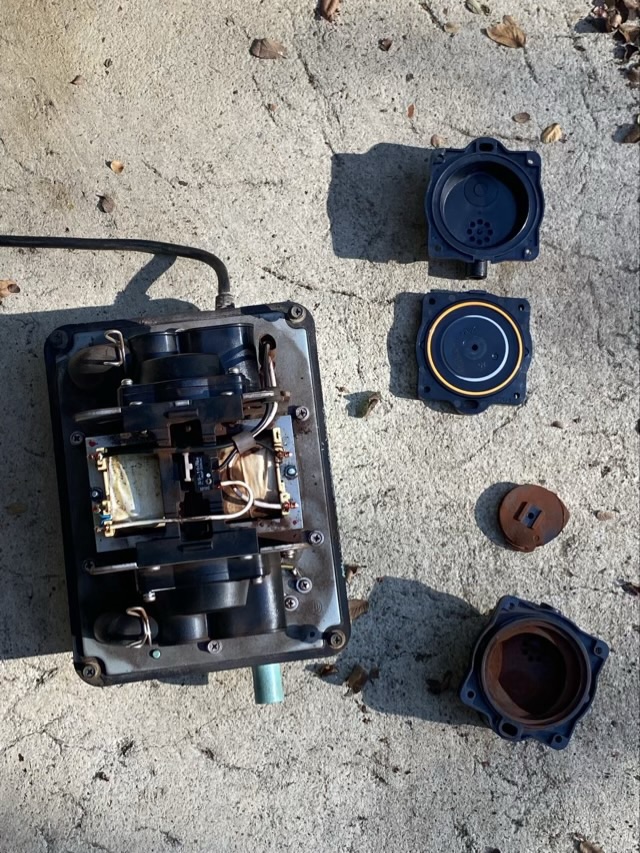
I rebuilt a Hiblo air pump this week using a rebuild kit. This is the first time I have rebuilt one, but it won’t be the last. This particular pump is for the large tank of water in the garage. It blows air into the tank to remove the hydrogen sulfide smell (rotten egg) from our well water. We have another one for our aerobic treatment system. These little pumps run 24/7, blowing critical air into tanks of smelly liquid to make our living spaces less odorous. They are lovely little pieces of engineering. Yes the diaphragms wear out after several years, but they are designed to be easily replaced. The rebuild kits are a fraction of the cost of a new unit. I love things that have good functional design that are easy to maintain.

Photo description: inside of a Hiblo air pump (left), worn out diaphragm (bottom right), and a new diaphragm assembly (top right)

Throwback Thursday: PSA

In August of 2015 I was assembling cube shelves and kept whacking my fingers with the hammer driving in tiny finish nails. “Necessity is the mother of invention” and I came up with a different way to hold the nails to have less swearing. I felt so strongly about it I made graphics and probably shared it on social media. Here the public service announcement is again today: how not to hold a small nail.

Photo description: how not to hold a small nail showing pinching the nail between finger and thumb and the edges and of the fingers above the head of the nail with a large red circle and slash over the hand
Photo description: a better way to hold a small nail, between two fingers with the hand flat on the surface well below the head of the nail

In either case, if you completely miss the nail head, your fingers are going to suffer. Another alternative is to use a needle nose pliers to hold the nail, keeping your fingers completely out of the way.

Tube stand

I needed a stand for poster boards with lyrics printed for my chorus. We are changing a few lyrics of standard songs for a Halloween show, and we don’t need to commit them to memory. I love making frames from PVC pipe because they are light, easy to assemble and disassemble, and relatively inexpensive. I was out of PVC elbows at home, but I did have a ladder ball game, full of elbows, connectors, and tubes.

Photo description: stand made from plastic tubes from a ladder ball game

The stand has two positions, a vertical display, or turned 90 degrees, a slanted surface. It is just smaller than the poster board, so the edges of the signs are supported. To hang the poster board, I punched two holes at the top and used book rings to connect several sheets. One sheet always has to be on the back as counterweight, then the assembly hangs over the top bar of the stand.

Cork restore

Something happened to the cork sole of my shoes. I’m not sure if it was damaged by something scraping across, or if the cork was already weak in that area, but it definitely affected the integrity of the shoe. I scraped out the soft cork until I reached solid composite cork at the damaged area.

Photo description: cork particles scraped from the heel of a cork shoe, the inside heel of the shoe shows the damage

I mixed up some two part epoxy, then mixed the cork particles with the epoxy and filled in the hole with the mixture, smoothing it with a piece of wax paper.

Photo description: fixing the hole with two part epoxy

I let it sit overnight then sanded the area. The result seems to be structurally sound, but time will tell. The patched area is darker, but I could treat the whole corked area with a sealant to help even out the color. I might do that in the future if the patch holds. Since it is on the inside of the heel, I’m not as concerned about it.

Photo description: heel repair complete and smooth, but the color is slightly off