I have been trained well. I put the fuzzy blanket back on my chair (excuse me, the cat’s seat) when I get up so she can get comfortable. The problem comes when I come back. She allows me to pick her up with the blanket and settle her back on my lap, but then unfolding the blanket is awkward and she leaves. I have found a solution.
Step 1: Blanket placed on the chair with the edge accessible
If I place the blanket folded roughly in half, with the edge forward, I can slide my arms under the first layer, pick up the cat, sit back down on my chair, get the blanket spread on my legs and the cat settled on my lap with minimal fuss.
Step 2: Cat in place on seatStep 3: Cat transferred to lap and legs covered with the blanket
I spend a chunk of money on sketch books, both for me and my kids. I want them to practice their art skills, and they enjoy it, so it is a worthwhile sacrifice of paper. But purchased journals are usually heavy as well as expensive. To help lighten up my youngest’s backpack, I made some simple blank journals from printer paper, card stock, and upholstery thread.
Fold 2-4 pieces of printer paper and one piece of card stock in half, open up, and mark points an inch apart along the inside foldPoke holes through all sheets of paper and cardstock using an awl or needle and pliers (if you’ve broken your awl)Cut a length of upholstery thread three times longer than the fold. Using a threaded needle, start at the top hole from the inside.When you get to the bottom hole, sew back up. This will cover the gaps with thread.On the inside, tie a square knot and trim the ends.You now have a simple, light, blank journal for a fraction of the cost of store bought.
My youngest noticed that when the microwave is going, her bluetooth connection from her iPad to her hearing aids gets glitchy. Then my husband mentioned that when ever I start the microwave, the TV connection goes out. Our microwave is in a strange location, tucked into a hole on the end of the kitchen island. Our router and internet connection are on the counter opposite. Options on moving either device so they don’t face each other are low, and all the possibilities involve drilling new holes. So I tried taking my largest cookie sheet and propping it up against the microwave to block the interference. It seems to work. It is an ugly hack, so I might design a decorative door with patterned perforated metal in the future. Conductive metal blocks microwave radiation. As long as the holes are smaller than the electromagnetic waves coming out, it should work and still provide ventilation. Here is an interesting article on microwaves and wireless devices from Wired, which supports my thinking.
Last minute Valentine’s hack! To tie up some goodies in a bag, when you don’t have a pre-made bag, but you do have some fabric and some ribbon. This is like a hobo bag, but fancy, as the resulting tied fabric looks like a flower. I used a square of chiffon fabric and sealed the edges by passing them by the flame of a candle to melt them. If your sewing machine is up and running you could also hem the fabric, but the slightly melted edge works for this flower form. You could also use a pre-hemmed square of fabric. To tie the bag shut, I used about two feet of ribbon. I put the chocolates in the middle, gathered the ends together, then tucked the corners back under. I have made a short video on how to here.
Chiffon fabric tied into a flower shaped goodie bag
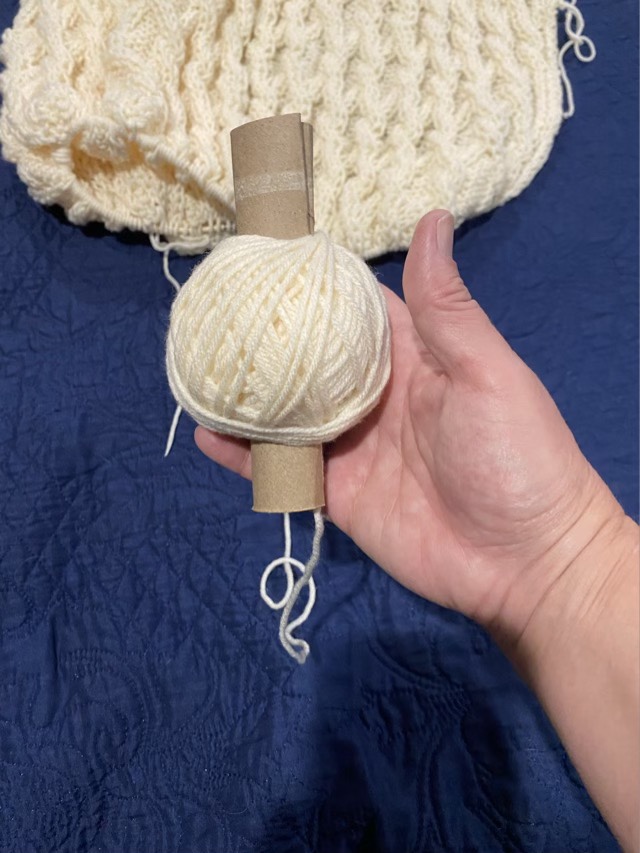
When I was learning to knit and crochet, I was taught to roll up extra yarn into a ball. Generally, you started with a small nest of yarn and wrapped more yarn around, changing directions every so often so it came out more or less round. Inevitably, I would drop the ball, it would roll across the floor, the cat might help its progress, and I would have to wind it up again. When I was older, I obtained a “new wool winder” which winds yarn from a hank into a cake-like structure, but was wonderful because the cake sat still and yarn could be pulled from the center. It did not work so well with small amounts of yarn, and I had to go and find the machine and a place to secure it to use it. Fast forward many years (better just skip, because there is quite a lot of time from then to now), and I was learning about spinning on a dealgan (a Scottish type of drop spindle), and the presenter in the video said the newly made yarn was wrapped around the spindle in the same way as for a nostepinne. What? The resulting cop of yarn could come directly off the spindle and the yarn could be pulled from the center. Hm. New rabbit hole. Nostepinne is a word for a fancy stick. I used a 1” dowel, which worked just fine the first time, but you really don’t even need a stick. A rolled up piece of paper will also work (especially if the cat is comfy on your lap and you can’t reach your stick, but there is a handy piece of paper).
Wrapped yarn ball (left) versus center pull ball (right)
I’m sharing because I really found this way of winding to be life changing. And it is so simple.
On a separate note, Adobe Premier now will make captions from my audio automatically. So that saves me a bit of typing. It still needed editing because “nostepinne” is not in its transcription vocabulary. Shocking. The video isn’t fancy because I’m still learning the software.