Volunteer: Clematis pitcheri

My husband spotted something unusual coming up out of our crossvine, inverted pitcher-like purple flowers that were very different than the crossvine’s peachy-orange vessel flowers. The iNaturalist app gave us the category “clematis and leather flowers”. Searching leatherflowers, the purple leather flower, Clematis pitcheri, was a visual match. We certainly didn’t plant it, but it is quite welcome!

Photo description: two purple leather flowers coming up between crossvine leaves

For those curious, the flower is quite robust, and the curling tips feel very much like leather (as a leather worker, I feel confident in that assessment.) I did not dissect a bloom, but if it continues to do well and produces more than just three flowers, that will be a future project.

Mossarium: third time

I cleaned and washed the terrarium a third time. When rebuilding this round, the chunk of wood that kept sprouting mold was not included in the build. Instead I turned to our backyard, which is mostly clay and marvelous to sculpt. I put a layer of glass pebbles down in the base, added some activated charcoal, then put down a compacted layer of dried sphagnum moss. I used the top part of a champagne flute (the bottom broke off rather jagged, but it went down into the moss, so no danger of cuts) as a form, basically a glass tube in the middle that would be a “pot” for my jewel orchid to ensure it had room to grow and didn’t get soaked, as I tend to overwater.

Photo description: Bags of rocks and stones on the left, the base of the terrarium showing the glass pebble and charcoal base layer covered with sphagnum moss, and the top of a champagne flute on the right, all on a outdoor cast aluminum table

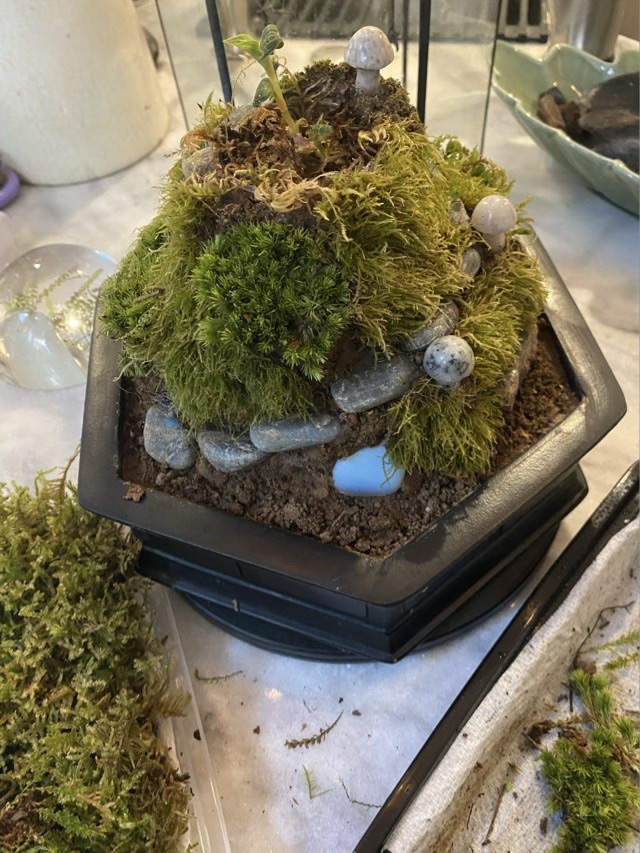
I gathered clay soil from different areas in the backyard, where wild moss was already growing, and built it up around the glass tube. I found my stash of labradorite pebbles, some of which I tumbled, some were raw, and added the smooth stones as steps, and the rough rocks as “boulders” in the sculpture. I then used a spatula to gather small sheets of moss from different areas in the backyard, trying to find different looks, and laid them over the clay base.

Photo description: moss sculpture in progress outside on the patio table with labradorite, moonstone, and stone mushrooms on a moss covered clay form with a hole in the center held open by the glass tube formerly known as a champagne flute

I really enjoyed this build. The clay soil was easy to work with because we have had a very wet spring, and the moss molded well against the clay. I made a spiral staircase because I like spirals. I filled the center tube with sphagnum moss and put the jewel orchid at the top. I found small plants in the yard in the shade that I tucked between sheets of moss as well.

Photo description: moved the build inside, out of the sunlight, this shows the opposite side with a labradorite “boulder” sticking out of the mossy hill
Photo description: another side of the mossarium hill showing one of the labradorite stepping stones showing a blue schiller effect
Photo description: my favorite view, straight down from above the mossarium build showing the sculpted spiral
Photo description: not a great photo of the complete mossarium with lid, I need to get out my polarizing filter and good camera to combat the glass glare with the terrarium lid in place, mister to the right, which is an old eye glass cleaning bottle, and left over bags of stone on the left

I’m hoping that the third time is the charm on this mossarium. It was a fun build.

Mossarium: attempt two

After boiling and baking my gnarled wood that I wanted to use in my terrarium, and washing the base and all the stones, I tried setting it up again. I visited a local vintage store and picked up some interesting stones, including tiny crystal mushrooms. Mushrooms!

Photo description: wood hardscape in a terrarium base with pebbles underneath and festooned with stone mushroom and frog carvings, tumbled stone, and crystal shards.

I kept the moisture to a minimum, setting the base with dry decorative rocks and glass pebbles, and using glue dots to adhere the carvings and stones. The only moisture came from the sphagnum moss that I tucked into the two hollows in the wood where I wanted to keep plants. I even braved the shipping and ordered a jewel orchid (I used points, so am not counting the cost of that towards the project). I let the moss sit for a few days to test for mold growth. My orchid arrived earlier than expected, and when I went to mount it, I discovered mold in the hollows. Dang it.

Photo description: close up of a hollow in the wood line with white mold.

I disassembled the terrarium, again, and set the wood out to dry. It is a neat chunk of wood, but clearly not suitable for terrarium life. (I’ve read that a dilute solution of bleach could sanitize wood, but I don’t keep bleach in the house because of our aerobic treatment system.) I washed everything, again, and set it out to dry.

I can’t give up on the terrarium idea, I now have a tiny baby plant that needs nurturing. Ah, but don’t worry, I have another idea. We’ll see if the third time works.

Mossarium: what not to do

I have a beautiful terrarium with a lift off lid that I originally intended for growing mushrooms. Well, it wasn’t quite big enough for that, so I put some plants I was rooting out inside. The plants grew and bumped into the top and looked crowded, so I started thinking about what else I could do with the container, a mossarium maybe? Mossariums are terrariums with a variety of mosses as the focal feature of the arrangement. Some have a few plants as well, but it is mostly moss. I have a fantastically gnarled root ball that I thought would make a fantastic hardscape for the moss. I soaked it in RO water, gathered moss from the back yard, and made a pretty cool looking arrangement.

Photo description: black base of the terrarium filled with dirt, rocks, a large twisted and soaked piece of wood with layers of moss and dirt

Turns out soaking the wood was the wrong idea. In that very moist enclosed atmosphere, the mold spores had a heyday.

Photo description: same mossarium setup, now covered with spiderweb-like mold spores

I tried cleaning off the strands of mold, but each day they renewed. Then I read that it helps if the soil and hardscapes in a terrarium are sanitized before assembly. Hm.

I disassembled my mossarium, cleaned the container and wood, then boiled the wood for an hour. To get it to dry out, I put it in the oven at 225 for an hour, then let it cool. It took three hours-long cycles in the oven to get the majority of the moisture out. I washed all the stones with soap and hot water and set them to dry. I’ll try a slightly different, dryer setup next time.

Our meadow

The Spring wildflowers are showing off in our meadow.

Photo description: horsemint, cutleaf daisy, and Indian blanket in the foreground, our coop and deer ornament in the mid ground, and the post oak and cedar elm of our wood in the background
Photo description: closeup of horsemint with a scattering of cut leaf daisy and Indian blanket flowers

Now, down the hill, hidden by those flowers is mostly grass. I’m not sure what happened to the flowers that used to come up there, although it could have been the heat, or the freeze, or the wet, or a grass roots take over. I might throw some extra seeds down back there and see if we can’t get something more started.