Throwback Thursday: ancient fibulae

Here is an example of a picture without a thousand words from January 2013. As I was going through my album looking for Throwback posts, this almost didn’t make the cut because I didn’t leave myself enough information.
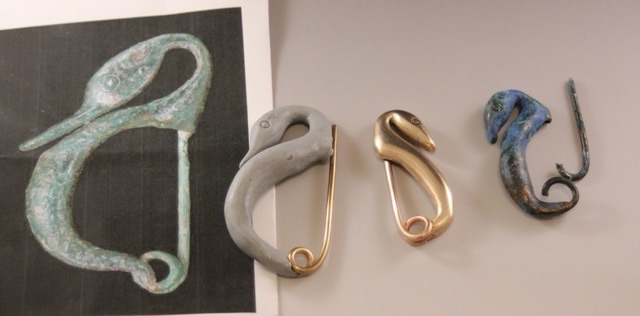
Photo description: printed image of an ancient bronze fibulae, clay model with wire spring, polished bronze clay fibulae (new), mystery fibulae (made by me)

At the time of the photo I was still experimenting with metal clay. My sister is an ancient historian and I suspected this was a project for her, so I pinged her for confirmation. She provided the name “fibulae” and an interesting article about their findings and use.

I can tell from my photo that I had a museum photo as reference, and I made a model with less expensive polymer clay, that looks more swan-like than my reference photo. The middle polished bronze clay fibulae I obviously spent more time on, but I’m not sure if I fired the clay with the wire in place or epoxied it in later (I’m already not using ancient foraging techniques, since I’m working with modern metal clay.) The last fibulae on the right is what raises the most questions. Did I not polish it? It is the same shape and style as the bright bronze, so I’m sure it is my work (my replication skills are not finely honed, especially then.) Did I try to antique it by adding patina, or is this how it came out of the kiln? Did I make this before or after the bright bronze fibulae? I have a feeling that I fired it with the wire in place and either the firing or the antiquing weakened the metal, causing the breakage. Did I do it on purpose? So many questions.

Here is a picture of the back, which answers the question of how the pin fastens.
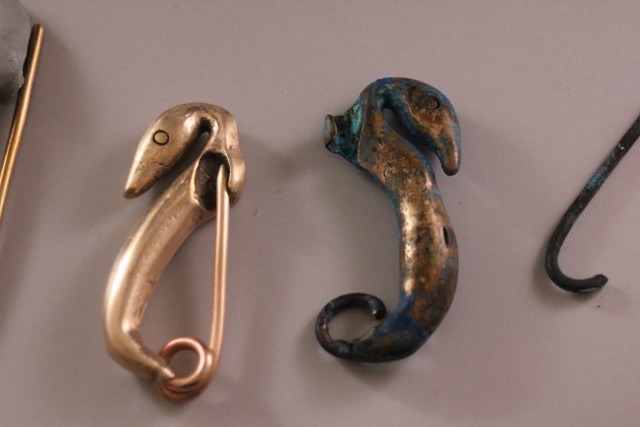
Photo description: back of modern-made bronze-clay fibulae showing the pin pocket

Tips

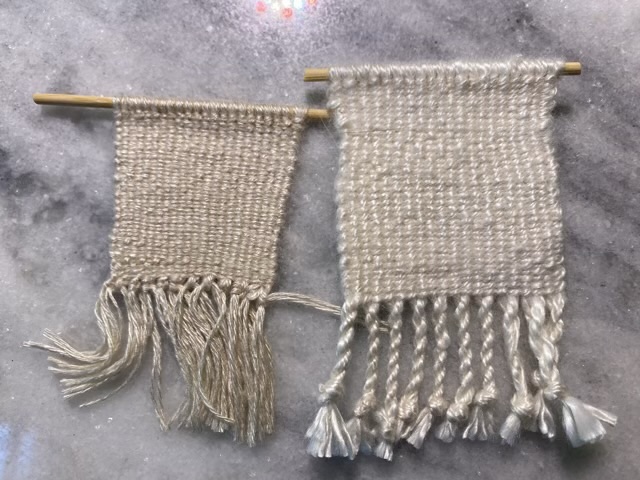
I was struggling with the sides of my twined weaving coming in and not staying straight. My neighbor, who is an accomplished Cherokee weaver, and who taught me how to twine bags, suggested that I flip the work for each row. I had been working from just one side, going right to left, then left to right. For my rose fiber swatch I followed her advice.

Photo description: left twined weaving made with hand spun mint infused cellulose, right side twined weaving hand spun rose fiber

Flipping the fabric worked, the sides of my swatch are better than my previous attempts. They aren’t perfect, but my skills are improving. It is those little tips and insights that make learning from accomplished crafters so valuable. YouTube is great for general knowledge and diving down rabbit holes, but the knowledge we can gain when working with another crafter is invaluable.

Crochet cables

Crochet cables are an entirely different beast than knit cables. Rather than just switching the order of a few stitches, it involves at minimum three different stitches, and different placement. I ripped out my swatch twice trying to get my brain wrapped around the technique. I finally made myself a rough chart, which helped, and religiously counted stitches on each row.

Photo description: hand drawn crochet chart with non standard symbols, a size G (4.0mm) crochet hook, and the cabled swatch made with hand spun two ply rose fiber yarn

I used a combination of single crochet, double crochet in the front post, and treble crochet in the front post. I have not puzzled out how to reverse the cable twist, although I suspect it involves some pretzel like moves.

Knit Cables

When I went to swatch my hand spun rose fiber yarn I had an urge to cable, so I did. Cables in knitting look fancy but are not technically difficult. The stitches get a little tight in the twist, so take a little longer, but the concept is just to put one side of the cable on a cable needle, put the extra needle to the front or back, knit the other side of the cable, put the first side back on the knitting needle, then knit them. Honestly the words took longer to type. There are brave souls who can cable without the extra needle to hold the loose stitches, but I haven’t worked up the courage yet.

Photo description: two ply hand spun rose fiber yarn knitted swatch with two cables of opposite twist on a garter stitch background using a size 4 Prym circular needle

The direction of twist depends on if the skipped stitches are moved to the front or back of the work. Since I was swatching, I did one of each.

It doesn’t need to be fancy

If you don’t have a swift or a nostepinne (or don’t want to go upstairs then get them), the back of a chair and a roll of paper work fine to take yarn from skein to ball form.

Photo description: skein of hand spun cotton hung on the back of a wood chair, and center pull ball of yarn started on a roll of card stock, black dog looking on in the background

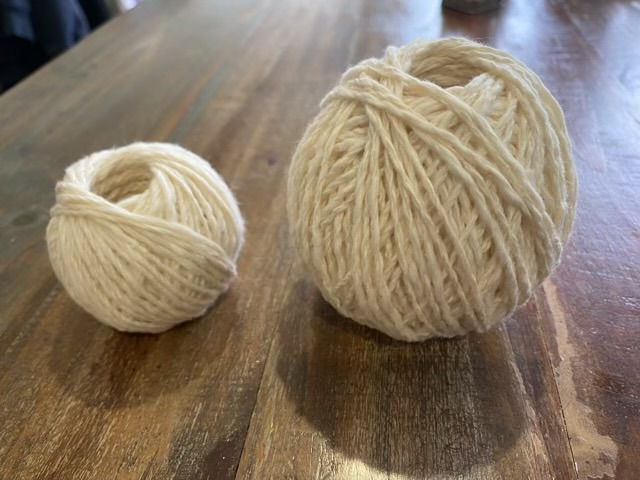
I rolled up two skeins of hand spun cotton this way. This is the cotton that I spun from raw bolls then three plied two ways: crepe and chain ply.

Photo description: two nostepinne style balls of cotton yarn, chain ply on the left, crepe on the right

I’m most interested in how these two preparations knit up. Yes, I’m looking forward to swatching. I’m weird like that.