
The Rose Top fiber sample was nice to spin, and working up the swatch projects was satisfying. Even though this fiber is produced in a similar way to Tencel, only using rose stems and leaves rather than wood pulp, I found this easier to handle.

The Rose Top fiber sample was nice to spin, and working up the swatch projects was satisfying. Even though this fiber is produced in a similar way to Tencel, only using rose stems and leaves rather than wood pulp, I found this easier to handle.
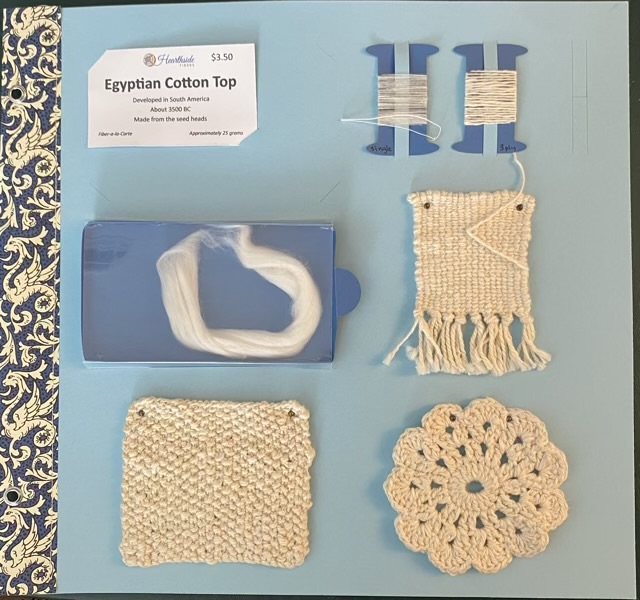
I spun this Egyptian cotton sample on an Ashford Traveller spinning wheel fitted with a high speed whorl. Egyptian cotton has a longer staple length so is less inclined to form pills. It was nice to spin and worked up into the swatches well.
I enjoy spinning cotton, but is definitely a sitting activity, either on a wheel, or with a tahkli spindle. I also avoid wearing black, as the small fibers accumulate everywhere.
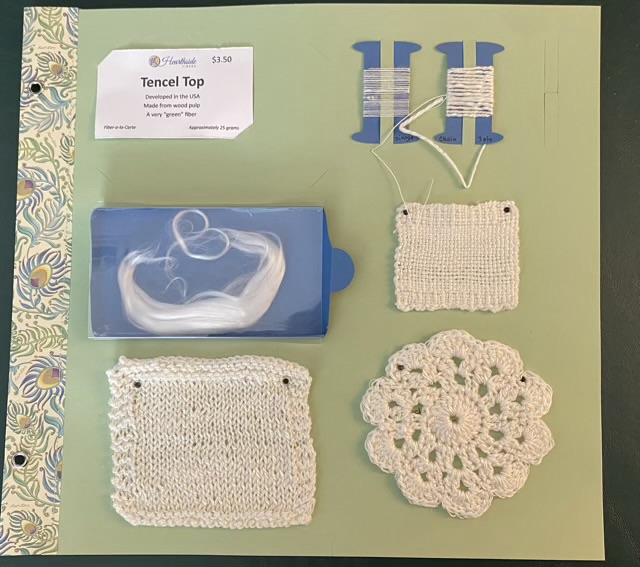
The next completed fiber study page is for Tencel. Tencel is made from wood pulp and the combed fiber is shiny and silky looking, but it is not easy to draft consistently. I want to like it because it is made from waste product, but it fought me when I was spinning. Maybe it would be better if it were blended with something. Blending fibers is another whole rabbit hole.
Despite the difficulties spinning, my swatches are more rectangular and less skewed than with other fibers. I block most of my swatches, but the Tencel really benefitted from being wet and reshaped.
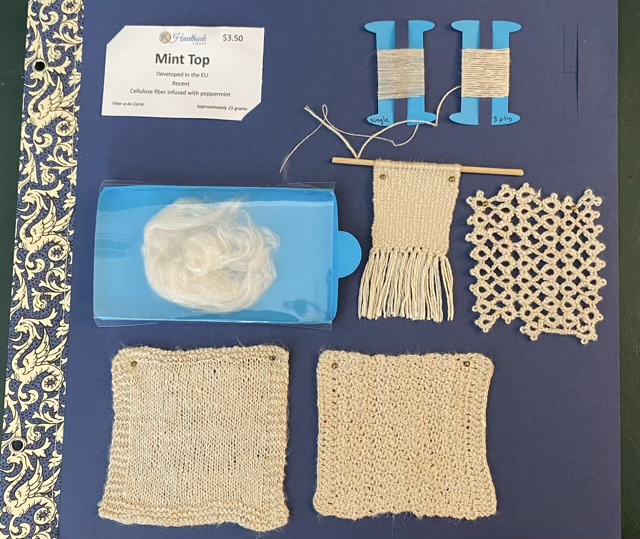
I think this was my bottle neck for assembling my fiber pages. I had several sets ready for assembly but this one wasn’t ready because the tatted swatch took a long time. I think next time I tat for the book it will be a ribbon rather than a rectangle. Or a small doily. Choices.
My favorite piece on this page is the crochet, because I used an orange peel stitch that alternates between single and double crochet and gives a beautiful texture.
The fiber is cellulose infused with peppermint, according to the description. It is supposed to feel cooler. I do not feel it. It was easy to spin thin, gives a nice drape in the knitting and crochet, is possible to tat with (but has more halo than pearlized cotton), but is not noticeably “cool”, any more than cotton can feel cool.
I might purchase this fiber if I had a light summer shirt I wanted to make, but I would be more inclined to purchase cotton or linen.
When I was in Michigan I visited the Sweetgrass Jacob’s Sheep farm and picked up a bump of two-tone roving. The shepherdess told me it a pain to separate out the colors for the mill, but I’m very glad they do because this was fun to spin. I chose to spin it with my Ashford Traveller spinning wheel fitted with the standard whorl and the sliding jumbo flyer, but with a standard size bobbin.
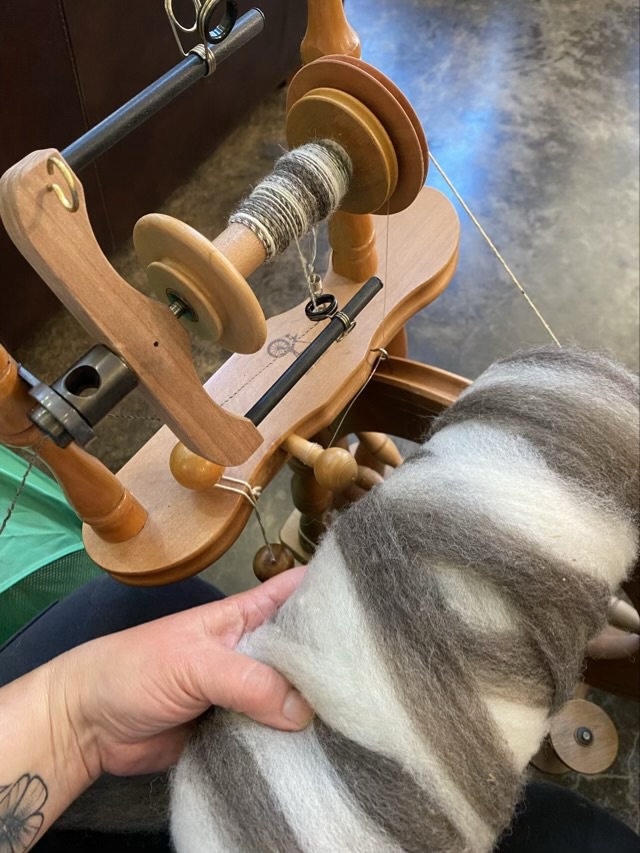
The standard bobbin held all the singles I spun from the bump, barely. I should have started with the jumbo bobbin, but now I know.
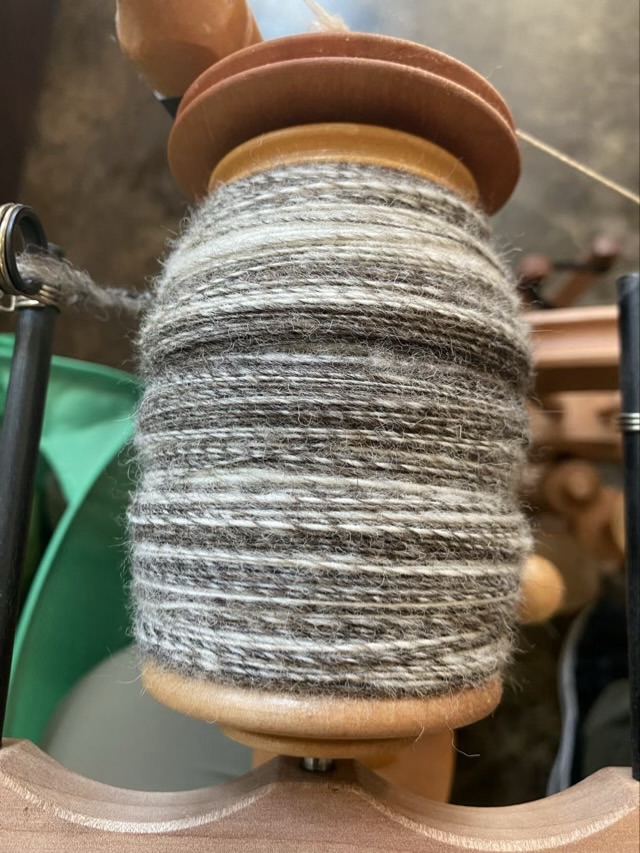
I love how this yarn is coming out! The random variations in the color ratios make me happy. Now, I’m not usually a fan of knitted variegated yarn, so I’ll have to ponder the use of this yarn for a while.
 Critters and Craft