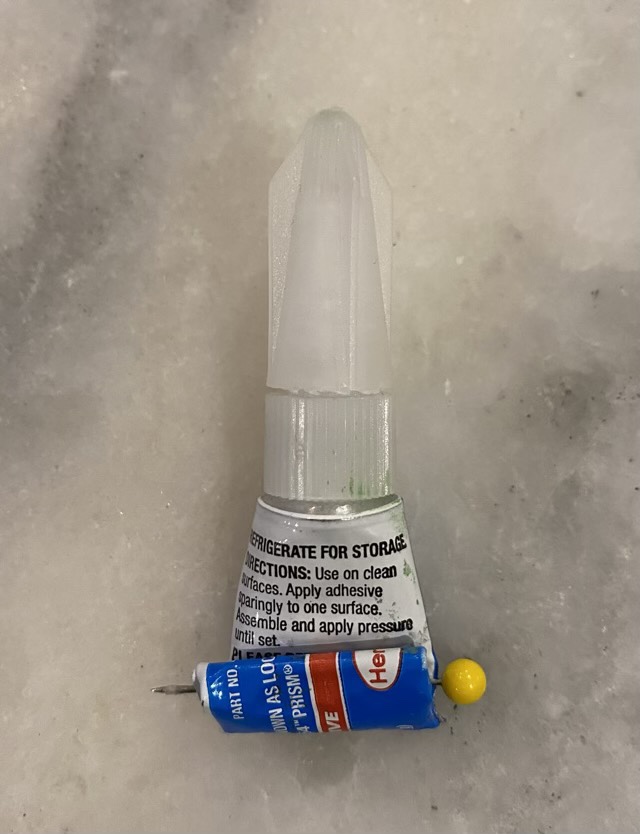
It is inevitable that my cyanoacrylate glue plugs up after the first couple uses, no matter how well I wipe the tip, or how fast I get the lid back on. When the time comes to use it next, I have to go hunt down a pin to break through the dried plug. What would be better? Tucking the pin in the folded section of the glue tube! Now the pin is right at hand when I need it. Yay.
Stick pin attached to the glue bottle
This is Loctite 454, which is my favorite instant glue, and yes, I store it in the refrigerator.
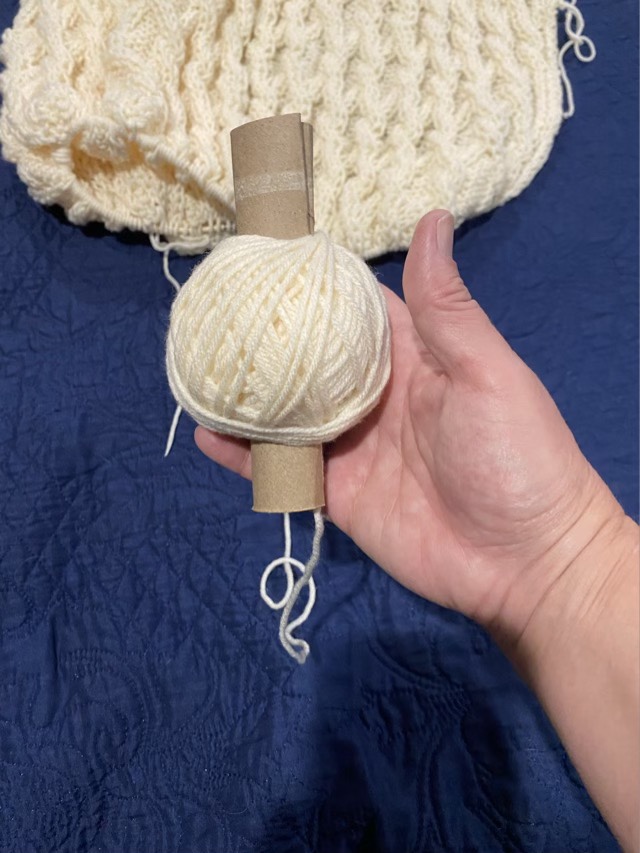
As the pull skein of yarn sat wrapped up in my Grandma’s blanket, waiting for me to finish the edges, it became quite untidy. Since it will be awhile before I am ready to get back to knitting on this piece, and I will have it laid out and put away several times to measure edges, I decided to rewrap the yarn to keep it neat. A cut and folded paper towel roll works well as a center, and if you run the yarn down the fold, it stays out of the way during wrapping.
Folded paper towel roll cut in halfRewrapped yarn with working side on the inside of the ball
Here is the link to my short video on wrapping a center-pull ball of yarn, if you need it.
I’ve been working through my carded alpaca rolags (although they have unrolled in the basket so are now more like small batts) both with the upcycled wheel and walking with the drop spindle. The charkha-like motion of the converted stationary mini bike means I have to wrap the newly spun yarn into a cone shape on the spindle. To ply, I like to have center-pull balls, so I have to rewrap the yarn.
Transferring alpaca singles yarn from the spindle to a center-pull yarn ballWheel spun singles (left) and drop spindle spun singles (right)
I’ll let the balls sit for while, then get to plying. The thicknesses of yarn produced by the two different methods is close enough that I will combine it all together into one skein.
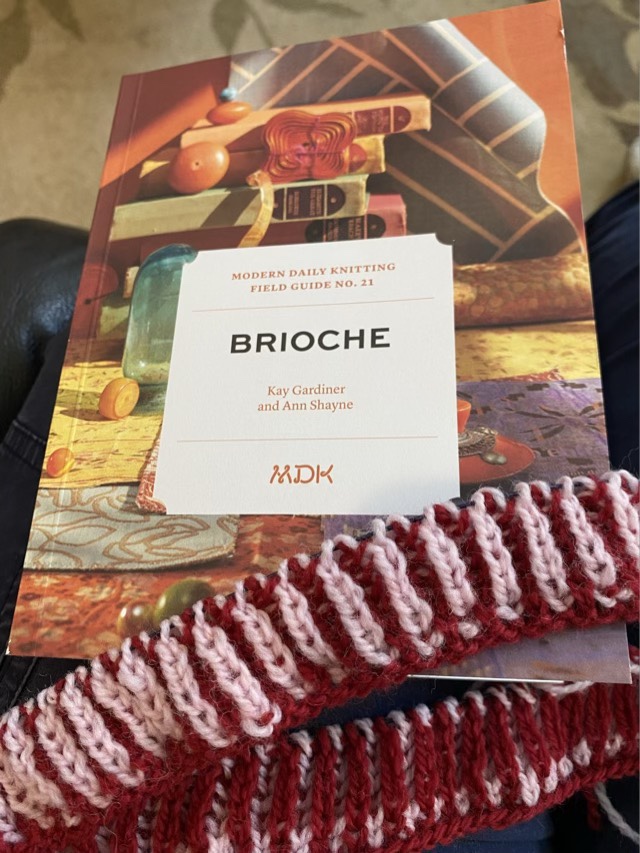
Surprisingly, this post is not about bread. Brioche is also a style of knitting; it is often used with two colors of yarn to beautiful effect. The technique first caught my eye when I was scrolling Pinterest (rabbit holes!!) Then Modern Daily Knitting collaborated with Nancy Marchant (brioche guru) on a new Field Guide with four beginner brioche patterns. I couldn’t resist. Today starts a new MDK knit-along for the first pattern in the book. This is my first attempt at a knit-along, so we’ll see how it goes!
Learning brioche knitting
I’m sure no one else is counting, but I’m acutely aware that I am now in the middle of three knitting projects. Hm.
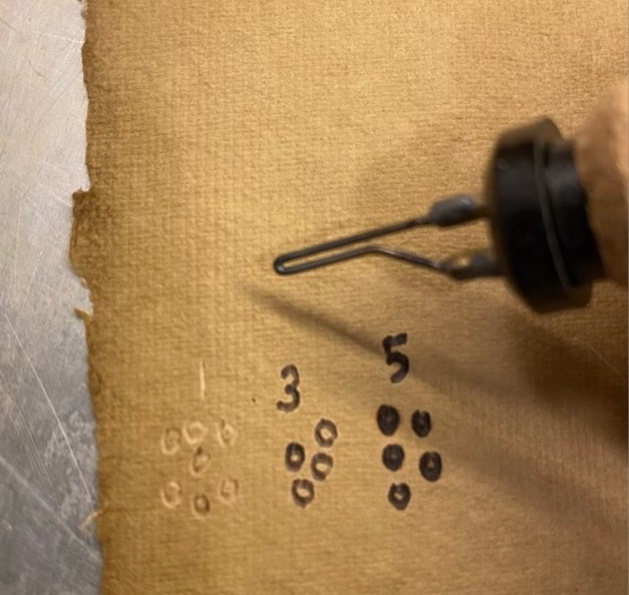
I wanted to try my new professional wood burner setup on some paper. I ordered some handmade paper that looked vintage and setup my wood burner with a small writing tip. Since this was new, I started on a low setting on the control box. I had an unexpected result. The lines on the paper where lighter, not burned. I turned up the dial and then achieved the brown color I was expecting from hot metal applied to paper. I made little circles and wrote down my dial settings.
Different effects at different temperatures of a wood burner with a writing tip on handmade paper
The light color was intriguing. Was it a fluke? Could I reproduce the effect? Being able to add dark and light to a drawing certainly opens up interesting possibilities. I turned the dial back down and was able to get light lines again. Maybe the fibers are being ironed down. Maybe the gentle heat is reacting with what ever was used to age the paper. What if I use a different tip?
Different burn results using a loop tip
Different tips do carry the heat differently. I was almost able to achieve the lightened effect with a slightly larger tip, but only at the lowest setting. Still, so many possibilities.
And Happy Father’s Day to all those that fill the Father’s role!