Frankenstein spindle

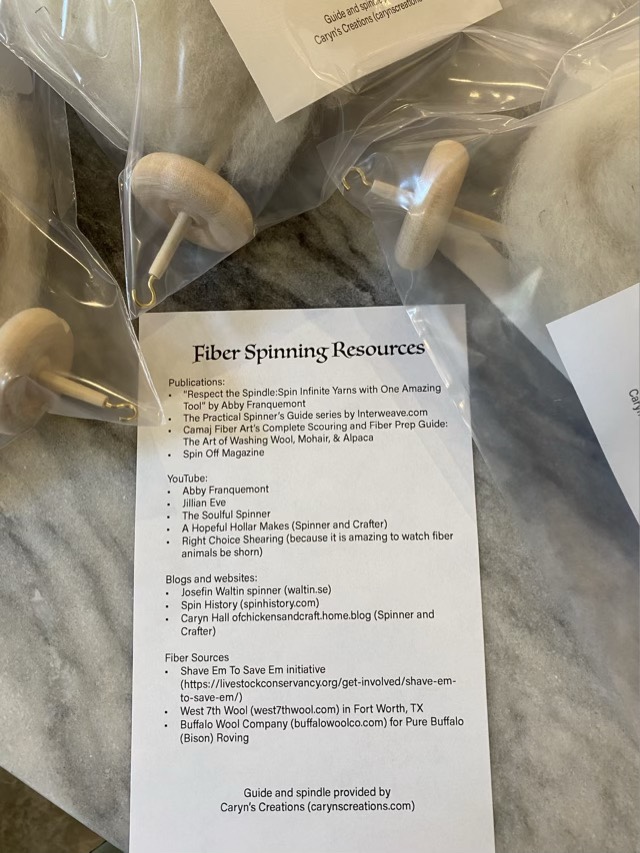
Well it happened. I dropped my favorite spindle (again) and the head cracked and came completely off this time. All this near the beginning of a walk. I tried spinning from the other end, but the yarn wasn’t aligned right. I tried just turning the spindle with my fingers, but the yarn produced was much, much thinner. So I tucked it all in my bag and went home.

Head came completely off the spindle this time

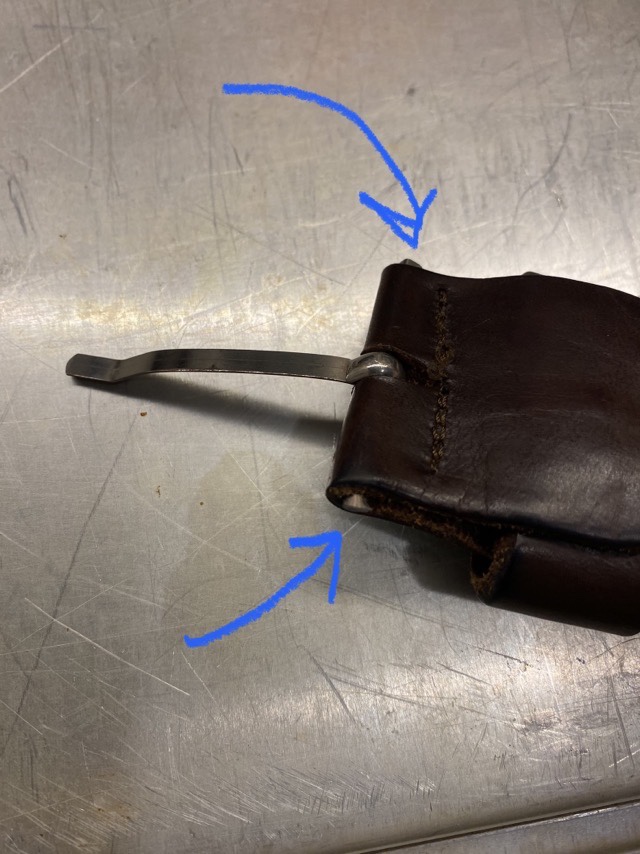
I glued then clamped the head back onto the spindle, but since that didn’t hold the last two times, this time I drilled a small hole and hand riveted the two pieces together as well. It took some experiment; the brass wire was too hard, but aluminum filled the hole nicely with some hammering. I sanded the rivet smooth so the edges wouldn’t catch on my yarn.

Rivet made from aluminum wire to provide mechanical strength to the broken spindle head

It looks like a Frankenstein spindle now, with its metal rivets on the neck, but it is holding. I’ve dropped it three times since repairing (not on purpose) and the head has held. I do now carry a spare spindle in the bottom of my bag, just in case.

Wooden cane

I made this wooden cane as another prop for the play my eldest is working on. The character that needs the cane is an old woman whose husband was a wood cutter. What better than a cut branch then? I wandered through the back woods and found a suitable dead limb on a cedar tree, with a side branch at a good angle for the handle. I cut it off, removed all the twigs, then used my oscillating drum sander to remove the outer layer. I left it a little long so they could cut it down to fit the actor. After I had the rough shape, I hand sanded first with 100 grit to get everything smooth and shaped the way I wanted, then worked down in grit to 120, 220, then 400. To finish, I put on two coats of 50/50 tung oil and mineral spirits, then seven coats of pure tung oil. A final polish with 0000 steel wool put on a slight sheen. The cracks were left as is, as it gives some character to the piece and the story is a slightly scary one. Despite the cracks, the wood is solid.

Wooden walking stick made from a dead cedar limb

How to make ugly needlecraft

My eldest needed another prop for a play; this time it was ugly needle craft. Hm. In theory, to make ugly needle craft you need to do the opposite of all that is done for good needle craft. The director sent an image of cross stitch as an example, but these guidelines would work for most kinds of needle craft, should you find yourself needing to make cringe-worthy thread embellished decor. So here are my pointers:

  • Use poorly woven cloth that does not have an even or straight weave (I used a scrap of a cotton drop cloth)
  • Use inexpensive thread (I think this thread came from a bracelet kit)
  • Don’t starch the cloth or iron or tape edges
  • Have only a vague plan, don’t mark cloth with guidelines
  • Watch an engaging movie, don’t correct the stitching mistakes
  • Completely ignore color theory
  • Mess up repeating patterns
  • Try for long straight lines of stitching
  • Put in a spelling mistake
  • Use all capitals, make them different sizes
  • Left align the words
  • Use strange color changes for the letters
Ugly cross stitch for a play prop

Honestly, this should have everyone’s OCD twitching, even if you don’t usually have OCD.

One white glove

Ok, maybe a wrist warmer, not a full glove, but the reason I only have one is that this is a prototype for what I wish to make with my spun buffalo down. The super wash merino sock yarn I used for this wrist warmer is considerably less expensive, but has a similar weight to the buffalo yarn, which I spun with a tahkli spindle. I wanted to learn the Dalarna nålbinding stitch because I like the way one side looks woven, and I wanted to see if a sideways slit would work for the thumb hole. Testing the concept with white yarn (the buffalo is dark brown) allows me to see the stitches better as well, so I can get the feel of the stitch under my fingers with less struggling to see loops. I’m happy with how this came out, so now it is time to get out the buffalo yarn!

Wrist warmer prototype made with merino wool sock yarn (right side out)
Wrist warmer shown inside out

Leather journal

For a prop for a play set in the 1920s, I made a simple leather journal from 11×17 paper, goat leather, and waxed linen cord. I made a paper template to test the wrap and strap, then cut the leather and dyed it in a mottled pattern using a wool dauber. I finished the leather with a spray designed for leather and suede that should resist water and drying out and cracking.

Handmade leather journal

I use 11×17” paper because the grain of the paper goes the right way when it is cut in half (8 1/2 x 11”) and folded. (Try this yourself: gently bend a piece of paper length wise and then width wise. One direction will bend more than the other; this direction lies along the grain of the paper and the paper will fold or tear more easily along the grain.) Each signature (group of papers to be sewn) in the book is made from four sheets folded in half together. I marked the outside of the six signatures with pencil and marked the matching spots on the leather. I then used an awl to poke holes at the marks.

Here is where I erred. I was hoping to sew the signatures to the leather without long lines of thread on the outside of the cover, but the goat leather was too thin to support the stitch I wished to do, so I had to change my attack. I made an odd number of holes, but for the new method, I needed an even number. Lesson learned: when trying a new technique, have an escape plan. I ended up skipping the middle hole, which is not ideal, but still made a secure attachment.

Edge of leather journal showing stitches

For each signature, I sewed up and back following the holes, which made nice parallel lines on the outside. To finish, I tied the beginning thread and end thread together before snipping the ends.

Journal opened to the center of one signature to show the stitches

I have taken book binding classes and can do a hard bound book, but this was quicker and we had all the materials on hand. Plus, it looks really cool.