Leadership commission

I was commissioned to do a desktop inspirational piece on leadership recently. The parameters required fancy paper and something subtly rebellious. I found deckle edge recycled cotton paper, and did a design in Adobe Illustrator that says “Leadership is helping others grow” with custom mirrored leafy vines. The dot and dash borders are actually morse code and the bottom line says “let me work”. The top line uses more colorful language.

The paper went through my inkjet printer beautifully. I painted the leaves with various colors of iridescent inks, so each piece was unique.

Photo description: Deckle edge paper printed with black ink and colored with iridescent inks on cardboard surrounded by ink bottles and a paint pallet.

I then suspended the finished paper in a purchased desktop frame that uses two sheets of glass slid into a slot in the side of the frame. I really like the look of suspended art, especially with the lovely raw edge of the paper.

Photo description: Light wood frame with suspended art in the foreground, an additional two frames just visible in the background.

This design is also now available on my brand new TeePublic site!

Site note: My slide over to the blog title: Critters and Craft seems to have worked. The old link ofchickensandcraft.home.blog links to the new crittersandcraft.blog domain. Gotta love dynamic labels.

Another way

Here is another way to reduce the likelihood that machine sewn stitches with unravel: tiny stitches. On a sewing machine that doesn’t have a reverse stitch, like my Singer model 66 treadle, turning the knob to the left to make the stitches smaller for a few stitches, then back right to increase the stitch length for the rest of the seam, is a little extra insurance. It also helps work the sewing machine oil (SMO) into the threads of the knob. Bonus.

Photo description: seam stitched on the diagonal of a light colored fabric strip showing smaller stitches at each end of the (wavy) stitch line.

This actually takes about the same time as turning the fabric and making a “reverse” stitch, currently. The stitch regulator knob of the 107-year-old machine is still a little stiff.

Yes, I can sew a straight line. I just need more practice sewing a straight line while turning a regulator knob and controlling the balance wheel so it doesn’t go backwards and break the thread. Goals.

Undressing

So if putting fiber on a distaff is called “dressing”, then taking it off would be “undressing”? I’ll just file this under: Things that pop into my mind as I spin.

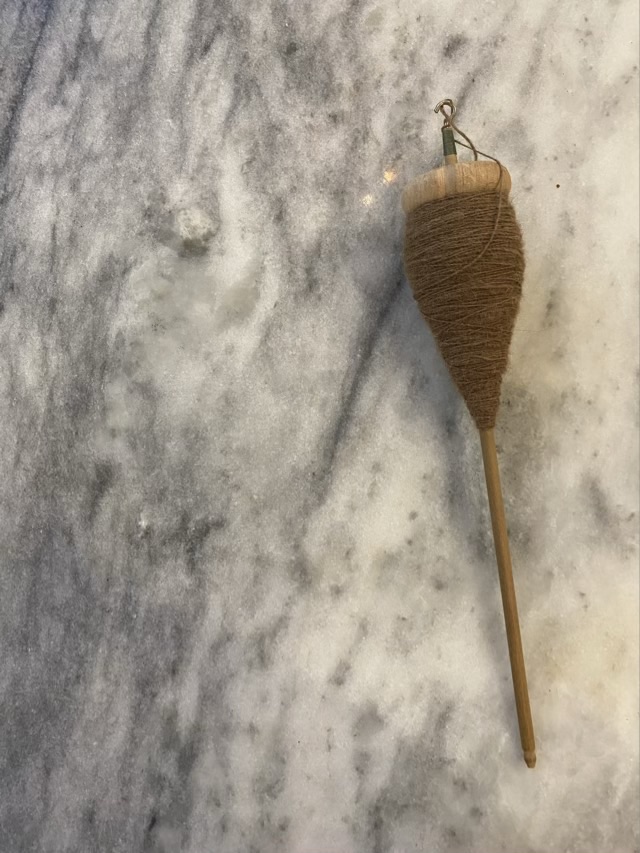
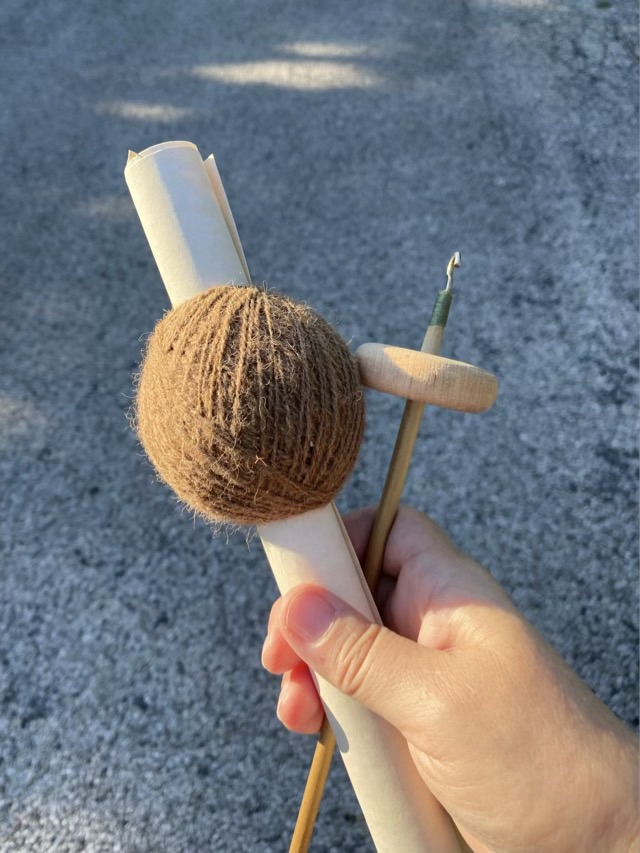
Photo description: 3D printed Turkish-style spindle with a chaotically wound “turtle” or cop of yarn next to a partially undressed distaff. The fiber is gone, but the handkerchief robe and tie are still attached.

Piecing

I bought a grab bag of scraps from the local quilt store because it had fabric that matched what I have in my stash. I set it on the sewing table of the Singer model 66 and later decided to try sewing some squares together. I haven’t pressed the seams yet, but I love the way the machine works. It is the advice from The Treadle Lady to take these old machines on a “Sunday drive”. Using them weekly encourages proper regular maintenance, and keeps everything moving.

Photo description: Four squares of red fabric sewn together on the surface of a Singer model 66.

Tinier stitches

I thought the Singer model 66 was set at the tiniest stitch, so I’ve been gradually turning the stitch length knob, pictured below and marked with an arrow, to the left. This knob on both my machines was quite difficult to turn and needed extra sewing machine oil, and a wrench with the jaws wrapped in leather, so as not to damage the knob.

Photo description: Balance wheel side of a Singer model 66 sewing machine, with an arrow pointing to a large silver round knob which controls the stitch length.

My assumption was wrong. Turning the knob to the left makes the stitches even tinier!

Photo description: Light colored fabric with concentric rectangular stitches. The outer stitches were done after turning the knob to the left. The inner stitches were after turning the knob almost all the way right.

So now it makes sense that I have seen these knobs all the way screwed in, the longest stitch works well for sewing the most common fabrics. There wouldn’t have been much call for changing the stitch length, so more time for the knob threads to seize up.

I also figured out a way to “reverse” stitch on the treadle machine that absolutely does not have a reverse capability: I turn the fabric around. I sew a few stitches, bury the needle, lift the pressure foot, turn the fabric 180 degrees, lower the pressure foot, sew a few stitches back to the beginning, then turn again and continue with my seam. Here is a video. These stitches are so small I probably don’t need the extra reinforcement, but it makes me feel better.