Chicken update: I still have three chickens. I had a scare the other day, one of the hens tucked herself under the supplementary coop and didn’t move when I came to give treats. When I touched her tail feathers she woke up and was rather offended at being touched.
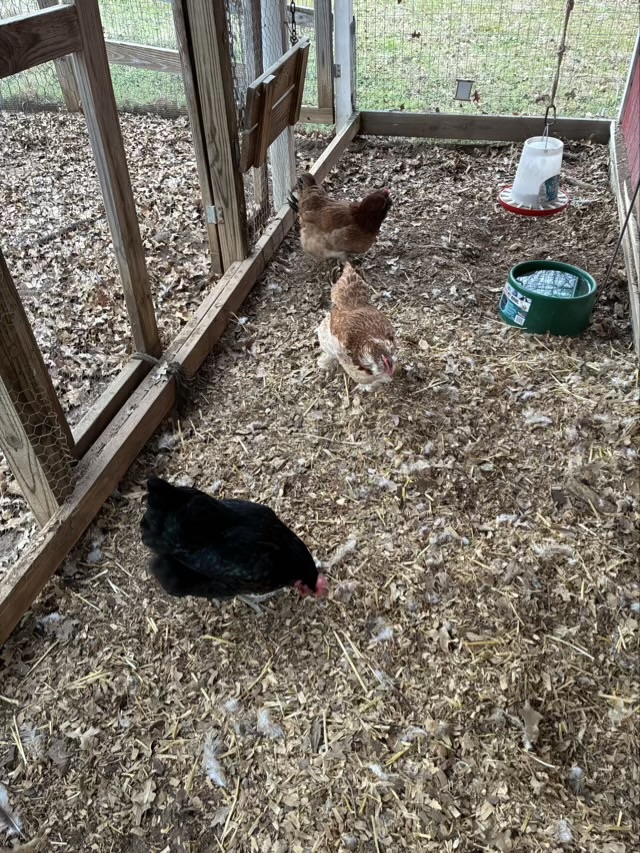
Photo description: black star hen and two Faverolle hens in the run outside the coop
I was rather startled when I found an egg in the coop. The last time Wingding the Black Star hen laid an egg was in August. My two Faverolle hens haven’t laid any eggs since April. All three hens are about six years old and well past prime laying age.
Photo description: light brown egg in my hand in the foreground and a Black Star hen and a Faverolle hen in the background
When we added two chickens to the flock and had them separated, I put a hanging feeder in with them. When I integrated the flock I kept the hanging feeder full because I wasn’t sure the new hens would be able to use the Grandpa’s Feeder my original flock used. Turns out that all the hens preferred the hanging feeder. The advantage of the “Grandpa’s Feeder” is the wild birds and rats aren’t heavy enough to activate the lever and open the food bin. The disadvantage is that bugs can still get in. When checking feed I discovered that the entire bin was full of food riddled with holes.
Photo description: chicken feed in a Grandpa’s Feeder riddled with insect holes
One of the other advertised advantages of the Grandpa’s Feeder is that the metal grid and high sides keep the chickens from wasting food because they can’t fling it out of the container. A hanging feeder has this same advantage, so I emptied out the Grandpa’s feeder and decommissioned it, since I was only feeding bugs.
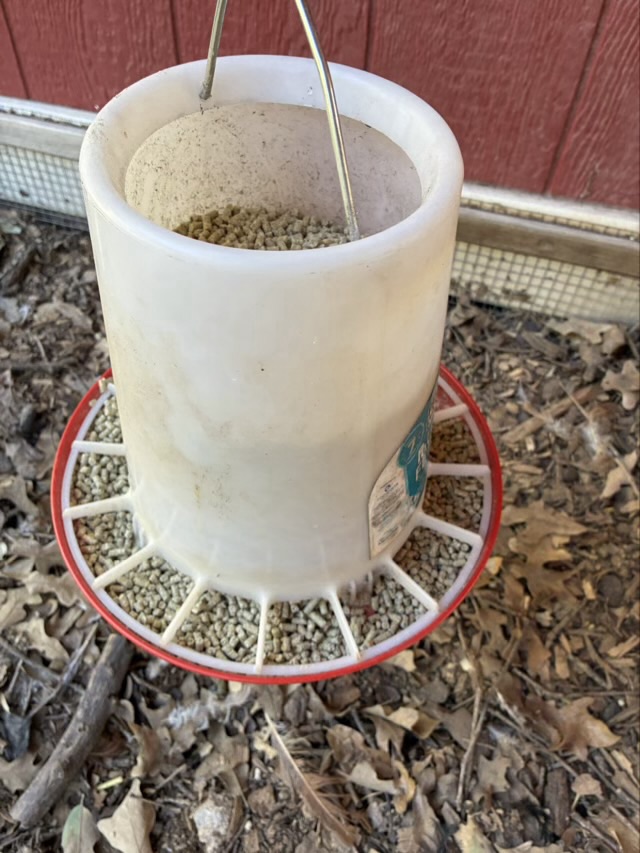
Photo description: hanging feeder filled with chicken feed
Another advantage of the hanging feeder is that I can see the food level from a distance. A disadvantage is that it is open on the top and if we get a heavy rain storm I loose a batch of feed to the wet. I’ve moved the feeder farther inside the porch area of the coop to see if that fixed the weather problem. Overall, the hens prefer the hanging feeder, and the hanging feeder is a fraction of the cost of a Grandpa’s Feeder.
Full disclosure, I bought pumpkins before Halloween, but we didn’t get round to carving them until after. I think this might be the second year this has happened, maybe the third. Hm. I specifically bought pie pumpkins so they could nourish the chickens after carving. The large carving pumpkins are stringy and the hens don’t care for them as much. Since at least one pumpkin was going straight to the chickens, I had to give it a horrified look.
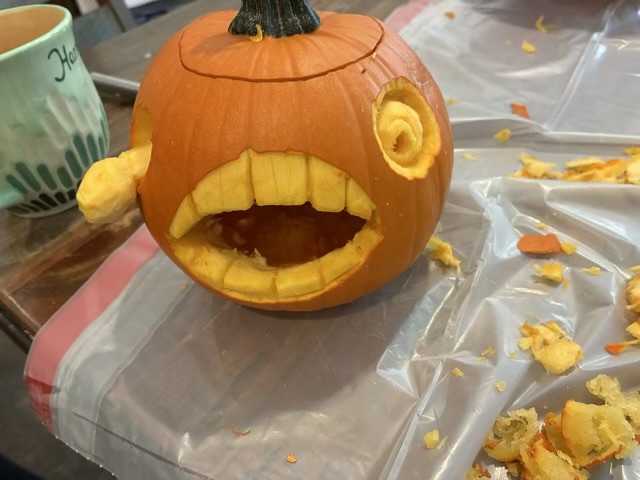
Photo description: small pie pumpkins carved with a open mouth showing square teeth, one round eye, and one eye hanging out of the socket
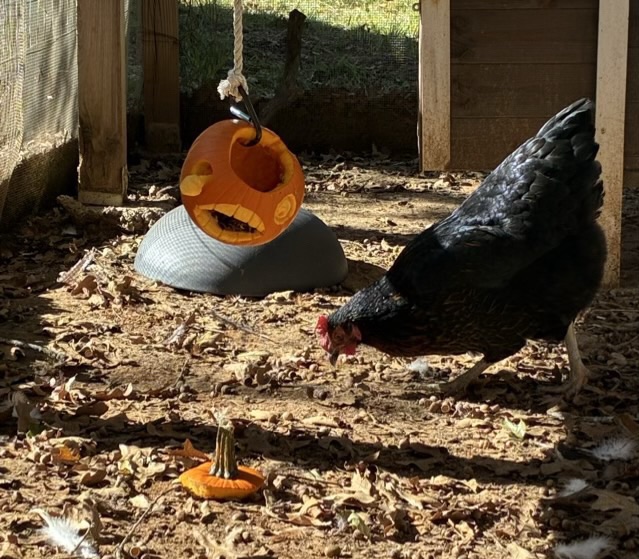
I hung the pumpkin up for the chickens using a carabiner clip. Last year I remembered to cut the bottom out to scoop out the seeds so the pumpkin could hang from its stem. I forgot this year, but it looks a little like the pumpkin is horrified that it lost it’s lid, or that a hen is coming.
Photo description: pumpkin hanging in the coop with a Black Star hen approaching the lid on the ground
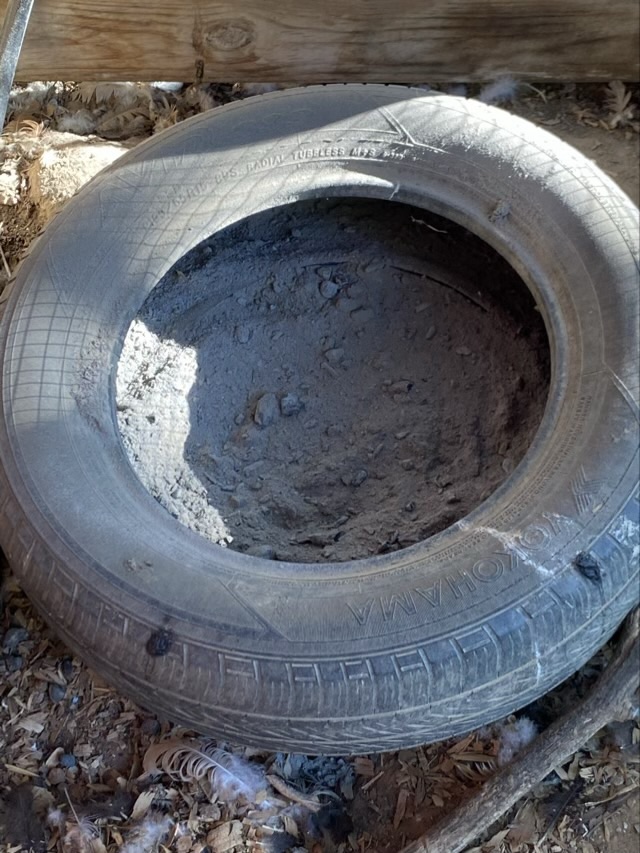
Not that it has been awhile since I was able to fill the chicken’s dust bath, but the volume in the tire was negative.
Photo description: old rubber tire used as a chicken dust bath with the inside soil level below the tire and surrounding ground levelPhoto description: approximately six gallons of dust bath mixture (wood ash, soil, and diatomaceous earth) added to the tire bath
There is room for another batch or two of dust bath mixture.