I had a logo contest pop up on my feed for Lacewing Creative Retreat in Texas, and decided since I love crafts and a place to dedicate time to finishing a craft seems like a fabulous idea, I would submit a design. I made the top five! They are having FB fans make the final call on their page. (I’m cross-posting this on my business blog too, so I apologize if you follow both and get a double hit!)
When I sit down to breakfast in the morning, I have an intense audience. Not because they get table scraps, but because I get out the laser light for the red light game. If it is too early in the morning, Missy doesn’t run, she just stares at my hand, which is irritating. So I run the light up her leg and onto her tail. That usually gets her riled up enough to run. Nothing like a little tromp around the kitchen island to get the appetite up for breakfast.
Salmon Faverolle eggs are described as “pink”. What makes them pink? One of our pink eggs had some straw stuck to the shell, and when I picked away the stalks, there was brown underneath. Which indicates that the pink color comes from a white layer that overlays the brown.
Pink egg (top) showing brown beneath the white
The inside of these eggs shells are white. The brown color is deposited in the oviduct near the end of the egg’s journey. So it looks like in Faverolles, the bloom (which is a protective coating deposited before the egg is laid) is more opaque, thus looks white, than other brown eggs. As an interesting aside, blue eggs are the result of a pigment spread throughout the shell, so the inside of a blue egg shell is blue. A green egg has the blue pigment over laid with a brown coating. Ah the interesting egg!
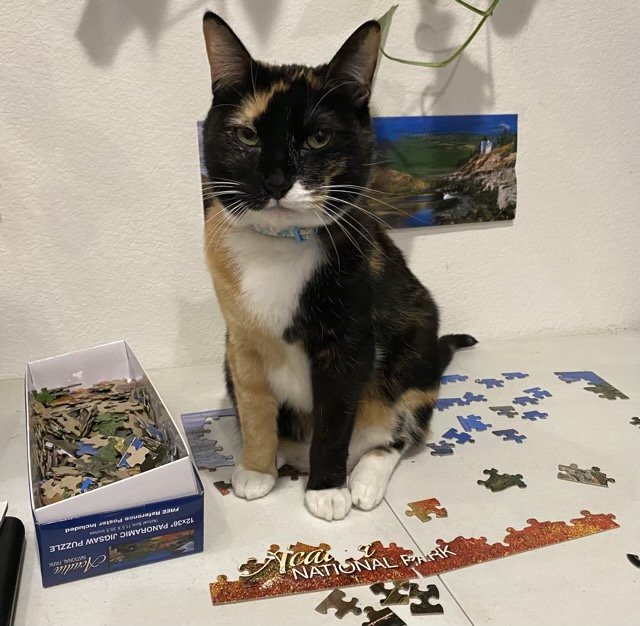
I took the cover off the puzzle, and within two minutes the table sprouted a cat. I feel that she is looking at me thinking “this is my rightful spot, I dare you to move me”.
This moth settled on the glass of the back door, which offered a unique opportunity to photograph it from underneath while it is still living. The photo isn’t as crisp as I would like, but you can still see the feathering on the antenna.