Resist

Resolene is an acrylic based leather finish that can protect smooth leather. I have a very large bottle of it. What else can I use it for? Will it work as a resist for watercolor art? It should, and it does!

Preparing to use Resolene as a resist on watercolor paper

I used a small paint brush to write “Happy Birthday” on two sheets of water color paper, then used a hair dryer to dry the writing.

Resist added to paper and dried

My youngest and I then each painted watercolors over the entire paper. We wanted to try out some new pearlescent watercolors, so it was a double experiment (not recommended in scientific experiments, but encouraged in artistic endeavors.)

Watercolor paintings

I think if I use Resolene to make words again, I will make the letters a little thicker, but overall the venture was a success! The clear acrylic kept the resisted areas mostly white, so the writing is readable in the final product. Pearlescent watercolors don’t photograph well for sparkle, but they do have a nice shimmer in person.

Henbit explosion

Yup, spring. And a wetter spring than we’ve had in a few of years. We have a bumper crop of henbit, with its pretty purple carpet, in our meadow as well as throughout the countryside and town lawns (the ones that go natural, at least).

Henbit in the morning light in the meadow

It was easy to pick a handful (for at least the past two years it wasn’t), and offer a snack bouquet to the chickens.

Chickens considering a henbit bouquet

This is the time that I get a little wistful that my hens can’t free range the meadow, but I haven’t done a metal sweep of the whole meadow, oh, and there is the plethora of predators. There’s that. Everything likes to eat chickens.

Beauty like the night

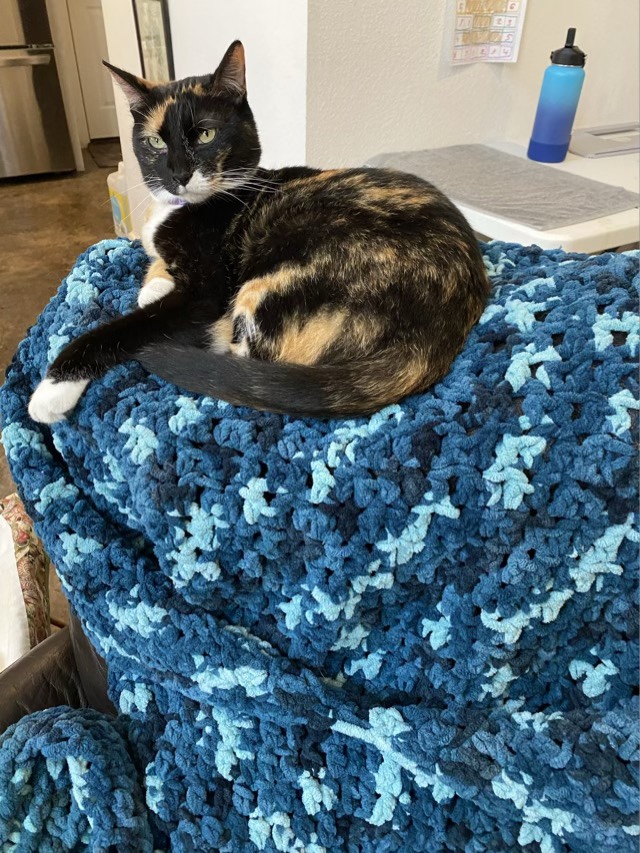
Shadow the cat posing

Here is another picture of not-my-cat, but isn’t he in a pretty pose? This definitely gets marked as a favorite and saved for a reference for future art. The arc of the tail! The perfect feet! That light necklace of fur that gives him an even more regal air! Those eyes! I missed the picture of him meowing at me. He will approach, but not allow the familiarity of pets let alone brushing. He is Mr Tom’s Shadow, and they hang out in the meadow.

New skills

Kicking a ball while combing alpaca fiber

Thanks to Missy (IAB (Identified At Birth) dog) , I am learning new skills. I can now kick a ball while combing out alpaca fiber. I started singing and she thinks that is my signal I want to throw the ball (laughter also prompts her to bring someone a ball, hmm). My hand were full of combs, but my feet were available to send the ball in various directions. She was quite disappointed when I started to spin and both hands and feet were busy.

Reinforcing

Spindles with hooks have a weak point where the hook screw connects with the wood, especially if the shaft is slender. I like slender shaft drop spindles because I feel I can control the spin better and the light weight is more comfortable. I don’t like when I drop it and the shaft cracks. To give the metal to wood join some reinforcements, I decided the wrap the weak area with waxed silk.

Clockwise: scissors, beeswax, silk cord size D, drop spindle

The method I used to wrap is called common whipping. Plugging those two words into your search engine will generate all sorts of illustrations and tutorials, as long as you get the words right. It took me an hour of searching to find the right words, I had a synonym of whipping in my head that I couldn’t dislodge. So, two words: “common whipping” are my gift to my readers today.

Common whipping on a drop spindle with waxed silk cord

I ran an arms span of the silk cord through my wax block three or four times to build up a layer of wax. The wax helps protect the cord and makes it stay in place better. I start my whipping with a loop laid along the shaft. I wrap toward the loop, run the end of the cord through the loop, then pull the loop end to draw the ends into the middle of the wrap. (This is where the internet search comes in handy if you are a visual learner.)

I used silk because I tried hemp and it wasn’t strong enough and the diameter made a wrap thicker than I wanted. Waxed linen is also commonly used, and is strong, but I didn’t have any on hand.