DIY bobbins

In my Grandma’s stash of knitting supplies, there is a stack of bobbins she made from plastic containers. I decided to follow suit, and make more bobbins from my used plastic lids.

Grandma’s bobbins (left), commercial bobbin (bottom), ricotta cheese lid (right)

There are no signs of tracing on Grandma’s bobbins, I’m not sure if she wiped them off, they wore off, or she made so many she didn’t need to trace them. I need trace lines, so I used a thin sharpie to outline the commercial bobbin.

Tracing the bobbin onto the lid

I cut out the traced design with kitchen scissors.

Cut out bobbin

I think cutting was a harder task for Grandma; the plastic she used was much thicker than mine. It is a visible reminder that plastics manufacture has changed, and products are using less plastic per item now.

Grandma’s plastic (left), modern plastic (right)

Despite the thinner material, my new bobbin works great to organize the extra bits of thread I’m accumulating as I warp my Inkle loom.

Newly made bobbin wrapped with pearlized cotton

Intruder

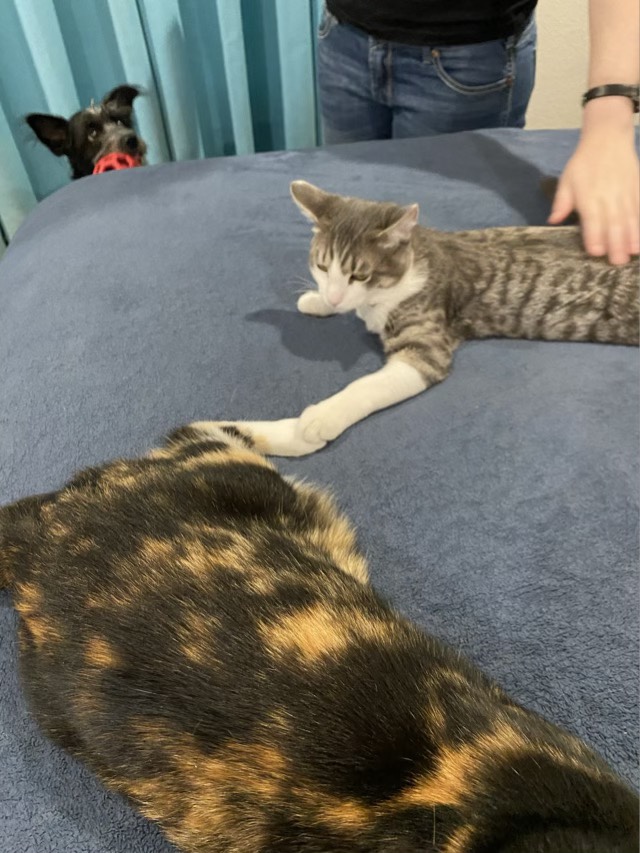
Izzy going for a nuthatch

The picture is terrible, but frankly I’m surprised I obtained any image at all. There was a nuthatch outside on the coop looking in the house, then a ruckus behind the curtain that caught the cat’s attention. I pulled back the curtain to see a second nuthatch in between the screen and the window on the inside. I snapped the picture just as the bird dove down into the cat’s claws. I pulled the cat off and the bird rocketed back out the hole in the screen, through the catio bars, and off to freedom. That was quite the excitement for one morning, thank you. I’m very thankful I didn’t have to chase the bird through the house. I’ve seen some insects come through the flap I sewed into the screen so the cats could access the catio, but never a bird!

Crochet flower garland

I’ve had this as a purse project for a couple weeks. I wanted to make a flower garland, and I wanted to use crochet (which is still my top choice for an easy-to-pick-up, easy-to-set-down project). I chose pearlized cotton from my stash. I was sad, but not surprised, that all the green is gone, but the multicolored blue did a fine job for the leaves.

Crochet flower garland in process at my favorite coffee shop

I started by making the flowers with white thread. These are made with five petals crocheted into a magic circle, each petal is a chain 2, double crochet into the circle, chain 1, slip stitch into the top of the double crochet, chain 2, slip stitch into the circle. I made subsequent flowers along the thread because I didn’t want loose bits floating around my purse. When it came time to crochet the vine and leaves, I would clip off a flower and add between leaves (which are similarly constructed to the flower). I neatened up the white threads ends later by weaving them in and clipping.

Long strands with flower bobs enjoy getting tangled. I didn’t have an extra bobbin, so I tore off a side of a tissue box, rolled it into a tube and tucked in the ends. This allowed me to wrap the ornery lengths around it to keep them neat, and the tube served as a holder for the 1.00 mm crochet hook I was using. Not pretty, but effective.

Finished garland

For the final flower, I joined in the start of the chain to make a continuous loop. Now the garland can be doubled and used as a head band, or looped and worn as a necklace.

Gregg’s Mist Flower

We planted one Gregg’s Mist Flower in the front garden. We tried a different variety of mist flower previously, but they didn’t take well, and didn’t attract butterflies. These are growing well and nearly every time I walk by, I see a butterfly! Hurray!

Butterfly on Gregg’s Mist Flower

I believe the butterfly visiting in the photo is a Painted Lady butterfly.

Designing a tablet weave

My inkle loom calls out again, and I have a stash of pearlized cotton that needs to be used. My craft supplies are very demanding. I measured the warp space on my loom and did some calculations to see how many warps I could make with one skein.

Length calculations

It turns out there are several websites that have apps for designing tablet weave patterns. Neat. I tried the first one on the list, found it intuitive, and designed a pattern that I could make using what was in my stash.

Screen shot of “Tablet Weaving Draft Designer” app
Printed pattern with skein colors

Warping the loom takes a couple hours, but taking time in this step is well worth the effort. The diagram I printed was easy to follow to set up my cards.

Warp completed

I cut a strip of card stock with two long slits that fit over my pattern so I could keep track of my rows. I’m all ready to start weaving! Except, where is my shuttle? No seriously, I can’t find it. I probably put it somewhere safe again. Hm.