I still have the trail cam set up to watch the water bowl behind the coop. It turns out that there are at minimum five raccoons washing in the dish. Hm.
Photo description: Night vision photo showing two raccoons in the water bowl, one to the right, one behind, and a fifth on the stair in the background.
I’m not the only one watching. Mr Tom was caught keeping an eye on an opossum coming in for a drink.
Photo description: Night vision photo with the back of a white cat’s head in the foreground, and the glow of an opossum’s eyes in the midground.
I finished recycling my Bernat blanket yarn mermaid tail into cat mats. In total, I made 7 large mats, 3 crate-sized mats, and one round basket liner. The yarn used was taken from the old unused blanket and scraps from other projects.
Photo description: Seven crocheted rectangles
To make the mats, using a 8mm hook or a hook that makes a tight but not difficult stitch, chain 30 for a large mat, or 20 for a crate sized mat. Single crochet each row until the mat measures about 17”. I donated most of the mats to the local no-kill cat shelter.
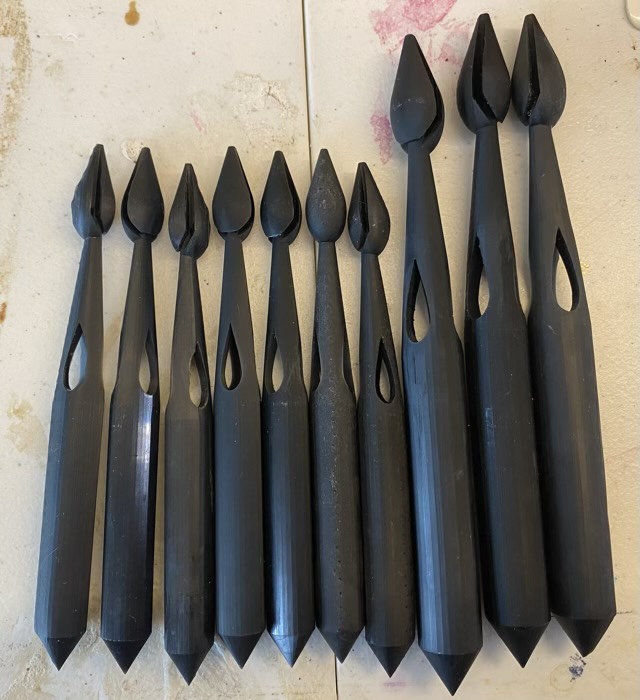
I recently received 3D printed spindles from our first production run! Very exciting. The spindles have passed their drop tests, so the tough resin is holding up well. They aren’t completely indestructible, but it takes a great deal of effort to snap the neck (yes, I should have measured the force, but hindsight is 20/20.) The next step is to sand down the production marks (they take sanding well), and apply some decoration. Then I need to design the packaging. Phew! But I am inching forward!
Photo description: Seven small 3D printed spindles and three large spindles in black tough resin with grooved heads and teardrop holes above a straight shaft and pointed end.
I’m leaning toward calling these “phase” spindles, because they have aspects of other historical designs; the large diameter shaft is similar to a dealgan, it can be used as a supported spindle or a drop spindle, and the weight is adjustable.
I’ve had a little more growth on my cultivated Pearl mushrooms, but no mushroom heads, so I poked some holes into the substrate using bamboo skewers to let the water in. Now we wait. Again. I purchased this kit about eleven months ago. It produced about five small mushrooms, then I accidentally broke off the stems (they really do mean it when they say cut the heads off with a sharp knife, it needs to be seriously sharp to leave the stem cluster intact). No more fruiting bodies since then.
Photo description: round plastic container filled with mycelium with three clumps of tendrils emerging from the top. The center of the top has six bamboo sticks poking out and four open holes.
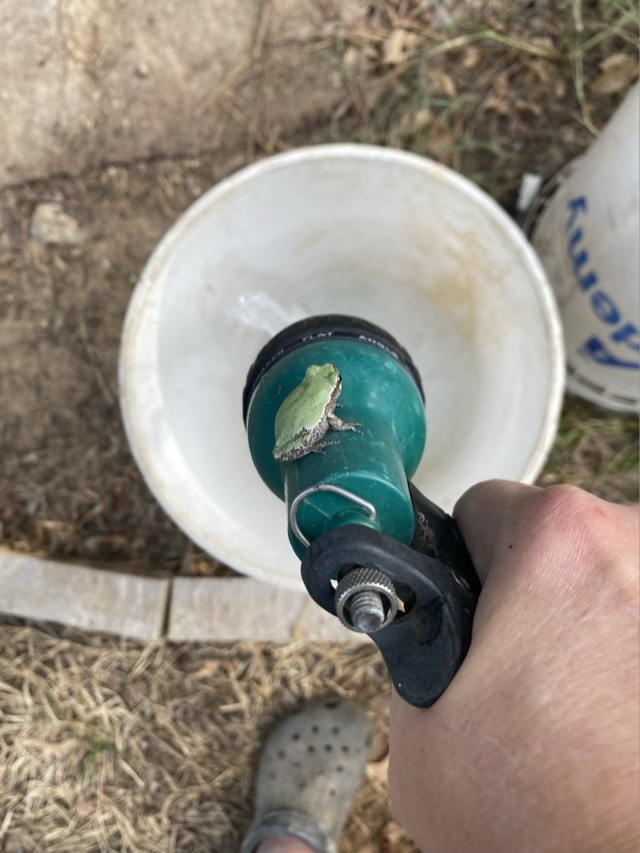
I went to fill the water bucket and didn’t notice the frog on the spray head until I started the water. Huh. He was unbothered, but I still transferred him back over to the fence.
Photo description: Hand holding a green sprayer with a small green tree frog sitting on the barrel watching the water go into a large white bucket below.



 Critters and Craft