Wool nests

I have some Baize Shetland wool that came as large batts. I’ve been tearing off strips to spin, but decided that it was inefficient to unroll the batts every time, so separated all of the batts into strips and wound them into loose “nests”.

Photo description: Separating a strip of near white Shetland wool from a batt, showing the approximately two inch strip coming away from the main batt, with a hand wrapped nest above.

To wrap the nest, I loosely wrap the wool strip around four fingers, then tuck the end in the middle. The nests stay together, and are easy to grab when it is time to spin.

Photo description: Eleven visible wool nests in a pile.

Corriedale page

I did a fiber sample page for the Corriedale wool I’ve been using for teaching spinning. The woven sample is my best yet; I started the weaving with a pass of twined weft away from the edge of the loom. My weaving then stayed more even and consistent to the end, where I did another twined pass. The twining keeps the weaving in place better too, so I didn’t need to make knots. If I were making a piece that would see more action than laying in a book, I would secure the fringe better, either with more twined passes, or knotted or sewn fringe.

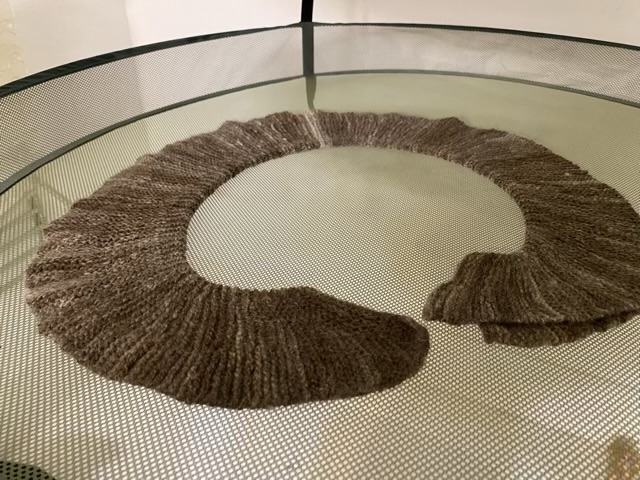
Photo description: clockwise from top left: 3×5 card with “Corriedale obtained from Mohair & More on Etsy, Huntsville, TX, spun on a drop spindle”; single ply on a paper bobbin; two ply on a paper bobbin; crocheted lace round; woven sample with two salvages; knitted sample with garter stitch edge; sample of un-spun fiber

Corriedale is very nice to spin, has a nice feel, but isn’t the softest. The blended dark and light fibers make it easier to see the twist, which is why I like it for learning.

It bloomed!

Our Texas sage bush bloomed! This is supposed to be a sign of coming rain, but it has not panned out. I’m pleased to see blooms, though. This little bush has seen some trauma; it originally lived in the flower beds by the house, but that was too much water and its roots were wet. Not a happy plant. When a freeze came through and we thought we lost it, we moved it to the meadow, just in case. We were quite surprised when the following spring it sprouted leaves. That was two or three years ago; this is the first time it has bloomed since the transplant.

Photo description: light purple blooms on a Texas Sage (Leucophyllum frutescens) with trees and the chicken coop in the background.

Happy Surprise

I will be doing a spinning demonstration soon for a local founder’s day, and I thought I should really dress for the part this time. Fabric is crazy expensive, and as much as it saddens me to purchase costumes made from synthetics made in a foreign land, I did not have the time or resources to make all the pieces myself this time. I did not have high hopes for the online order, I have been thoroughly disappointed before, and it was in the plan to make modifications, but I was quite surprised when the garment arrived. Yes, it is made with synthetic fibers, but nicely, and well sewn. There were decorative pleats in the skirt that could actually be let down to give more length. And there were pockets. Yes, you heard me right, pockets. Proper, can-actually-hold-my-phone-without-falling-out, pockets. Color me impressed. I did take out the elastic on the arms, and let out one pleat to so the dress come closer to the floor (but not more since I don’t want to trip over it, but that’s it. No it isn’t authentic, yes, the re-enactors will have things to say, but it is much better than capris and a t-shirt, and I like the color.

Photo description: Green fabric with a pocket and decorative pleats that can give skirt more length.