Throwback Thursday: Socks

My current endeavors are not my first foray into knitting socks, as proven here in a picture from November of 2003. I was knitting with thicker wool, and sewed tooled leather to the soles to make a slipper. Tooling leather isn’t the ideal slipper sole, it is thick and stiff. Now I would use suede or a finished supple leather, something to reduce the chance of slipping while walking more than the simple tooling I tried here. I do like how neat my stitches are, though, and worsted weight yarn knits up much quicker than sock weight yarn!

Photo description: cream colored wool slipper socks with a lightly tooled leather sole whipped stitched with leather lacing.

This was over 20 years ago. Hm.

Blocking Soy

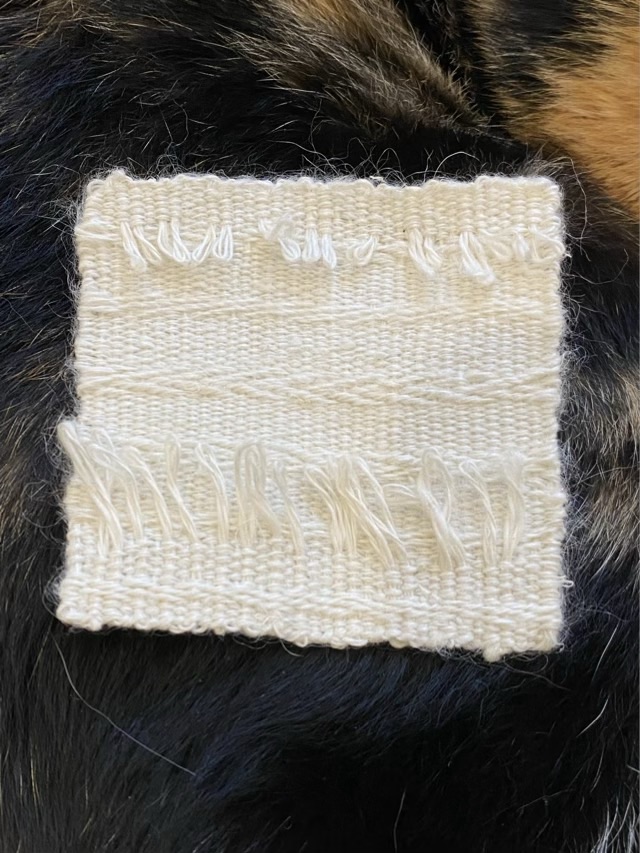
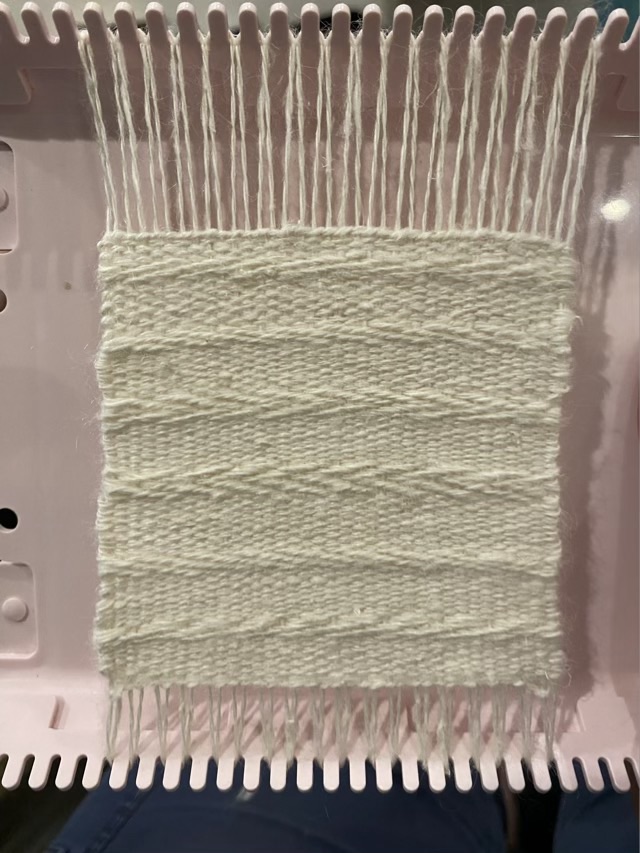
I made four example swatches from my spun soybean fiber: knitting, crochet, weaving, and nålbinding.

Photo description: swatches before blocking, clockwise from top right: stockinette knitting, plain weave, nålbinding Dalarna stitch, and crocheted lace round

The knitting swatch tells the most about the yarn, the obvious skew is because my singles have more twist than my ply. This bias does not have a significant impact on the other swatches. The nålbinding has several small knots because I could not get the fiber to felt together. I used a 1.75mm hook for the crocheted coaster, which was on the small side because the stitching is dense and stiff. The soy yarn is incredibly strong; I can’t break a single strand with my hands, but it is also incredibly soft even with the amount of twist I put in the single. There is good reason that it also carries the name vegetable cashmere. It also blocks well. It was very easy to shape when wet, and kept that shape when dry.

Photo description: same swatches after blocking

I was able to square up the knitting, and give the woven swatch some more twist in the fringe. The nålbinding swatch stitches opened up, but the crochet didn’t have much change, probably due to the density of the stitches.

The next step is to mount the swatches in my fiber book.

Turtle shell

When spinning on a Turkish Spindle, the ball of yarn created on the arms of the spindle is called a turtle rather than a cop as it is for other drop spindles. My theory is that the ball of yarn looks like a turtle shell, complete with four leg holes, when the spindle shaft and arms are removed. The useful part as that the turtle is a center-pull ball, and doesn’t have to be rewound before it can be used. If you were ever curious on what a ball of yarn from a Turkish spindle looks like when it has been pulled from the center, I have provided catharsis below.

Photo description: hollowed out ball of yarn from a Turkish spindle.

The over two, under one wrapping used to make the turtle provides a surprisingly stable structure when a layer is complete. In the photo above, the inside of the turtle looks woven. I didn’t press my luck and the potential collapse of the turtle shell storing it with the middle missing, rather I rewrapped it nostepinne style before tucking it in my bag. This yarn was spun from soybean fiber, then 2 plied.

Bluebonnet patch

We have our own bluebonnet patch!

Photo description: grassy clearing with leafy trees in the background.

It looks like an April Fools joke, but it really is a bluebonnet patch. Here is a photo taken from another angle:

Photo description: sparse bluebonnets in a field of green, taken at a ninety degree angle from the first picture.

There are more bluebonnets in this area than last year; we’ve had a wet spring. Some of my neighbors’ yards are breathtaking with their bluebonnets. I’m hoping this patch continues to thrive and expand. We won’t mow it until late summer, when the state starts to mow its wildflower filled roadsides.

My helper

Photo description: gray tabby cat laying on a bag of metallic plastic easter eggs on the bed, folded bits of paper with jokes in the foreground.

I made up slips of paper with jokes on them to stuff in easter eggs. I used the OpenDyslexic font, which is brilliantly designed to visually weight down the letters and make each shape unique. Thor the cat decided that laying on the eggs was a comfy place to watch me work and take a bat at the occasional egg.