Parallel view bluebonnets

I was obsessed with Magic Eye pictures in the 80s, and recently found out that the same eye unfocusing technique can be used with photos taken at slightly different viewpoints then framed together. So I have started experimenting with my own photos.

Photo description: original photo with bluebonnet field with trees in the background

There are two different basic ways that the photos can be presented. Parallel view, where the left eye looks at the left picture and the right eye looks at the right picture, and Cross view, where the left eye looks at the right picture and the right eye looks at the left picture. I can’t do the cross eye viewing, so can’t double check my work, so I’m only presenting parallel view today.
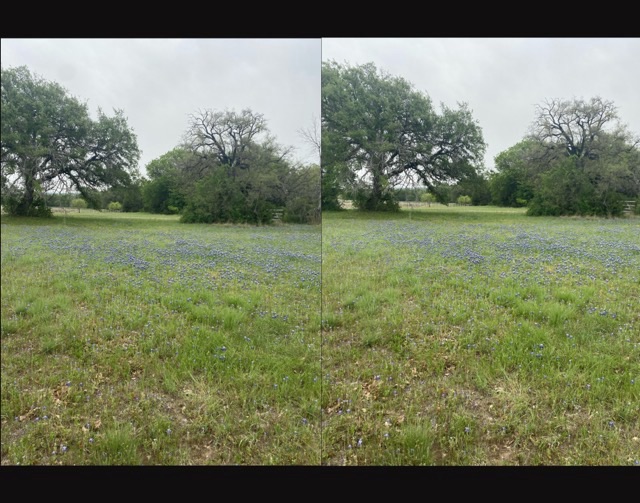
Photo description: stereoscopic presentation of the same bluebonnet field, parallel view

For me, I unfocus my eyes until I see three photos instead of two, and I can then focus on the middle photo, which looks 3D.

I’m also learning about framing and composition. Experiments will continue.
Grape vine hand rail, stage 1

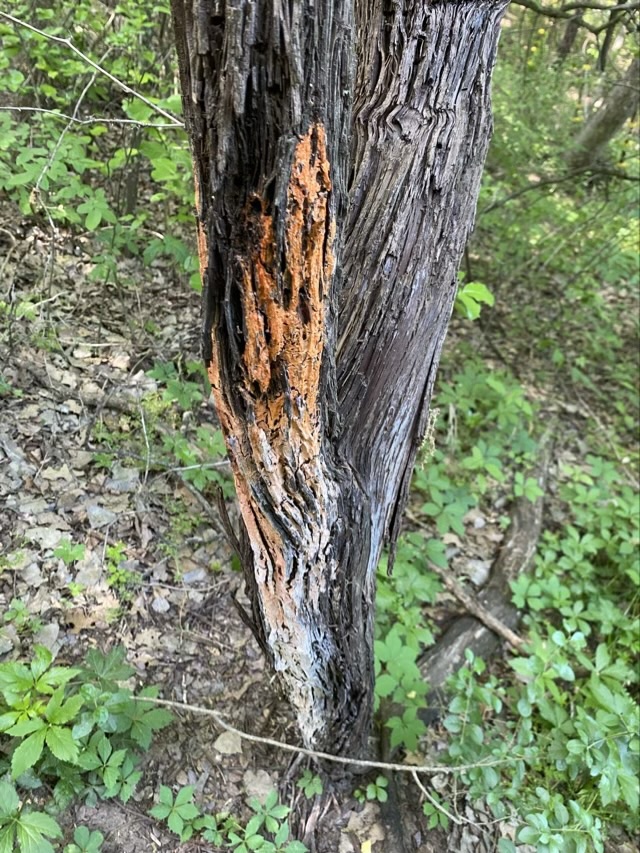
My husband built a beautiful rustic style curved stone staircase off our back porch. Our challenge has been getting a handrail to match the curve without throwing a lump of money at it. The first attempt involved cedar sapling trunks, but we didn’t have one long enough, and splicing two together was tricky. When I was wandering our woods looking for hand rail candidates, I saw a grape vine that I’ve been meaning to trim because fungus has started into the side of the bark.

Photo description: orange and white fungus on a large muscadine grape branch

I cut off the vine above the fungal damage, and since that vine was a nice diameter for a hand rail, freed it from the canopy. I then cut away the diseased tissue from the main vine and sealed it with pruning spray.

Photo description: sealed main vine, approximately 7-8 inches in diameter
Photo description: muscadine grape vine freed from the woods and dragged to the back yard

It took three of us to wrestle the vine into place as a hand rail, but because the vine is supple and we waited until the rain gave it a good soak, it was possible.

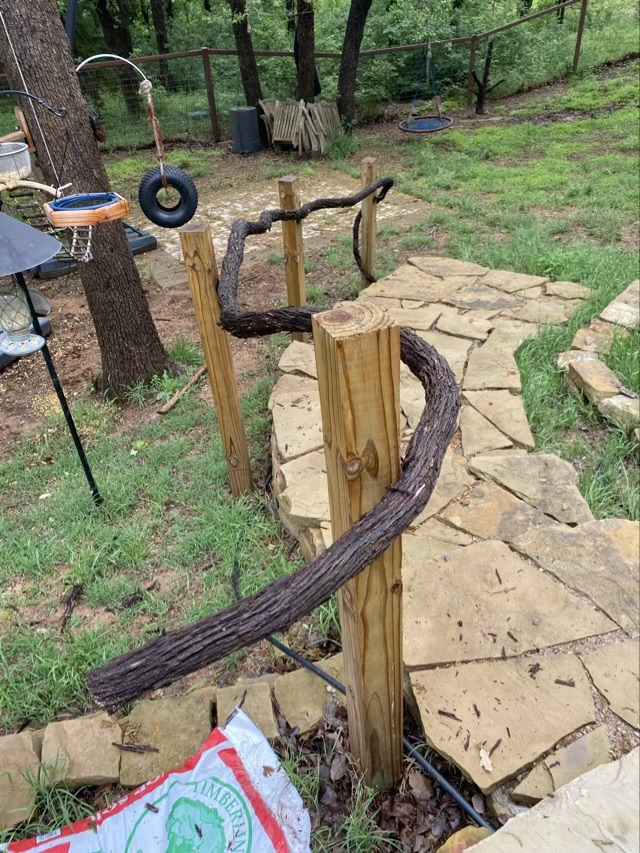
Photo description: grape vine installed as a hand rail on a curved stone staircase

We secured the vine with screws. The next step is to strip off the bark and seal the vine core so it lasts a little longer in the Texas weather.

Not long enough yet

I’ve seen where people have french braided long grasses, so when I wandered through our meadow and saw the waving Spring grass I thought I would give it a try. (Yes, I was completely in the middle of another project for this side quest.)

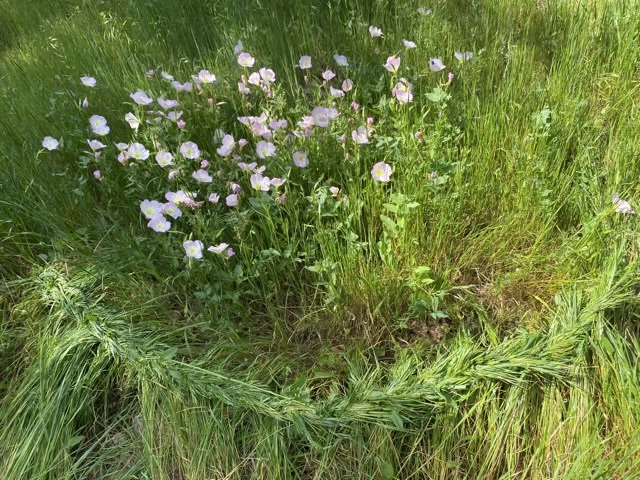
Photo description: patch of evening primrose with a half circle of braided grass in front

I did more of a Dutch braid, where the braid lays on top of the joined strands, but it didn’t have as much definition as I hoped. I was also struggling to have enough grass to join in the braid and still get the curve I wanted. So in a few weeks, when the grass is higher, and I need a break from a task that takes me through the meadow again, I’ll give it another go.

Door Hanger

I recently had the great fortune to learn from my neighbor who is an accomplished Cherokee weaver. She started me on a Cherokee style Peace Symbol/Door Hanger and told me that these would hang in the council house and be decorated with feathers. If the feathers were white, they were at peace, if red, they were at war, and if black, the village was in mourning. There are thirteen spokes representing the thirteen cycles of the moon during the year. I thoroughly enjoyed weaving this. I love the style and the way the light plays through the thin round reed.

Photo description: Wall hanging made of number 2 round reed with a woven center with thirteen interwoven loops

I am not Cherokee, neither in lineage or registration, so I’m being very clear that what I made is “in the style of” or “like” a Cherokee weaving.

Jewel orchid home

When my jewel orchid failed to thrive in my mossarium, I transferred it to an old fancy Ball jar filled with moss in a south west facing window covered in a translucent frost window covering. It was happy there, so happy that it started on a new leaf.

Photo description: fancy Ball glass canning jar filled with moss and one jewel orchid
Photo description: top view down into the jar, new curled leaf visible on the orchid

There are two problems with the canning jar container: one, I can only see the jewel orchid when I open the jar; two, if the orchid gets happy enough to bloom there is no room for the flower spike. So I purchased a tall clear acrylic vase, transferred the orchid and his moss to a different canning jar, and used the vase as a lid.

Photo description: same window, different home for the jewel orchid, a smaller canning jar, but a taller clear cover

I can now see the orchid, and if it sends out a flower spike, it has somewhere to go. He remains happy in his new home, as his leaf opened fully with no curling or discoloration.

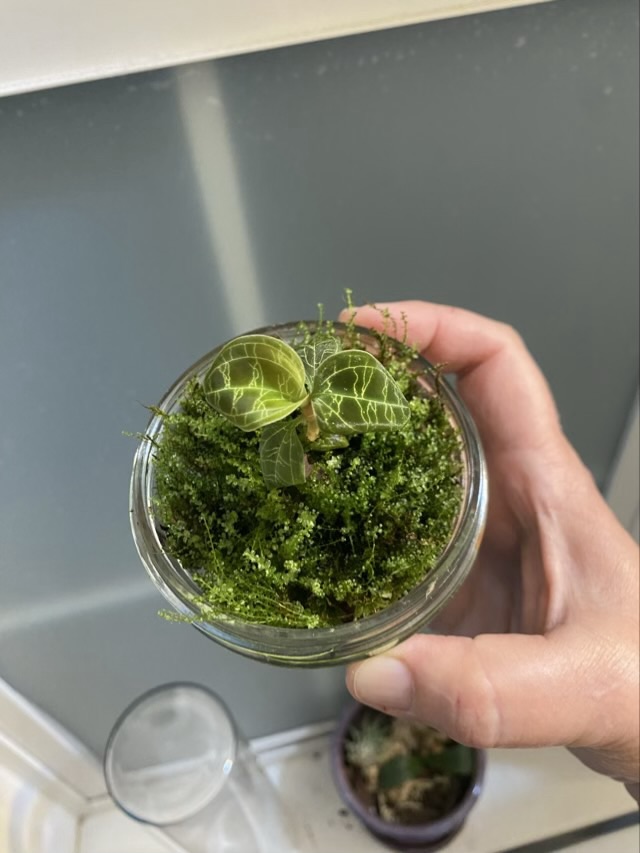
Photo description: 10 days after the last picture showing the jewel orchid with two fully formed leaves in a live moss bed in a small canning jar held up to the light