Since I purchased a high speed whorl for the Ashford Traveller spinning wheel, I thought I would see if I could spin cotton. Cotton has a short staple length and needs a high degree of twist to hold together.
Photo description: Egyptian cotton top spun on an Ashford Traveller with a high speed whorl
I’m definitely still working on my learning curve, but I’ve been getting sections that are even and not over spun. There are still lumps and bumps, and sometimes I’ll under spin and have several bits let go before I get back to stable yarn. I’ve divided my fiber into three sections to spin on three bobbins to make a three ply later. I hope.
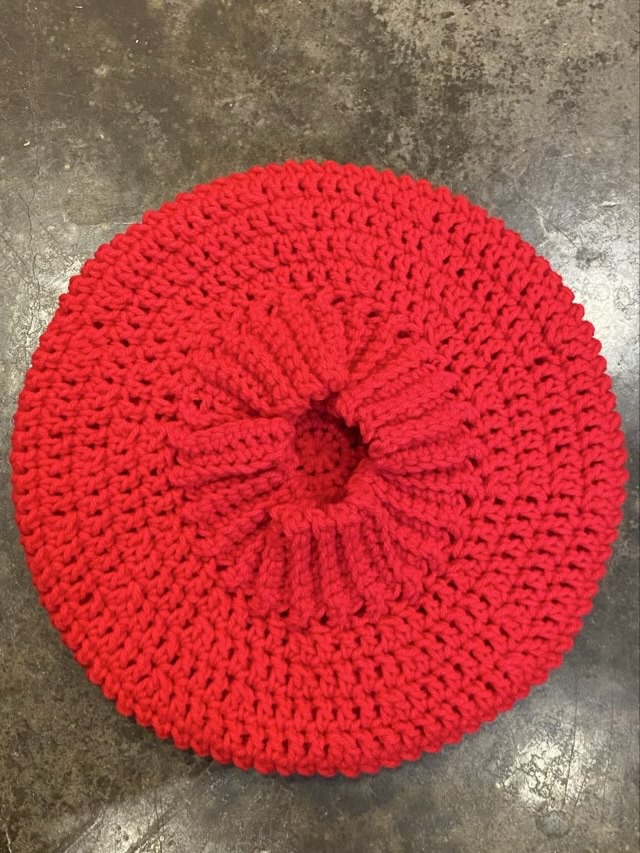
Once again distracted, I decided to try a crochet puff stitch to add some texture to a hat. And again, my circle expanded flat instead of nice curve, so I finished it as a beret rather than a beanie.
Photo description: red acrylic beret top with seven puff stitches per row, staggered, alternating double crochet rows with single crochet plus puff stitch rowsPhoto description: underside of the same beret showing the double crochet rows finished with a single crochet rib band
A puff stitch uses techniques from both increase and decrease stitches. Essentially you increase six double crochets in one previous stitch and finish by decreasing them all together so the stitch count doesn’t change. The width of the row does, however, which is why my circle just kept expanding.
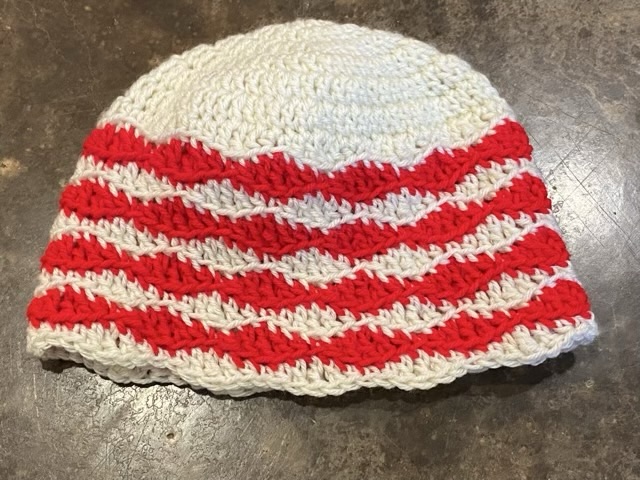
Next on the hat docket: stripes! But with a twist, or rather, a wave. I started the beanie with rows of double crochet in white yarn, then used a combination of single, half-double, double and treble crochet stitches.
Photo description: white and red crochet beanie style hat
Technical details:
In a magic circle 12 double crochets (dc)
Row 1: 2 dc in each stitch (24 stitches)
Row 2: 2 dc, 1 dc around (36 stitches)
Row 3: 2 dc, 1 dc, 1dc around (48 stitches)
Row 4: 2 dc, 1 dc, 1 dc, 1dc around (48 stitches)
Row 5: 2 dc, 1 dc, 1 dc, 1dc, 1 dc around (60 stitches)
Row 6: chain (ch) 1, *half double crochet (hdc) in next stitch, dc, treble crochet (tc), dc, hdc, sc. repeat from * around. Before completing last hdc, join in new color. Slip stitch to the beginning of the round. Don’t cut old color, don’t carry the old color around.
Row 7: ch 3 (counts as tc), make all stitches in the back loop: *dc, hdc, sc, hdc, dc, tc. Repeat from * around. On last stitch join in first color.
Repeat rows 7 and 8 until desired hat length is reached.
Tips: when lining up the rows, the tallest stitch pairs with the previous shortest, so the tc will always go in a sc, and vice versa. Putting the stitches in the back loop gives a nice line to the wave.
Last year I bought a sturdy plastic skeleton and secured it to the back of the wire deer in the meadow as if the deer was the skeleton’s steed. I had a different idea this year.
Photo description: decorative wire deer with ribbon around its nose being held by a skeleton as if pulling the deer
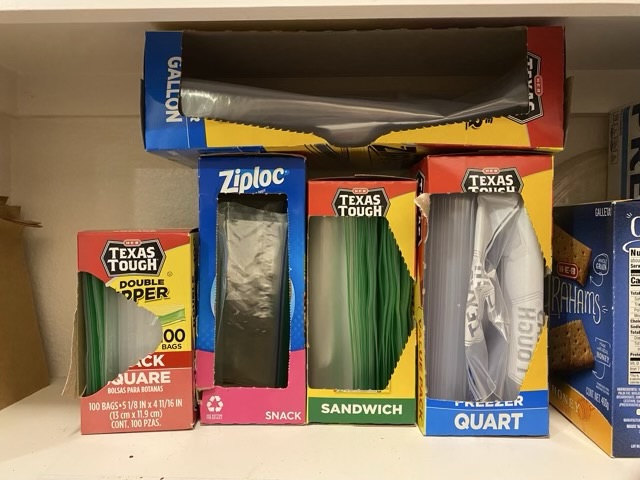
There are many times that I’m late to the proverbial party. I’ve been keeping my boxes of sealable plastic bags flat on a shelf in my pantry. I struggled with which size I was grabbing, and usually had to move the gallon bag box off to select something below it. I realized recently that the labeling on the boxes is designed to be seen at the top of the box. This works great if the boxes are in a drawer, or shockingly, standing on end on a shelf.
Photo description: snack square, snack, sandwich, quart, and gallon bag boxes arranged on a shelf with the openings easily accessible and the labels easy to read
The bags pull out easily from the box and it saves me a moment of frustration, which in some mornings is a rather large boon.



 Critters and Craft