Return of the hook

I finally did reunite a metal hook to my favorite drop spindle. I’m currently spinning Ramie combed top from Hearthside fibers. Ramie is a thornless member of the nettle family, and the fibers harvested from the stems are long, strong, and fine.

Photo description: lock of Ramie showing the long fine fibers, held in my hand, asphalt road in the background

I allowed myself to spin fine with this fiber, since on my last fiber I spun thick. I did not try to spin as fine as I could, that will be a later challenge, but just to spin a nice comfortable single.

Photo description: single spun Ramie fiber on a drop spindle, asphalt road in the background

I remembered to grab a cup hook and screw it into the top of the spindle, eventually. It really does make a difference in the spin of the spindle, because the arch of the hook allows the spindle to hang closer to its center of gravity, giving a smoother longer rotation.

Photo description: drop spindle with no hook, hanging from yarn secured with a half hitch, showing the point of suspension at the side of the shaft
Photo description: drop spindle with a hook, with the yarn secured by wrapping a couple times around the hook, showing the point of suspension centered on the shaft

It also helps that I am spinning clockwise again, which does not unscrew the hook. I will have to think on a way to add a hook that is secured without a screw or just glue, that can spin either way with ease.
Throwback Thursday: Egyptian Coil Bracelet

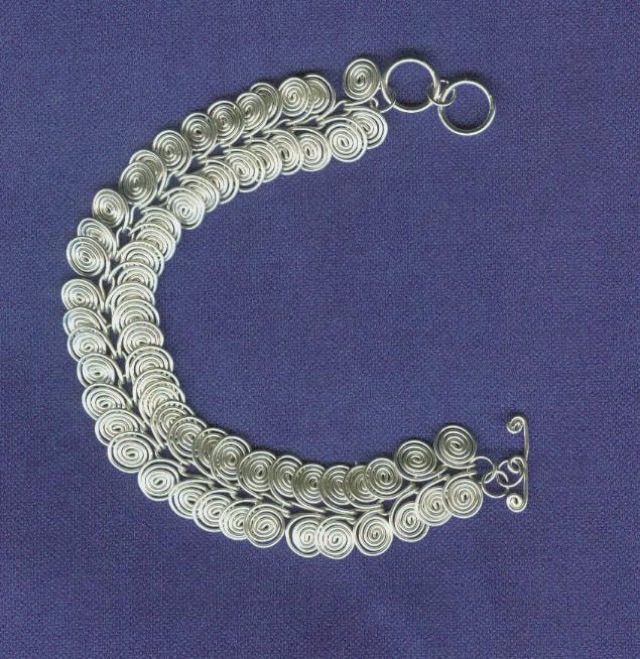
Here is a throwback to May 2008 of a work in wire that looks more complicated than it is.

Photo description: Egyptian coil bracelet made from 22 gauge silver wire with handmade toggle clasp

I enjoy items that are made my connecting identical elements to form something new. The Egyptian coil bracelet is made up of lengths of wire spiraled in opposite directions from the ends and folded in the middle. Each link connects through the center fold loop; the spacing between links depends on the length of the loop.

Although I like the look of the bracelet, the darn thing catches on everything. The thin gauge wire is easier to coil into a tight spiral, but when it catches on a thread or pocket, the wire pulls open. It is a good linkage study, though I recommend using 20 gauge wire or thicker.

Fiber Study: Banana

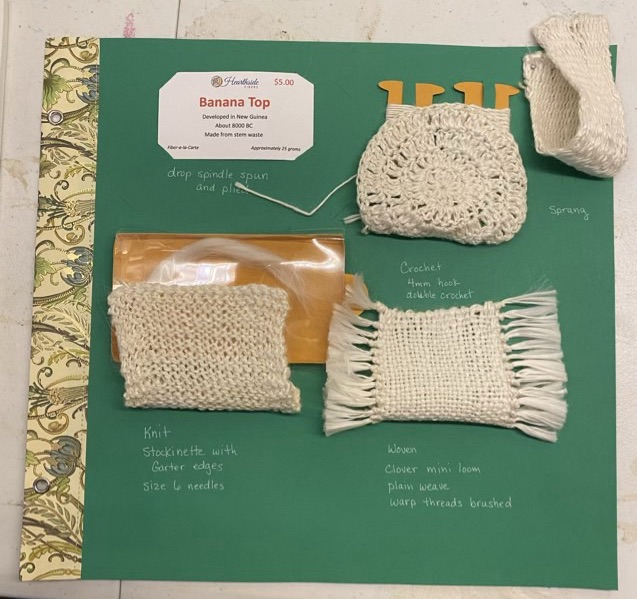
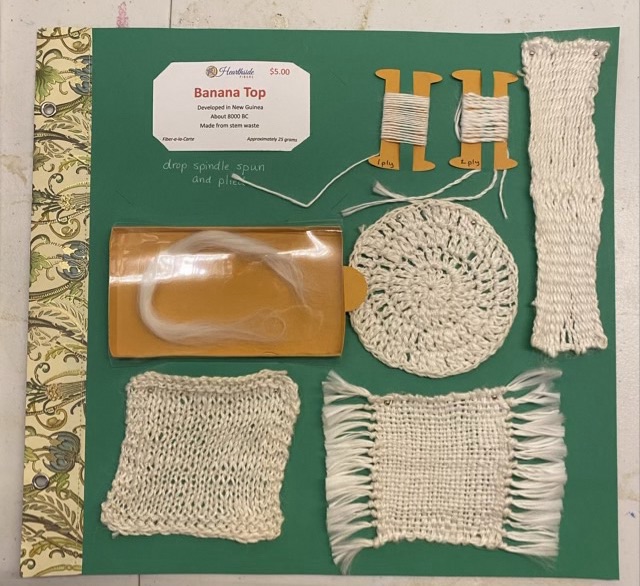
I assembled my banana fiber study page with yarn made from the stems of banana plants and purchased as combed top from Hearthside fibers.

Photo description: counterclockwise from top left: card from Hearthside fibers that reads “Banana top, Developed in New Guinea, about 8,000 BC, made from stem waste”, unspun fiber, knit swatch, woven swatch, crocheted swatch, sprang swatch, two ply yarn, and single ply yarn

Bananas are believed to have been first cultivated in New Guinea around 8,000 years ago and used for both fruit and fiber. The staple length of the combed top is long, about 8 inches, and the fiber is strong.

Photo description: banana combed top next to a ruler showing around an eight inch length

The fiber was pleasant to spin. I did challenge myself to spin thicker than my default spin, which resulted in more thickness variation, and also subsequently less length. I used up all my two ply yarn in my swatches, and had to piece together bits for my bobbin on the page because I forgot to set aside some at the beginning.

Photo description: same fiber page with the swatches flipped up to show the hand written descriptions

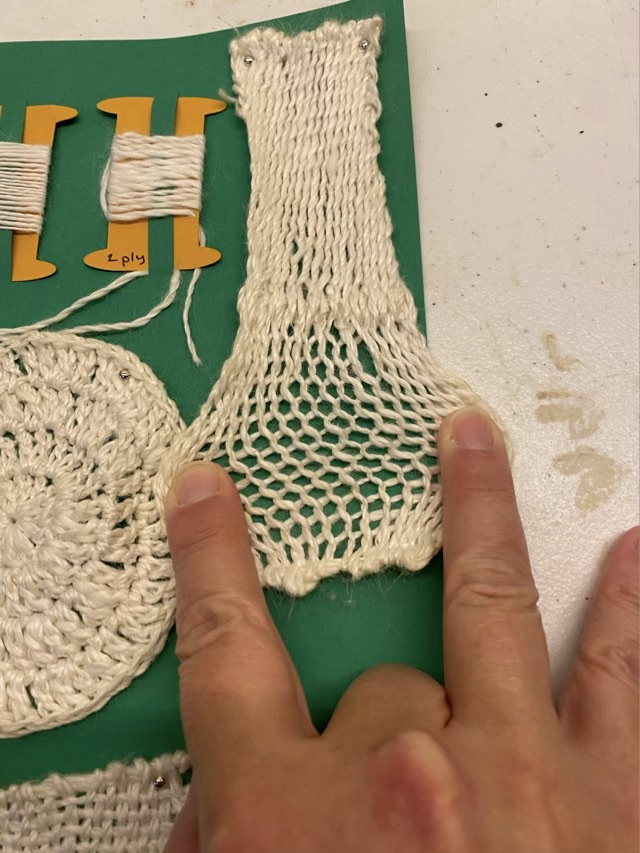
I made unadorned swatches to show the texture in the yarn that was also a result of the variations in thickness. My sprang swatch blocked well and has a lovely horizontal stretch.

Photo description: sprang swatch held expanded with my fingers to show the interlinking between the strands

I would absolutely spin banana fiber again, but I think next time, I would spin thin.

Cat dog

This is what you get when a dog is raised around cats. Missy the dog is playing with a cat toy in a pile of gift bags.

Photo description: small black dog on a pile of non-woven cloth gift bags, with a stuffed fish toy in her mouth

I did try to get a video. As soon as Missy noticed my attention, she stopped playing. I’ll have to be more sly.

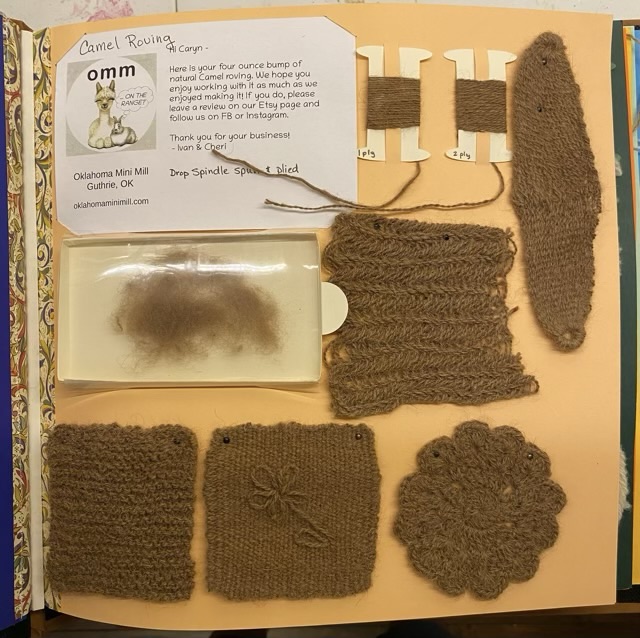
Fiber Study: Camel roving

Photo description: fiber study page for camel roving from Oklahoma Mini Mill, (counterclockwise) with a card from the mill, a sample of roving, knit swatch, woven swatch with embroidery, crocheted round swatch, nålbound swatch, sprang swatch, two ply on a paper bobbin, and single ply on a paper bobbin

I assembled my camel roving fiber page! I quite like camel fiber; it is nice to spin, and soft. I would definitely work with the fiber again. In fact, I have two and a half balls of 2-ply yarn with which to plan a project. Exciting. I have also decided to add a synopsis of my blog posts about the fiber to the pages, so I can remember how I felt about the fiber. Now to figure out how to attach the printed pages. I tried some washi tape, which surprisingly doesn’t like card stock much. Hm.

Photo description: same page with the swatches lifted to reveal the hand written descriptions

The roving sample isn’t as perfect as it came from the mill; I liked spinning so much I forgot to leave a bit unspun. The fiber in the box was spun, and then I brushed it back open. Oops.