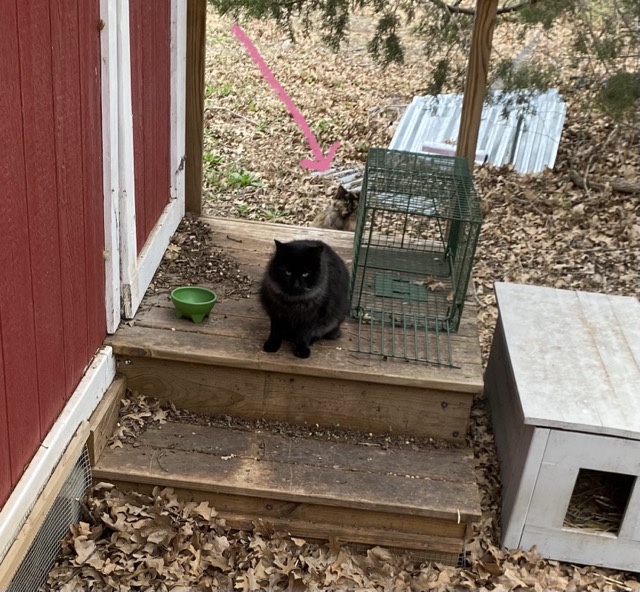
When Mr Tom and Shadow showed up for treats (OK, Shadow comes for treats, Mr Tom comes to get brushed and de-burred), Momma cat was right behind them! She has a pink arrow in the picture pointing her out behind Shadow.
Momma cat behind Shadow
She was too skittish to eat a treat while I was there. I have the camera up, but the SD card is glitchy, so I only get a live feed, no scrolling backward through time. Still, the food I’ve put in the back of the cage has been consumed, so I hope all this will help to catch her so she can be fixed.
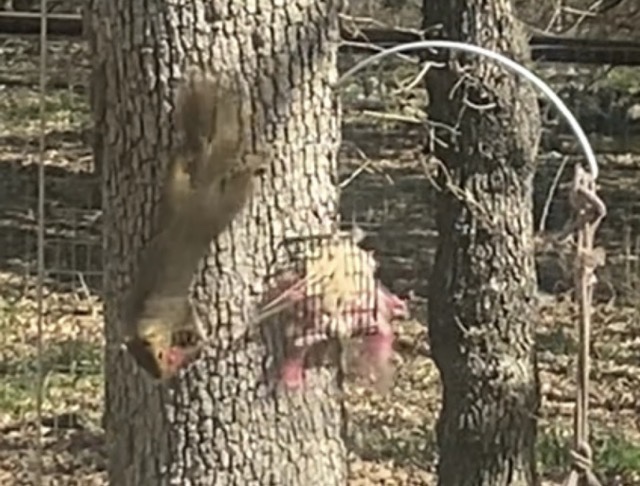
The suet cages I filled with scraps of wool are getting some attention. I caught one of the local squirrels gathering up the fiber and managed to record some video.
Video still of a squirrel wool gathering
Squirrels have kits twice a year, so I imagine this is Momma squirrel lining her nest for the impending babies. Or maybe a secondary nest construction, I’ve read squirrels can built multiple nests. Either way , I’m glad the unspun fiber is an approved squirrel material.
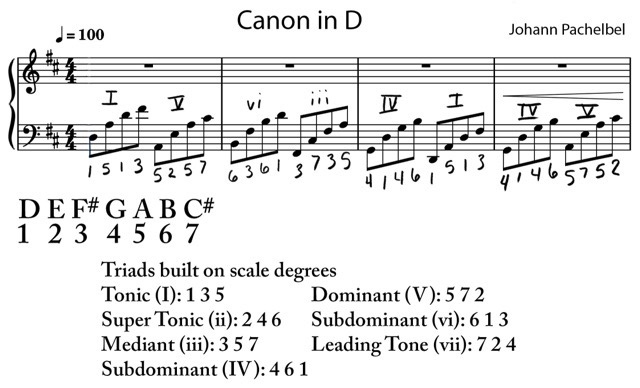
I know this is a craft and critters blog, but I’m going to sneak in a music post. I’ve started singing with a women’s barbershop chorus, and I’ve been learning about barbershop chords. Actually, before I get into barbershop chords, I need to learn about triads, or chords with three notes. It is amazing how complicated things sound when you combine two languages and two numerical systems. I was awash in Roman numerals, and tonics and subdominants until I wrote it all down. My first attempt, I used the note letter names (ABCDEFG), which did not help my chord understanding. Then I was told about numbering the scale. Lightbulb moment. In the image below I have labeled and laid out the chord progressions in the first four measures of “Canon in D” by Pachelbel. The D scale is under the music notes, labeled with numbers 1-7. Triads built on scale degrees is another way to say “the three note chords that go with the scale”. Musicians use Roman numerals for these chords, which correspond to the numbered scale. Oh. One, four, and five are capitalized in Roman numerals because these are important chords in the progression. Oh! Chord progressions make the song interesting to listen to. Familiar chord progressions make songs easier to sing along with. OH!
Canon in D by Pachelbel with chord progressions labeled
Thinking of the notes as numbers on a scale, rather than by the alphabetical name also makes it easier to change the key. I’ve been practicing Canon in D, but in the key of C on my Kalimba, which has the keys helpfully numbered as well as named.
My laser printer died years ago, but I still have a stack of transfer paper (think temporary tattoos, or candle decals, I used it for fusing iron oxide to glass, but they don’t make toner like that anymore), so I thought I would see what happened if I put it through my inkjet printer.
Inkjet print on transfer paper designed for a laser printer
First, the ink puddled after printing, separating up into bumps and changing the texture of the print. Now this looked really cool on the octopus, but made other prints just look muddy. Second, the ink didn’t dry, even after using a hair dryer. Well, could I transfer the print anyway? Maybe just pressing the wet ink against a surface?
Transferring the ink to skin by pressing
Instead of wetting the backing and sliding off the decal, I just pressed it against my skin to see what would happen. The transfer wasn’t fantastic, but it was interesting, until I touched it.
Ink rubs off skin (photo credit to my eldest)
The ink didn’t stay on my skin either, well, part of it did, but a good portion easily rubbed off and gave me dirty fingers. That won’t do either. So no printing on designated laser paper with an inkjet printer, at least not without more investigation into print density and drying methods. Yup, that is where I’m leaving this post. Not everything I attempt works, which is OK because there is still data gleaned and learning occurring.
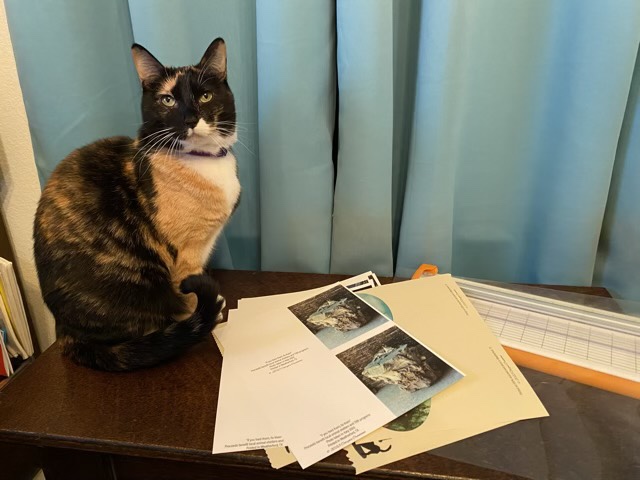
I’ve been making up greeting cards to sell at our local coffee shop: The Full Cup in Weatherford, TX. I have two lines: my little truck paintings, and cat photos. The cat photos are printed on 30% recycled linen paper and depict mostly feral cats that have been part of a TNR (Trap Neuter Return) program. Three are cats I have personally seen through the process, and several more are cats in Italy from when I visited in 2003. In Italy cats are protected by law. Colonies are registered and it is illegal to remove a cat from where it has chosen to live. They even have government funded neutering programs, which here we call TNR. Part of the proceeds from selling these cards will go to our local TNR programs.



 Critters and Craft