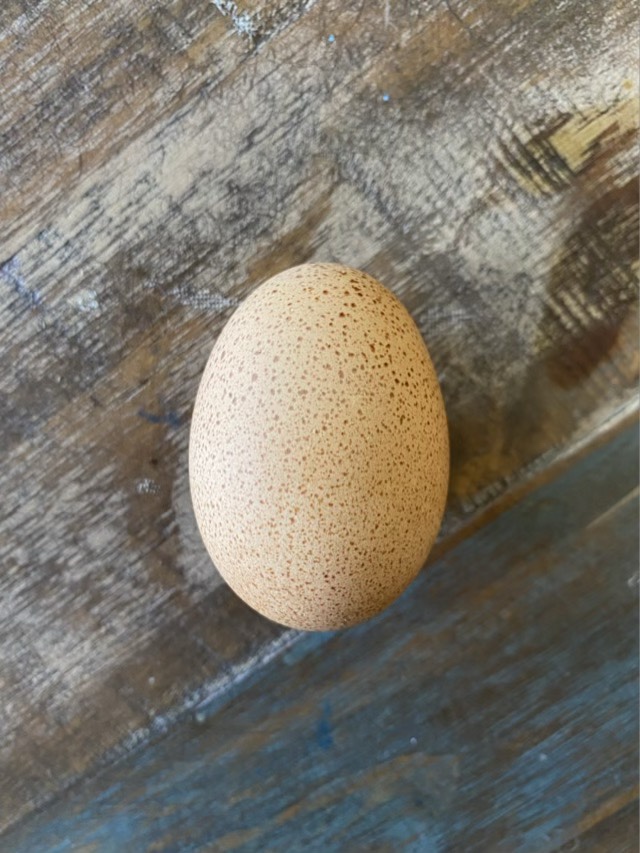
Speckled egg from my hatchery quality Salmon Faverolle hen
Faverolle hens are suppose to lay pink eggs. The “pink” comes from a white coating over the brown coating, as far as I can tell from personal observation. Some of my hens lay these pink eggs, some lay brown eggs, and one lays these speckled brown eggs. The speckles are always different, and definitely not consistent, but they are my favorite. Especially when they have a beautiful speckle pattern like the one pictured above. Since I don’t plan on ever showing my chickens, the “hatchery quality” doesn’t bother me. I did luck out that their temperament is consistent with the breed, and the variation in egg color is a bonus.
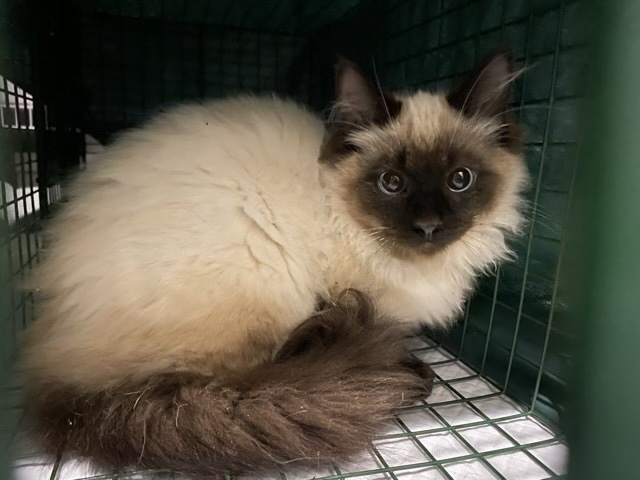
Look at this cutie, who is part of the colony next door. This photo is prior to the surgery to get the cat fixed, now the cat is sporting an ear notch to show there is no danger of this one contributing to additional colony numbers. Not sure where the point genes came from, since there are three other cats of the same age (so I assume are from the same litter) who are torti and orange. So I had to look it up. The “points” are a result of temperature dependent albinism. “A Seal point cat is actually a black cat with the Himalayan mutation altering how the melanin is developed and displayed”. (https://vibesfromaveterinarynurse.com/2018/05/03/siamese-genetics/) So Mr Tom is a flame point, which is an orange cat with the Himalayan mutation. Neat. And explains how you can have tortious shells, blacks, oranges, and points in a single related colony.
I made pies in honor of pi day (at the insistence of my youngest, although it wasn’t a hard sell). My favorite crust recipe is the Featherlight Vinegar Pastry from The Gluten-Free Gourmet Cooks Comfort Foods, by Bette Hagman. She uses her own “Featherlite” flour mix, but I’ve found King Arthur’s Measure-to-Measure flour is very similar and works well.
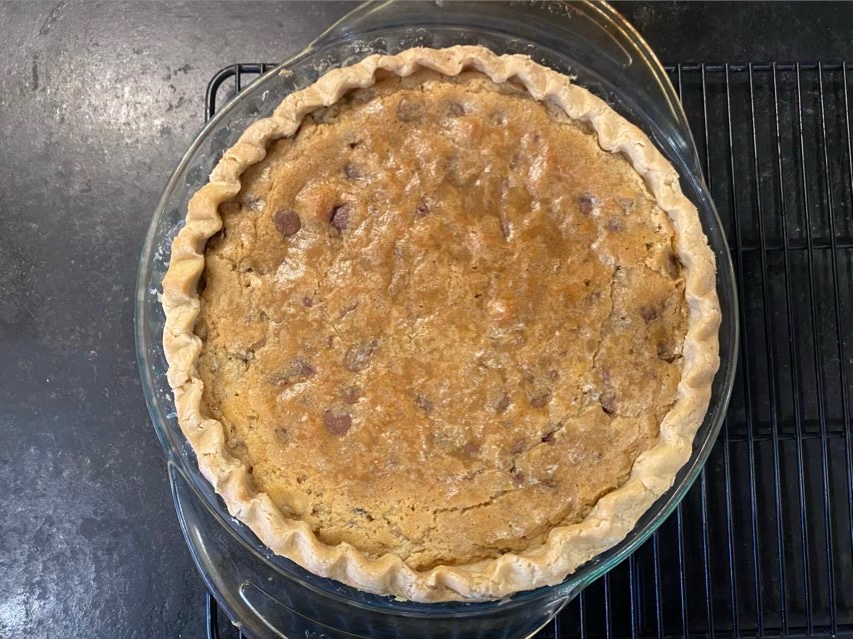
Chocolate Chip Pie
The crust recipe is for 2 crusts, so I used the first for my youngest’s favorite: Chocolate Chip Pie. I use this recipe, which is awesome as is. Either Gluten-Free flour or Heritage Wheat Flour work fine for the added flour.
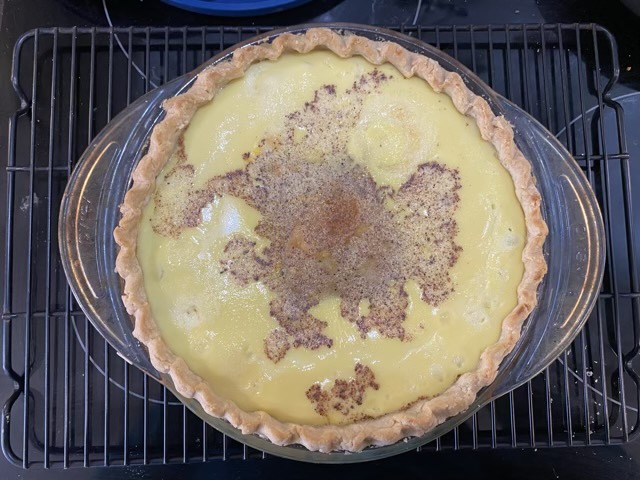
Custard pie
The second crust I blind-baked with pastry weights, but made the mistake of removing the weights and cooking it a little longer. It puffed up and cracked. Ugh. Here is a good site for crust crack issues, especially creating a spackle for cracks and using an egg wash to keep the filling from seeping. The recipe I used for the custard was easy and tasted good is from The Better Homes and Gardens New Cook Book. I won’t put the nutmeg on top before baking, as in the instructions, because it did strange things to the surface. I don’t know why I don’t make this more often, though. Yum.
Happy Pi Day! And yes, my pies are round. I also scheduled the post for 3-14 1:59, which makes me happy.
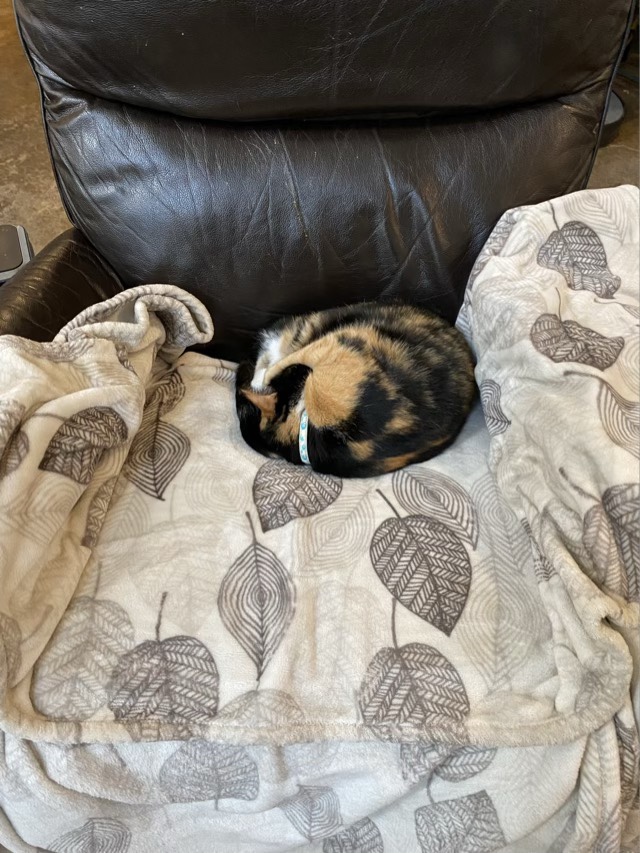
I have been trained well. I put the fuzzy blanket back on my chair (excuse me, the cat’s seat) when I get up so she can get comfortable. The problem comes when I come back. She allows me to pick her up with the blanket and settle her back on my lap, but then unfolding the blanket is awkward and she leaves. I have found a solution.
Step 1: Blanket placed on the chair with the edge accessible
If I place the blanket folded roughly in half, with the edge forward, I can slide my arms under the first layer, pick up the cat, sit back down on my chair, get the blanket spread on my legs and the cat settled on my lap with minimal fuss.
Step 2: Cat in place on seatStep 3: Cat transferred to lap and legs covered with the blanket
I made up another batch of student spindles. These are made from dowels, wooden toy wheels, and cup hooks. The only thing I work on is the dowel; shaping the top to friction fit the wheel, drilling a pilot hole for the cup hook, and this time, shaping a head on the other end so the whole thing can be flipped and used as a bottom whorl spindle or a top whorl spindle. Oh, I did also put a notch in the wheel because I read that helps beginning spinners, but my first student using one of these didn’t need it. Maybe another will.
New student spindles (right) versus my first handmade top whorl spindle (left)
The student spindles weigh in at under an ounce, which is much nicer than the behemoth top whorl spindle I made the first go round with a post oak whorl that tips the scales over two ounces.
I keep a stash of these spindles so that if I encounter someone that shows interest in learning to spin, I have something they can practice with right away.




 Critters and Craft