I’ve started taking my good camera with me on my morning walks again. It is a clunker, but my phone camera just isn’t up to the task of capturing anything much at a distance. Also, because of the pandemic, my walks are now close to home, which, in my past mind, isn’t near as full of potential wildlife photos as my trail walks. So it is the first day walking with my camera again, and there are some pretty things, but nothing worth making the dog stop (he is good about stopping and waiting, but he gives me a look). We are almost back home when a flock of snowy egrets glides overhead. It was stunning. They flew just over the tree tops and the sky was filled with the gleam of their white bodies reflecting the pink of the sunrise and beautifully set off by the blue sky with just whispers of clouds. I stood there staring up in wonder… with my camera hanging around my neck. I woke up and lifted the camera and managed one picture of their retreating flight. So this is what I give to you today, with words so that you might be able to picture in your own mind the splendor of standing under as they glided past.
When learning a new craft, the initial pieces are usually… well, let’s just say wonky. The value in these works is what we learn from making them, even if they aren’t aesthetically pleasing. Although I wasn’t enamored with weaving at the beginning (as I completely was with spinning), it is apparently going to wiggle its way into my life because I can’t get it out of my mind. I do not have the money or floor space for a large fancy loom, or even a medium one, but I do have many sticks. I found references to back strap looms, which are used throughout the world to make intricate and beautiful textiles. With sticks. And string.
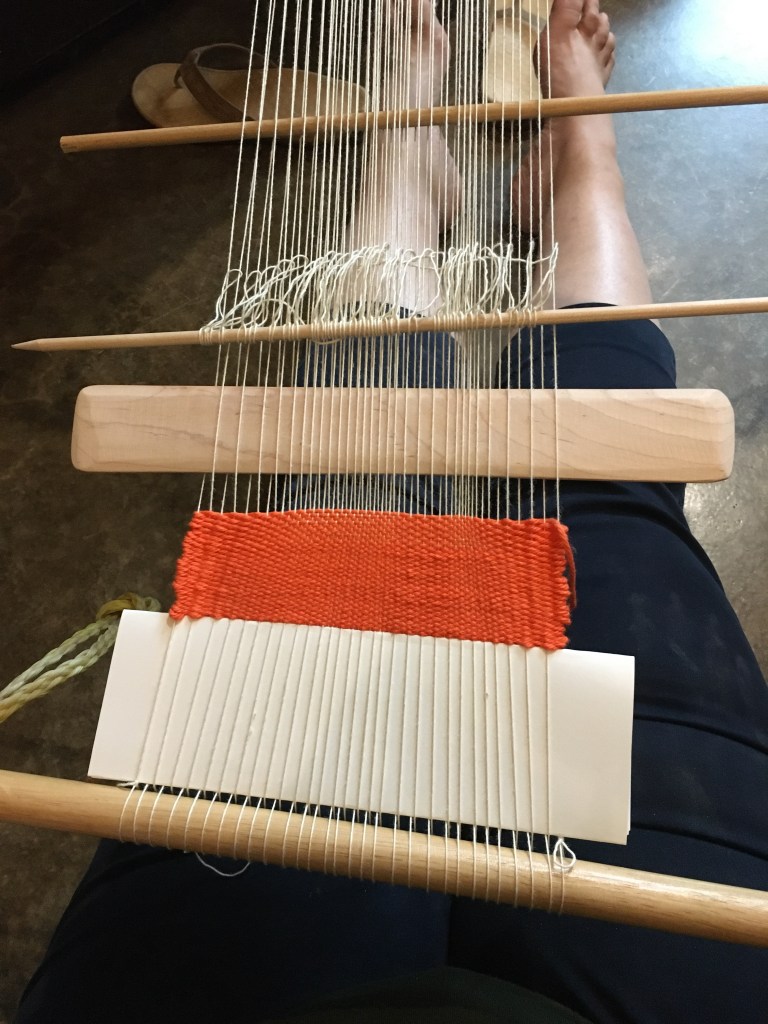
Initial test setup of a back strap loom
The back strap goes around the weaver’s hips, and the other end is secured to a stationary object, or the weaver’s feet. I had some dowels taken from a recycled toy rack, and some nylon rope in the garage, so I grabbed those, then gathered smaller dowels in my craft room, a piece of fabric for a back strap, and yarn. The only thing I made was a beater stick, which I cut from some 1/8” maple I had in my wood bin.
Attempted weaving, very wonky
My first attempt was confounding. I use online resources, videos, and pictures, and I’m not sure why my middle is tight and the edges are loose. What I did learn, though, is how to make a continuous string heddle stick, which lifts opposite warp threads than the shed stick, and makes weaving much faster as you don’t have to pick up warp threads on the back pass each time. This knowledge was completely worth the wonkiness. I decided to try again.
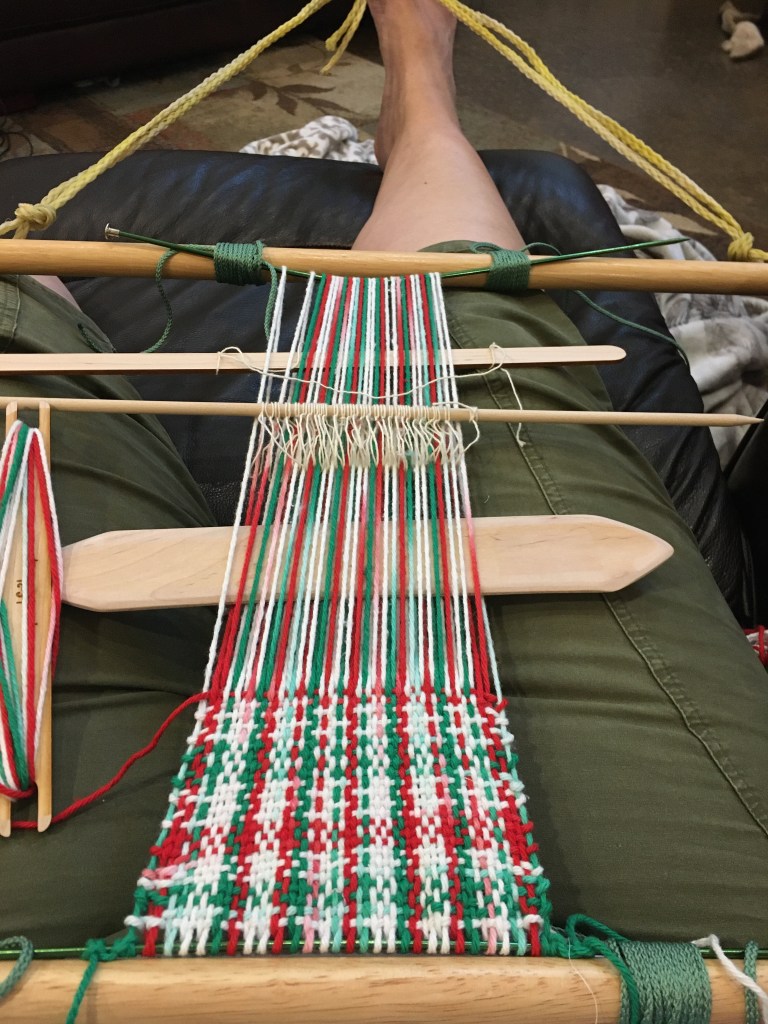
Second attempt at weaving with a back strap loom
With my second attempt I set up the warp with the same yarn as I wanted for the weft, and I used my foot for tension. (Because I am not used to sitting on the floor and it hurts, setting up this way lets me sit in my recliner. Cushy!) I also refined my sticks and used some knitting needles to hold the warp. What I learned this time was that the knitting needles are aluminium, not steel as suggested in the tutorial, and my tension may be a problem as I bent the needle on the far end. Oops. I also learned that all yarn is not created equal. The string I used for the warp and heddle the first time slid back and forth just fine. Sliding the heddle string along this different warp yarn felted the heddle and the warp together, making it inoperable.
Heddle string and warp yarn felted together
I shall try again, maybe after looking at some more pictures and videos.
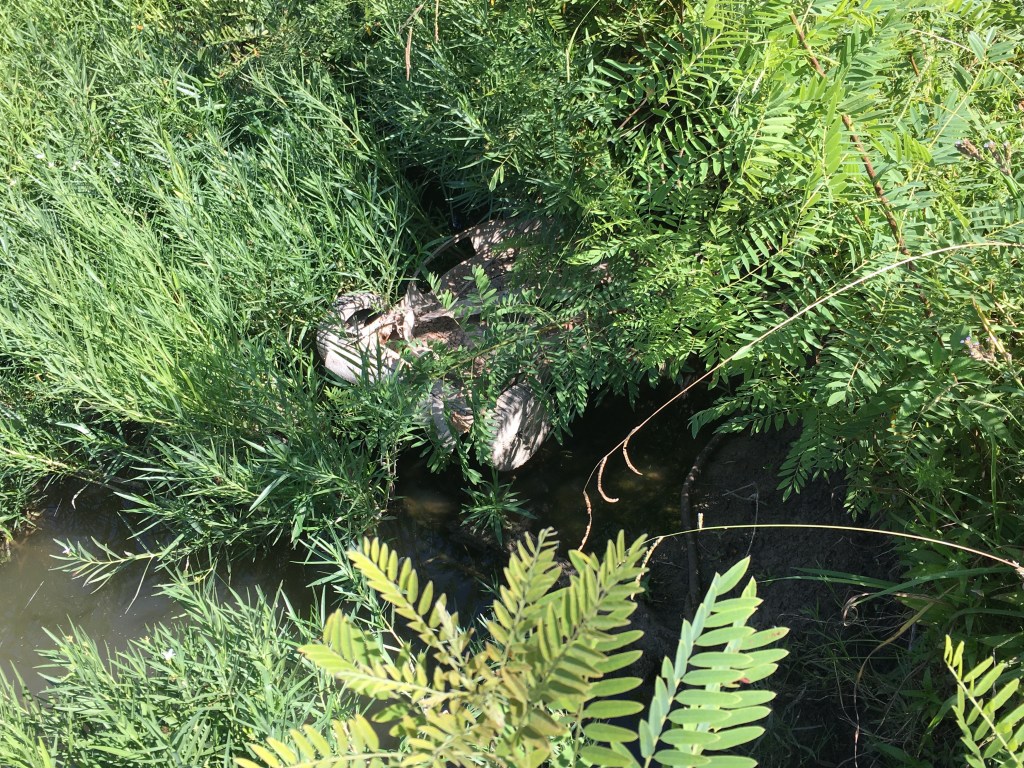
Today I give you the lawn mower surrender. I don’t know if some poor soul actually thought he could mow the growth at the lake side and the vegetation rose up for a hostile take over, or if a non- environmentalist was sick of mowing and she chucked it in the drink. Or maybe it was a fast and furious lawn mower race with an epic three mower crash and it spun off into the water while the sodden jockey pulled himself from the mud, leaving only bubbles behind. Who knows? It was visible at a local fishing hole because the water line is low. I thought it a compelling juxtaposition. (It was too far into the muck to safely remove from the lake. When the water line rises again, it will probably catch hooks and the vegetation be blamed. The reeds will probably snicker. So will the fish.)
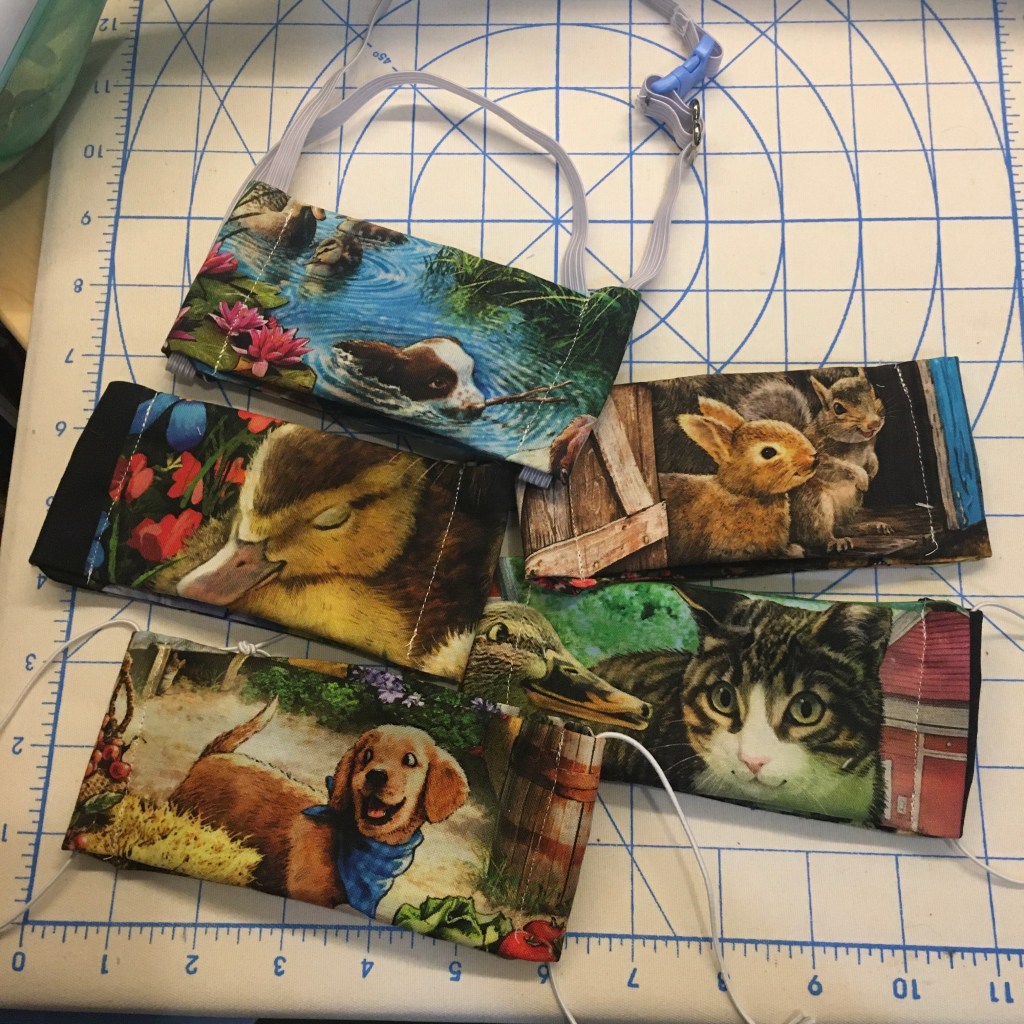
I found some cute barnyard animal panel fabric (large images printed on fabric rather than a smaller repeating pattern) at my local quilting store. I was trying to find fabric for masks for my nephew (this is not a quilting store that sells PawPatrol) and thought it might work with some fussy cuts. In quilting, a fussy cut is one where a piece is cut to capture a pattern or image in a certain way, rather than to maximize fabric usage. It usually leaves quite a bit of waste fabric, and making masks is no exception! Still, I was able to eek out five nicely composed kid-sized masks. It was an interesting experiment, but had too much waste for regular production.
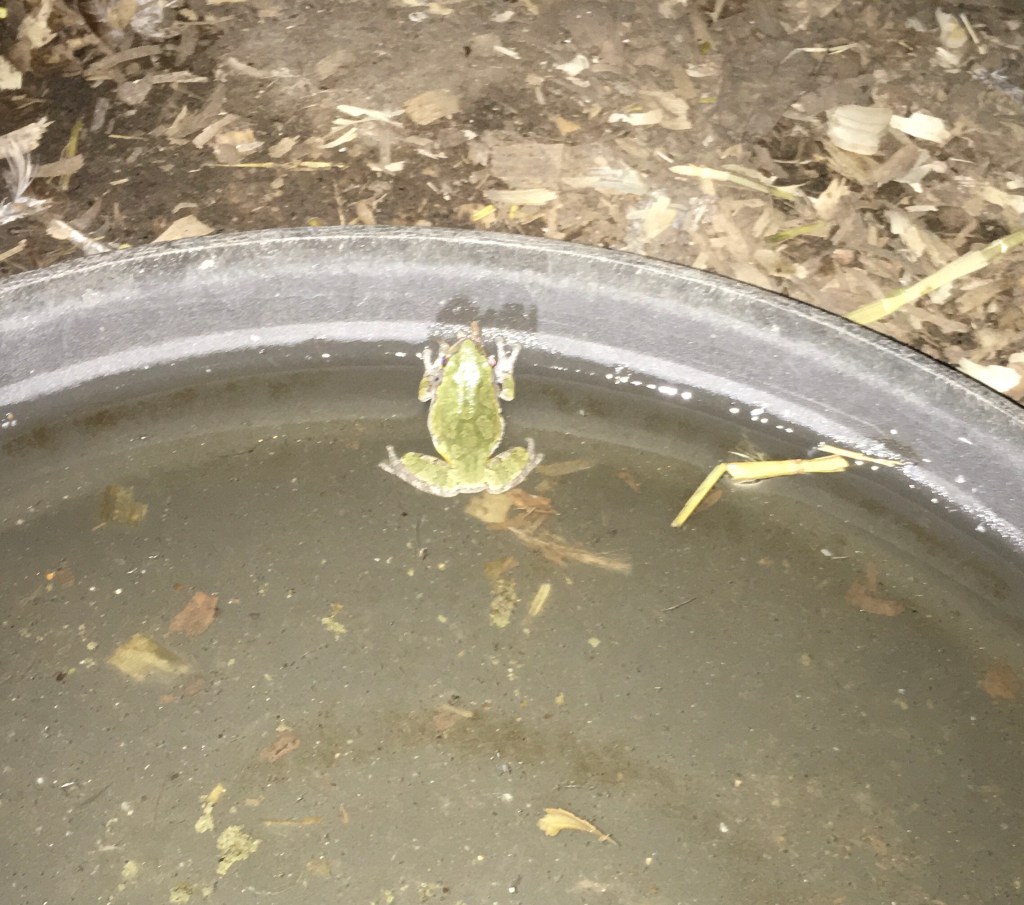
I usually close up the coop before bed and clean out the foot baths one more time so they are fresh in the morning. This little frog looked so comfy in his soak, I didn’t have the heart to dump him out. It has been so dry here, he was probably through the moon to find a “puddle”. He better skedaddle in the morning, though. He is about the size of a cicada, and the chickens make short work of cicadas. Taking pictures with a phone flash in the dark is not the best conditions for a good picture, but at least the subject is recognizable.




 Critters and Craft