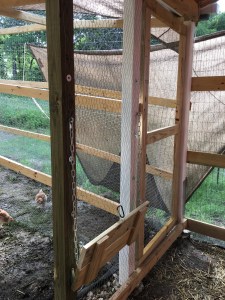
I made the first chicken run door and we put it up! It made doing health checks easier because after we checked weight, vent, and feet, we could separate the chickens who had been checked from those who hadn’t.
Door for run installed
I’ll spread some more seed in the area and we will keep this door closed for a couple weeks to let the seed sprout. Eventually I’ll have three runs, once I get the other doors done.
We have darkling beetles, and it is a happy thing!
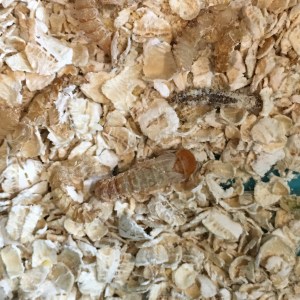
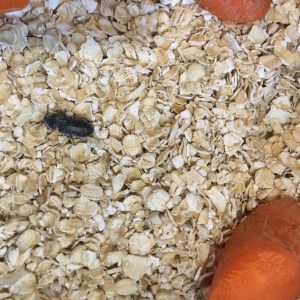
Some of the mealworm pupa have emerged as adult darkling beetles, which means we are well on our way to having our own mealworm farm.
I did put mesh screen on top of the beetle drawer, as well as the mesh on the bottom so the eggs can fall through to the drawer below. I wanted one extra precaution to keep the beetles from escaping. They are pretty chill beetles, really. Not very fast, like to dig down into the oatmeal and hide in the dark. I also had to hot glue in the mesh at the bottom because the little critters could crawl under the mesh. Oops.
We’ll see in a few weeks if any eggs hatch in the drawer below! We are switching drawers every two weeks. We have 8 drawers and the life cycle to pupa can be 10 weeks, so each drawer should collect eggs for a little over 2 weeks for us to have a near continuous supply of mealworms for the chickens.
Darkling beetle emerging from pupa shellNewly emerged beetleDarkling beetle
My young chickens are panting. The “feels like” temperature has been regularly reaching the 100s in the afternoon here. Their coop today was 88 (which is at least cooler than the 94 actual temperature outside the coop). There is a fan in the coop (which I regularly dust to remove buildup). I put out ice water foot baths (which my chickens love). I give them watermelon straight from the fridge.
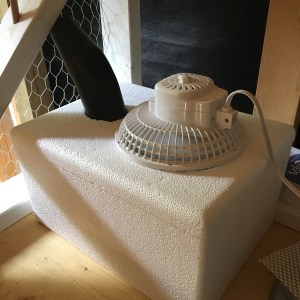
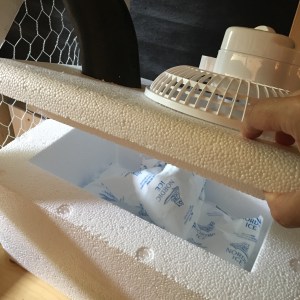
My Mom mentioned a DIY project using a fan and a styrofoam cooler to make an air conditioner. I did it. I had a styrofoam cooler from a medicine delivery, used an extra accessory for our shopvac as the air outport, and bought an inexpensive clip-on corded fan for the air intake.
Styrofoam cooler DIY air conditioner
I cut holes in the cooler to fit the tube and fan (here is a decent youtube tutorial), and put ice packs (also from the medicine delivery) in the cooler.
Ice packs in the cooler
I could definitely feel the cool air when I turned on the fan! I started with the cooler in the enclosed section of the work table in the coop, so the chickens couldn’t pick at the styrofoam, but felt like the cool didn’t reach the chickens. So I put the the cooler in a plastic storage bin (it fit! Phew!), which has a fold down, two-part lid.
Plastic bin for chicken protection
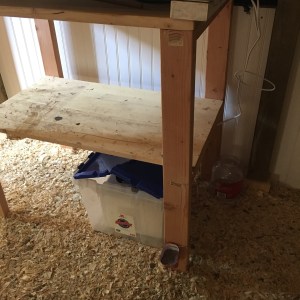
Sliding the plastic bin under the work table keeps the chickens out, and off, but allows the cool air to blow near ground/chicken level.
Cooler plastic bin tucked under the work table
The chickens were all lined up in front of the cooler, so I think they appreciated the relief. It certainly didn’t lower the temperature of the whole coop, but just made an area of slightly cooler air.
So I have been labeling all my YouTube videos with “chicks”. Now that they are fully feathered, I am labelling them “pullets”, except I’m not so sure they are all pullets. I took a picture of Seashell and Tigger on the chicken swing together and I think that Seashell may be a cockerel (male chicken under one year old), not a pullet (female chicken under one year old). Seashell is developing black feathers under his (?) chin, much like adult Faverolle roosters.
My young chickens (sitting on a swing…)Picture of adult Faverolles from a French Faverolle club site
So there is a debate in the household on chicken names. My eldest would like the cockerel we keep (oh yes, it looks like if there is one, there are maybe 3 or 4) to be named Cockatrice. My husband thinks it would be funnier for the blog to have a rooster named Seashell. Maybe when we know for sure, we’ll do a poll.
Ugh. There are cockroaches in the coop. I saw a couple when I opened the cabinet doors, then I found some in the chickens feeder that got stuck and couldn’t get out of the smooth curved walls of the feeder. I captured them and fed them to the chicks (yes! I did!). I spread some diatomaceous earth on the floor of the food cabinet and some more throughout the coop, then started researching what to do about cockroaches.
A couple different bloggers capture the cockroaches in glass jars and then in the morning, let them loose for the chickens. Rather than spray pesticides, we decided to give this a try. We had an empty dog treat jar, plastic instead of glass, but with curved sides at the top of the jar. We put some chicken feed in the bottom, and put it on the floor of the coop.
It worked! The next morning there was a trapped cockroach inside the jar.
I took the jar out to the runs (with the chickens close to my heels), turned it loose out in the open, and a chick caught it! Yay! It was incredibly satisfying watching the chicks devour that insect!





 Critters and Craft