No outside work today; the forecast said rain all day and it was right this time. So I broke down and cleaned up my craft space. It was better than cleaning the rest of the house! (Or folding laundry, ugh.)
I think I mentioned that I am easily distracted? Cleaning the craft area involved quite a bit of “I forgot I started this!” And “How can I fix this?” The wooden model now has a functioning hand again, I rearranged several boxes of supplies so I could get one more box on the shelves, and I found enough bits and bobs to make a new light for the space.
It is this last one that particularly pleases me. I had a shelf standard leftover from the last house (a poor single standard all by its lonesome, aw), and I had leftover LED strip lights and (amazingly) all the parts to make it work, so I lined the inside of the standard with the sticky LED tape, screwed in a bracket for it to sit on, and now I have lovely light all across my standing bench! Hurray! I love LED lighting.
LED strip lighting lining the inside of a shelf standard
Craft area ready with new light!
P.S. Though I love the sticky LED strips, they don’t stick as well as I think they should. After having the tape snake down three times, I finally took some hot glue to the sucker. Love hot glue.
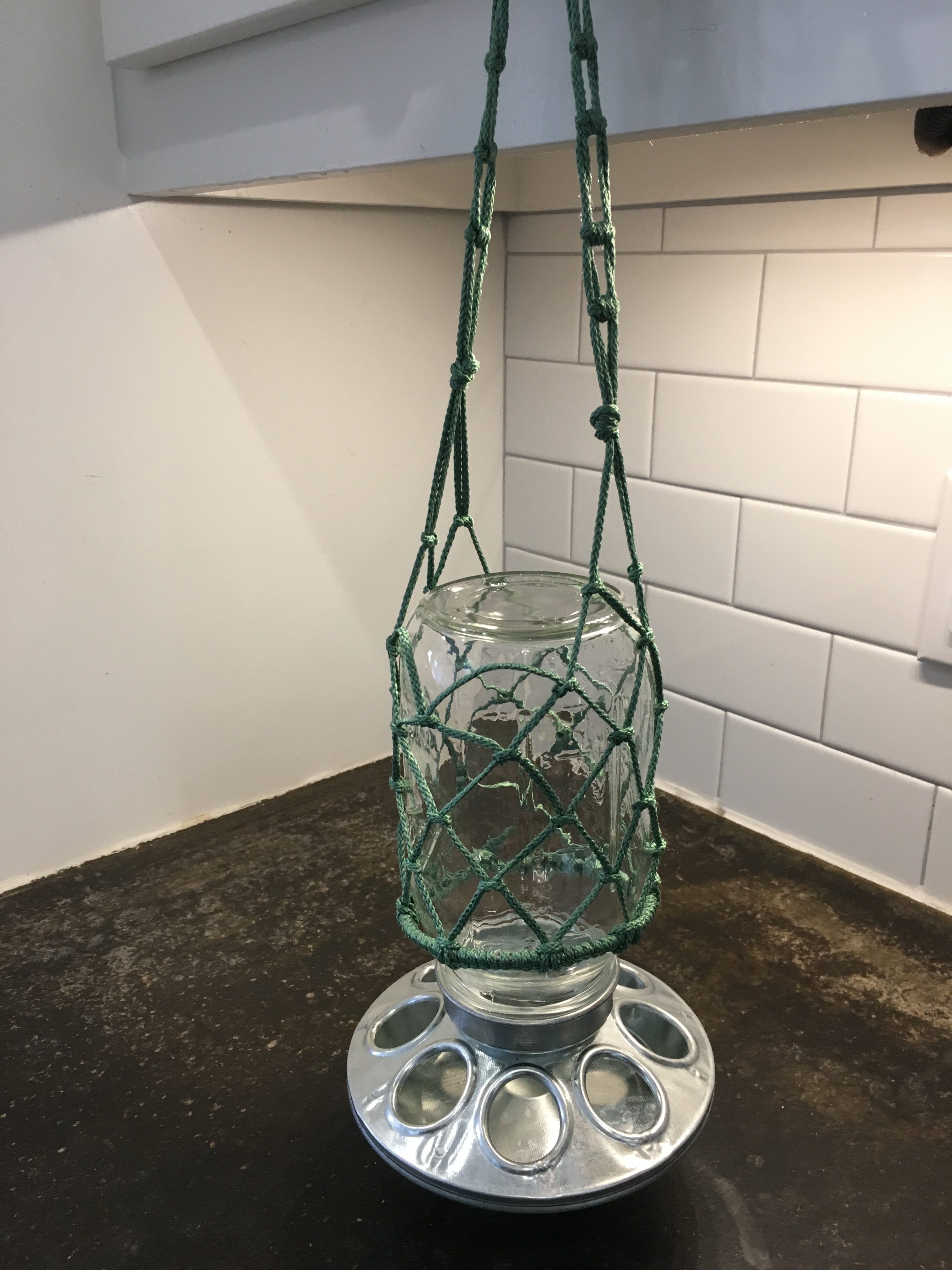
I’ve been reading up on how to feed and water chicks, and all the many different methods available! I’ve read that keeping the feeder at the chick back height is important, and one of my favorite suggestions was to use hanging feeders so the chicks can’t knock them over. Most hanging feeders are designed for wild birds and can get quite expensive (especially if you need 4!) So I came up with my own design for hanging regular, inexpensive chick feeders and waterers using the bases designed to screw onto quart Mason jars. I’m planning on using an old wire dog crate as my brooder, so hanging things from the top of the crate will be quite easy.
I was not able to find the exact instructions I wanted, so I combined a few different techniques. I used a steel ring so the jar could not slip through, made a wrap for the steel ring to protect the jar from bumps, a net around the jar, and “ladder” straps so I could easily adjust the height at which the feeder would hang.
I have written up instructions below, and have also done a “speedy” video for the curious with short attention spans. (My eldest said the video should be 30 seconds. I couldn’t quite get it that short, but I managed to get it down to 5 minutes. It goes fast, but is kind of neat to watch at super speed.)
Here is the materials list: Metal Chick Feeder Base (usually available at the local feed store) Quart Mason Jar (also available at the feed store, or at the grocery store) 4 inch Steel ring (you can pick these up in the macrame section of the craft store) 40 feet of craft rope (the kind used for macrame, also available at the craft store, usually for about $5 for 100 yards) S-hook or carabiner to use to hang the feeder
Instructions: Cut 20 feet of craft rope and seal the ends by melting them (I use a lighted match, but lighters work as well). Cut four 5 foot sections of rope and seal the ends.
Covering the ring: Wrap the 20′ section of rope into a center pull bundle by leaving about 12″ hanging and wrapping the rest around three fingers until there is 12″ left. Use the tail to wrap the bundle and tuck the end through the wraps. Use an overhand knot to tie the rope onto the ring, leaving about 4″ of tail. Then use half-hitches to cover the ring; remember to go over the tail as well to keep it in place.
Making the net: Using cow hitch knots (also called larks head), make 7 even loops around the ring. Use an odd number of loops to make it easy to go to the next row. When you have completed the base row, continue to make cow hitch knots in each loop, making sure to keep the loop lengths even and pulling the knots tight. When you have reached the bottom of the jar, use a few half hitches to secure the end of the rope.
Making the adjustable straps: (This is similar to making a rope ladder.) Choose two opposite pairs of loops on the bottom of the net, and attach one 5 foot section of rope to each loop by folding the rope in half and using the larks head knot. Take two ropes (four strands) and tie them together with an over hand knot. Take one of the left strands under two strands to the right, over two to the left, under the third on the left, and back across the top of the other three strands to the right. Then take one of the right strings and wrap it around the outside of the rung you just made. Open the loop on the left and tuck the end of the rope through, and pull everything tight. On the next rung, use the two strands that did not get used on the previous rung. This will keep the rungs from being able to scrunch together. When you have done 10-11 rungs, about 1″ apart, tie the four strands together with an overhand knot. Do the same procedure on the ropes on the other side of the net. Cut and seal the excess rope. Use the rungs on the ladder to hang your feeder!
When it is cold and yucky outside, it isn’t hard for my youngest to convince me to make cookies. She was upset that there were no chocolate chips in the house, but agreed to make these pecan cookies, as long as hers didn’t have nuts. Oh well! The rest of us enjoy these yummy pecan cookies.
1 cup butter flavored Crisco 3/4 cup brown sugar 3/4 cup white sugar 1 tsp vanilla extract 2 eggs 2 1/2 cup King Arthur Gluten Free All Purpose Flour 1 tsp baking soda 1 1/2 cup chopped pecans
Preheat oven to 350 degrees F. Cream together Crisco and sugars. Add vanilla and eggs, mix until fluffy. Combine dry ingredients, slowly add to butter mixture. Stir in pecans. Hand roll 1 Tablespoon balls of dough and place 2″ apart on parchment paper on cookie sheets. Bake at 350 degrees F for 10-12 minutes until edges are golden. Let cool on sheet for 5 minutes, then transfer to a cooling rack.
My eldest gets the credit for the words for this meme. I took the picture on a walk in town (once again the elder buck was elusive). One squirrel was the only photographic harvest on that venture. But I’ve been eagerly looking for more signs of spring!
Shortly after we moved in, we found that we had nine-banded armadillos living in the yard. Pretty sure you can’t get much more Texas than that. (You actually can, but it is a start.) In the last couple of weeks I’ve started to see signs of their passing again: small shallow holes dug in the ground as they look for tasty insects. Armadillos are insectivores, and so are good to have around. Now they also carry leprosy, so are not good to touch or handle.
Confirmation of armadillo activity resuming
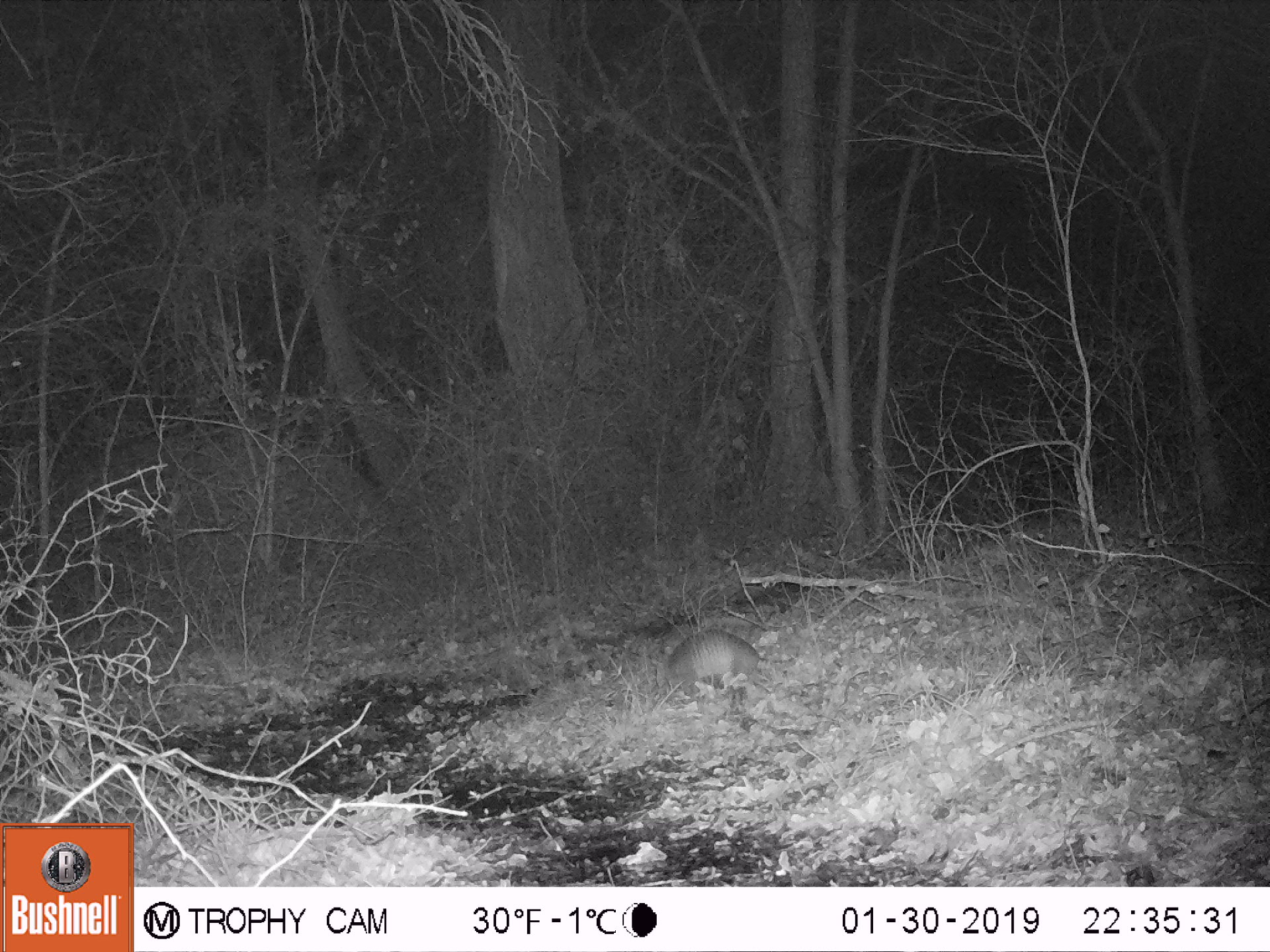
The armadillo babies are absolutely adorable to watch, though. Here is a picture from last year of one of the four babies. Armadillo females give birth to identical quadruplets. Every time. I’m really hoping to see a new litter this summer!
Baby armadillo trail cam picture
And those protective shells must protect some vulture gold, because those unfortunate enough to have a fatal encounter with a car attract vultures quickly and in mass. The vultures clean out everything but the shell.
Another plus, they don’t eat chicken! Finally something in the yard that won’t be after our future birds!






 Critters and Craft