Finger weaving

I’ve wanted to try finger weaving since I heard about it on a Sprang group (it was misidentified as Sprang). In Sprang, there are no weft threads, the vertical warp threads are overlapped consecutively. In finger weaving the warp threads become the weft threads, similar to braiding, but with more threads. I watched video after video before I found this video showing the weaving going out from the center, which made sense to me, and seemed balanced.

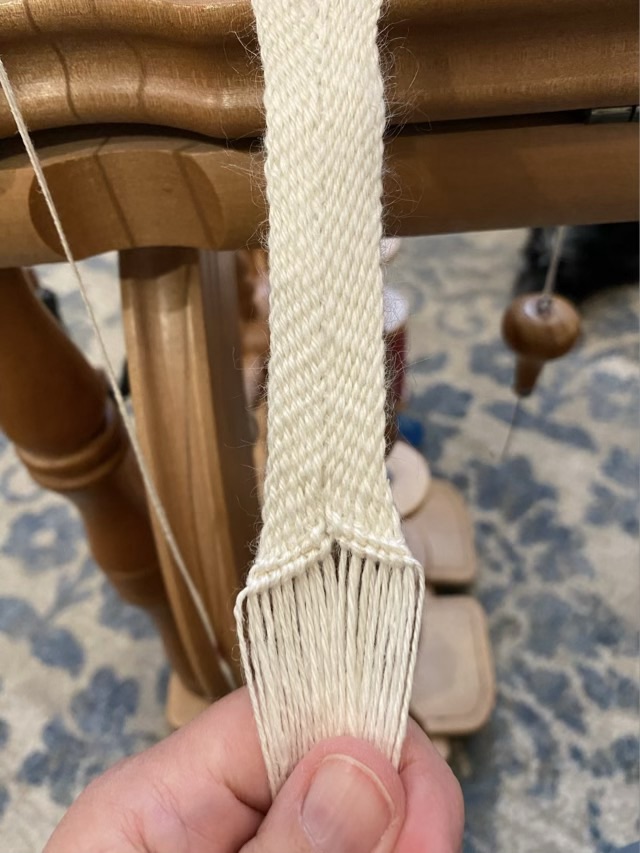
Photo description: start of a finger woven band made from hand spun Ramie four ply yarn, anchored on a bamboo skewer resting on a spinning wheel
Photo description: weaving continues, the characteristic chevron pattern emerging
Photo description: the end of the weaving secured with two rows of macrame knots

I wasn’t sure how to end the weaving, I’ve seen some bands just knotted at the end, but I want to put it in my fiber book, so the finish needed to be relatively flat. I opted to run two rows of double half hitch knots along the angles of the weave, which I think came out complimentary.

Photo description: back of the weave, showing the back of the knots and the sewn hem at the top

This was an interesting exercise, and finger weaving is a nice addition to my craft repertoire. It is nice that it can be done by anchoring one end, rather than needing a loom, and it comes out thinner and more flexible than macrame. It is more interesting with multiple colors.
Examining Chain-plied yarn

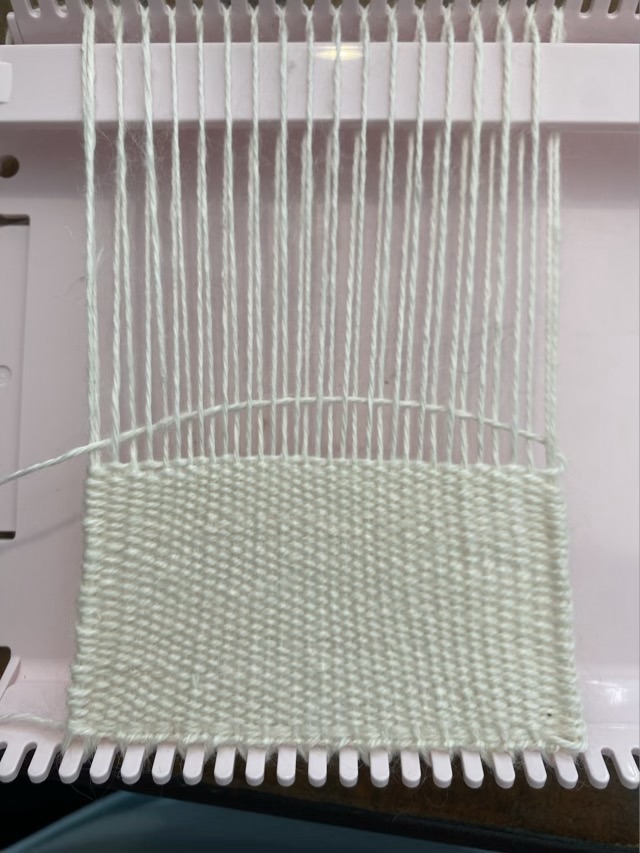
Chain-plying yarn takes a single spun yarn and makes a three ply yarn from one bobbin or ball. The spinner makes long chain links, like in crochet, but each chain can be the length of an arm. There is no waste as the yarn is always tripled to the end of the length. It is a very useful technique especially if the spinner wants to preserve a color gradient, or doesn’t want to waste any precious material dividing the ball into three and risking running out of one ball before the other two. It does leave its mark, though. Each chain has a bend of yarn, a hiccup in the twist of the ply. This is difficult to see in a finished piece, but in a half-woven swatch, the chain loop ends are more obvious in the warp.

Photo description: Ramie chain-plied yarn warped onto a Clover mini loom and done halfway in plain weave
Photo description: same picture, but with the visible chain bumps circled in blue, and one weaving error circled in red

These chain bumps are more of a concern if the weaver wants to leave a fringe. I wove in the ends and trimmed them. To fix the missed warp in the weave, I took a small piece of yarn and sewed it over the warp and tied it in the back.

Photo description: back of finished swatch showing trimmed ends and fixed warp
Photo description: front of swatch

The chain bumps are not readily visible in the end piece, but the edges are uneven, and I pushed the weft into the loops left by the loom, arcing the bottom of the swatch. Which is why I swatch, I learn so much from each piece.

Fiber Study: Banana

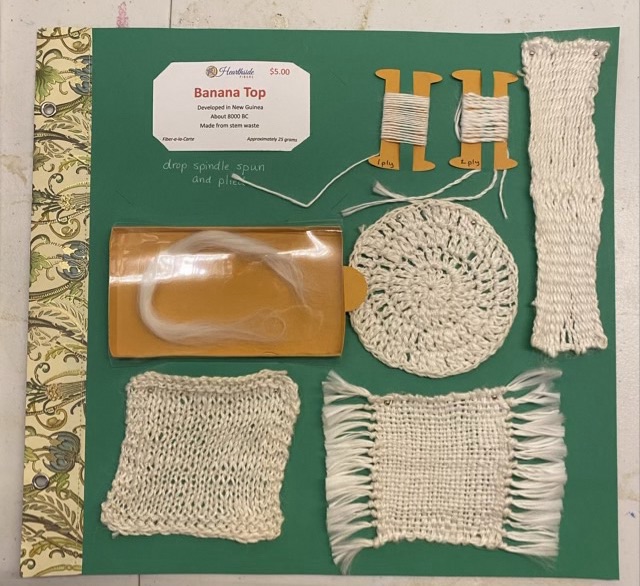
I assembled my banana fiber study page with yarn made from the stems of banana plants and purchased as combed top from Hearthside fibers.

Photo description: counterclockwise from top left: card from Hearthside fibers that reads “Banana top, Developed in New Guinea, about 8,000 BC, made from stem waste”, unspun fiber, knit swatch, woven swatch, crocheted swatch, sprang swatch, two ply yarn, and single ply yarn

Bananas are believed to have been first cultivated in New Guinea around 8,000 years ago and used for both fruit and fiber. The staple length of the combed top is long, about 8 inches, and the fiber is strong.

Photo description: banana combed top next to a ruler showing around an eight inch length

The fiber was pleasant to spin. I did challenge myself to spin thicker than my default spin, which resulted in more thickness variation, and also subsequently less length. I used up all my two ply yarn in my swatches, and had to piece together bits for my bobbin on the page because I forgot to set aside some at the beginning.

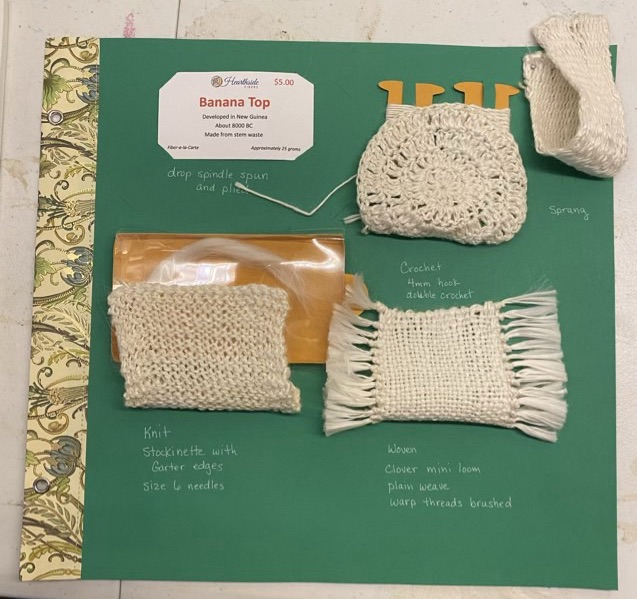
Photo description: same fiber page with the swatches flipped up to show the hand written descriptions

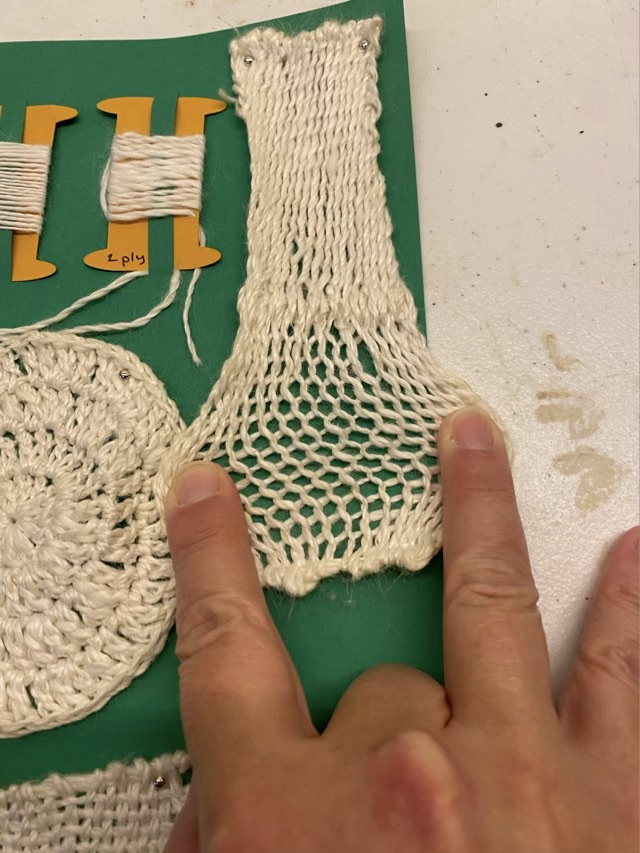
I made unadorned swatches to show the texture in the yarn that was also a result of the variations in thickness. My sprang swatch blocked well and has a lovely horizontal stretch.

Photo description: sprang swatch held expanded with my fingers to show the interlinking between the strands

I would absolutely spin banana fiber again, but I think next time, I would spin thin.

Fiber Study: Camel roving

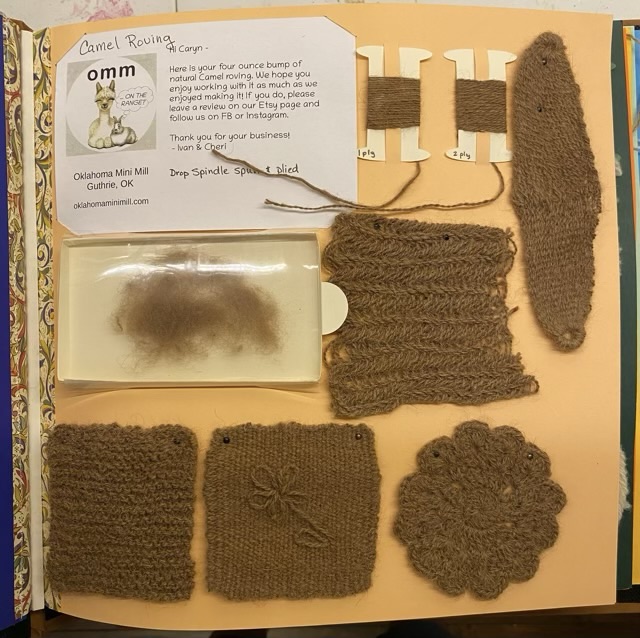
Photo description: fiber study page for camel roving from Oklahoma Mini Mill, (counterclockwise) with a card from the mill, a sample of roving, knit swatch, woven swatch with embroidery, crocheted round swatch, nålbound swatch, sprang swatch, two ply on a paper bobbin, and single ply on a paper bobbin

I assembled my camel roving fiber page! I quite like camel fiber; it is nice to spin, and soft. I would definitely work with the fiber again. In fact, I have two and a half balls of 2-ply yarn with which to plan a project. Exciting. I have also decided to add a synopsis of my blog posts about the fiber to the pages, so I can remember how I felt about the fiber. Now to figure out how to attach the printed pages. I tried some washi tape, which surprisingly doesn’t like card stock much. Hm.

Photo description: same page with the swatches lifted to reveal the hand written descriptions

The roving sample isn’t as perfect as it came from the mill; I liked spinning so much I forgot to leave a bit unspun. The fiber in the box was spun, and then I brushed it back open. Oops.

Weaving: camel

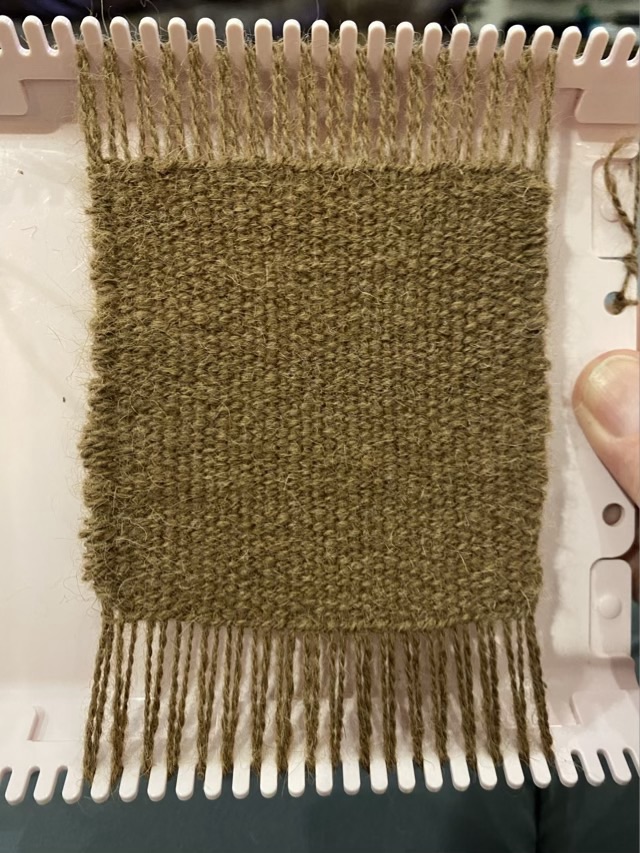
I used my Clover mini loom to weave a swatch of my two ply hand spun camel yarn. I like to double the warp and I chose a plain weave this time. I start and end my weaving with a twined row to help keep the ends in place.

Photo description: 2 ply camel yarn warped onto a Clover mini loom

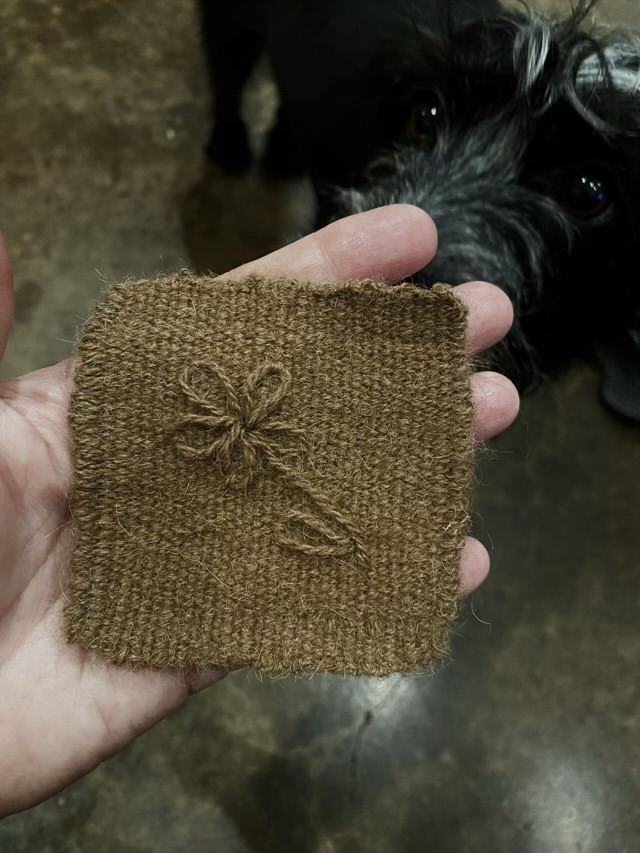
To finish, I used an embroidery needle to run the looped warp ends back through the weft on the back. I rather like the ribbed edge created by doing so. I added an embroidered daisy with a stem and leaf because the front looked rather plain. The daisy and leaf are done with a lazy daisy stitch, and the stem is a stem stitch, which amuses me.

Photo description: back of the small woven swatch showing the woven in loops and the back of the embroidery
Photo description: front of the small weaving swatch done in hand spun camel yarn with five petal daisy, stem, and leaf, Missy the dog looking on in the background

It is interesting that the color of the yarn looks different in each picture. In real life, the color is a soft brown quite like milk chocolate. I did try to color adjust the final picture. I suspect the radical difference in backgrounds is the primary suspect for the color shift.