Blocking transformation

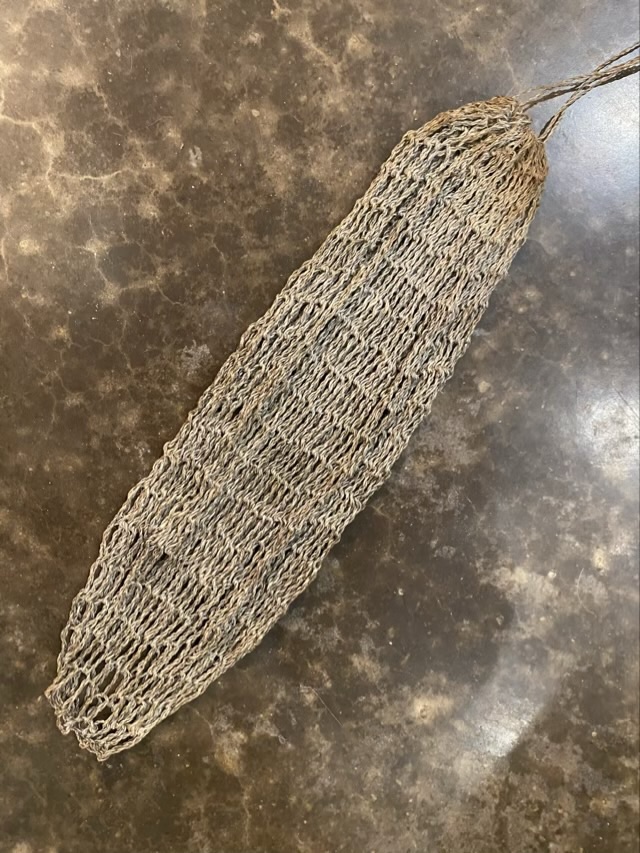
Photo description: linen loop and twist net bag

I finished twining and stitching a linen string bag using long line flax and a loop and twist construction. I would twine a section, then loop that section, so the bag was made with a continuous length of string. I did not used any tools other than my fingers. As you can see in the photo above it looks a little wonky. I took it to the sink, gave it a soak in tap water, then laid it out to dry. The transformation was remarkable.

Photo description: same bag after blocking

The bias twist in the stitches eased and it straightened out nicely. What wasn’t nice was the rust colored stains on the top.

Photo description: discoloration at the top of the bag

I used a different batch of flax for the last few rows, and I think something on my well water reacted to something in the flax, which is disappointing. I washed it with gentle laundry soap and laid it out to dry again.

Photo description: same bag after washing with gentle detergent

The rust color lessened, and now it looks more like a different batch of flax at the end, rather than a stain.

I’m also not pleased with the string ties. They are functional, but would be terrible to use to carry anything with much weight. The flax would hold, but the thin cord would cut into the flesh holding it. I do have an idea how to fix it.

Smarter with flax

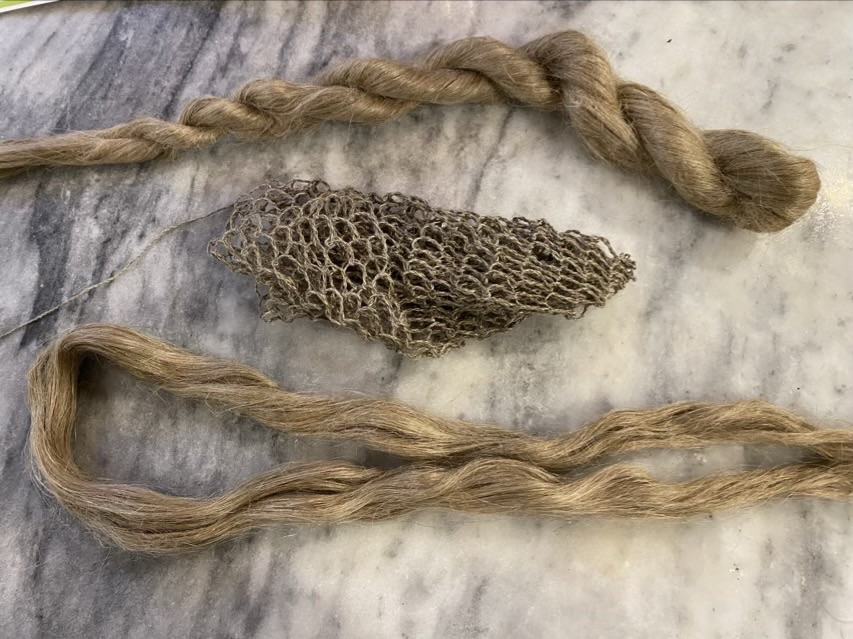
I started a twined loop-and-twist bag from a flax kit from Sally Pointer, historical educator. With the flax strick from the kit, I drew the fibers from the middle, which created horrible tangles of tow flax at the ends. (Tow flax is shorter lengths of flax, line flax can have strands over three feet.) When I ran out of long line flax, I attempted to continue with combed tow flax, which is doable, but I really like twining with long line flax, so I ordered another strick from a local company. I was smarter with this bundle of flax fibers, and actually read the flax passages in “the Practical Spinner’s Guide” book series. I separated out a section of the new flax, and put the rest aside.

Photo description: flax strick (top), twined loop-and-twist bag in progress (middle), smaller section of long line flax untwisted (bottom)

There are several methods of dressing flax to reduce tangles when spinning or twining, I chose to tie a ribbon around and drape the section over my shoulder. I sit on a high backed chair when I twine, so I can keep tension on the fibers by leaning back.

Photo description: section of flax tied with a ribbon to keep the fibers neater

I’d like the bag to be big enough to hold a pound of wool or so. The expansion capabilities of the loop-and-twist bag are quite extraordinary.

Moist extremes

When working with flax or plant fibers in general, it helps to have a little moisture. When I first started twining my flax bag on a car trip, I was using saliva. Traveling and licking fingers didn’t seem like a prudent plan, so on the next trip I made a sponge ring by cutting off the end of an inexpensive curler and trimming the hole with scissors.

Photo description: sponge ring to use to wet fingertips as I twine flax, made from a hair curler

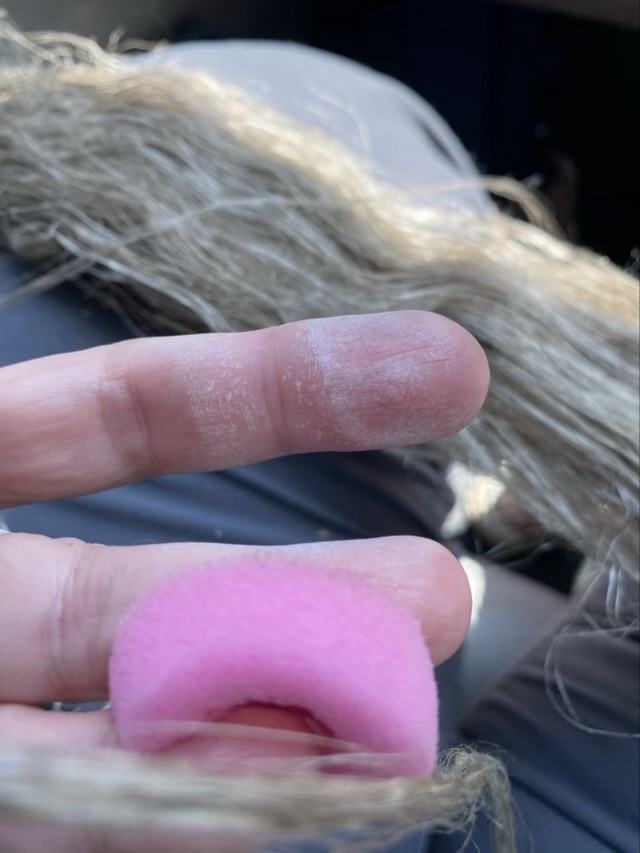
As I twined, I noticed the skin on my finger was turning white. Weird.

Photo description: white marks on my finger

I looked again at the small spray bottle I grabbed as I madly packed for the trip. It wasn’t labeled “H2O”, it was marked “H2O2”. I had been moistening my finger with hydrogen peroxide. At least it was sanitized. Sheesh.

Photo description: small spray bottle with pink sponge ring and “H2O2” written in Sharpie ink

Twine as I go

I’ve started a new project using the processed flax fiber from Sally Pointer’s twine kit. I’m making a twisted loop bag and twining the cordage for it as I go.

Photo description: two strand twined cordage made from flax fiber (in the background)
Photo description: the start of a twisted loop bag made of flax cordage, approximately six hours of worktime

I started the project as a car riding diversion. I like the twining because I can do it mostly without looking, which allows me to watch the scenery going by.

I learned to twine with a Z twist, which is opposite of the S twist that Sally Pointer demonstrates for beginners. This is fine, but when I went to start the twisted loops for the bag, the technique makes Z twists for each loop. I thought my bag would be happier (less twisty) if I made S twists to balance the Z cordage, so had to adjust the way I made loops by going in the opposite way from the video. It took some brain power, and I’m going to have to be careful going forward to keep the same stitch direction, but I think it will be worth it.

I’m not using a needle for this project, just flax and my hands. I started with a nalbinding needle, but it kept slipping off, which was irritating, but the newly made flax cordage is stiff enough that if I fold the end, it is easy to thread through the loops.

Last thought on this post: flax cordage is strong. The line I’m making is fairly thin, about four-five strands doubled, but I cannot break it with my hands.

Unexpected resistance

I went to rinse and block my small twined cotton bag and was a little shocked when it held water. It wasn’t completely water tight, there was a slow drip, but it didn’t absorb water like I expect cotton to do. My hypothesis is that because I hadn’t washed it at all to this point, there may be some natural water resistance on cotton bolls. Not enough to keep the harvest safe from rain (as this cotton farmer describes), but some. Or the twining is tight enough and thick enough to resist the water for a short time.

Photo description: small twined cotton bag holding water over a sink

I’ll file this under “things that make me go hm.“