Plying speed

Plying on a Turkish spindle is satisfying, especially now that I’ve figured out how to get the geometric wrap pattern, but it is not fast. I took the other turtle of yarn and pied it with a top whorl drop spindle.

Photo description: Top whorl drop spindle filled with 2-ply mixed wool yarn, my foot and asphalt in the background because I took the picture while walking.

I plied nearly twice as much yarn in half the time with the top whorl spindle versus the Turkish spindle. I can really get the top whorl spindle going by rolling the shaft along the outside of my leg. The Turkish spindle I have to get spinning with a flick of my fingertips.
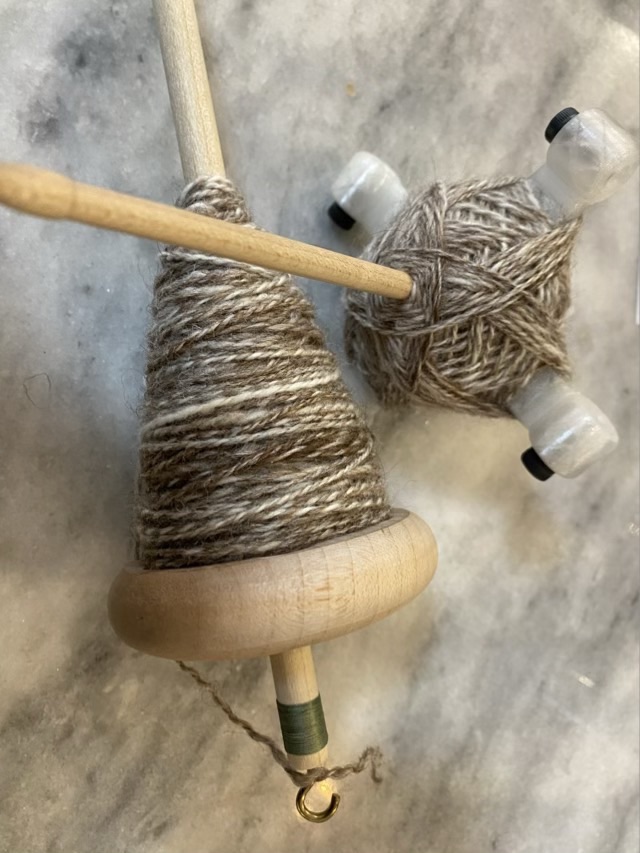
Photo description: Top whorl spindle on left, Turkish spindle on right, both wound with 2-ply blended wool yarn.

Now there is a difference after plying between the two spindles. The top whorl spindle has to be unwound from the shaft and wound into a ball or cake before it can be used. The Turkish spindle shaft and arms pull out of the yarn turtle and leave a center-pull ball of yarn that doesn’t need rewinding. I like to wind my yarn on a niddy noddy and wet set the twist, so did not save time in that area on this project. If I didn’t want to use the yarn right away, and wanted to let time set my twist, and marvel at the pretty geometric wrapping, a Turkish spindle is a way to go.
Eureka!

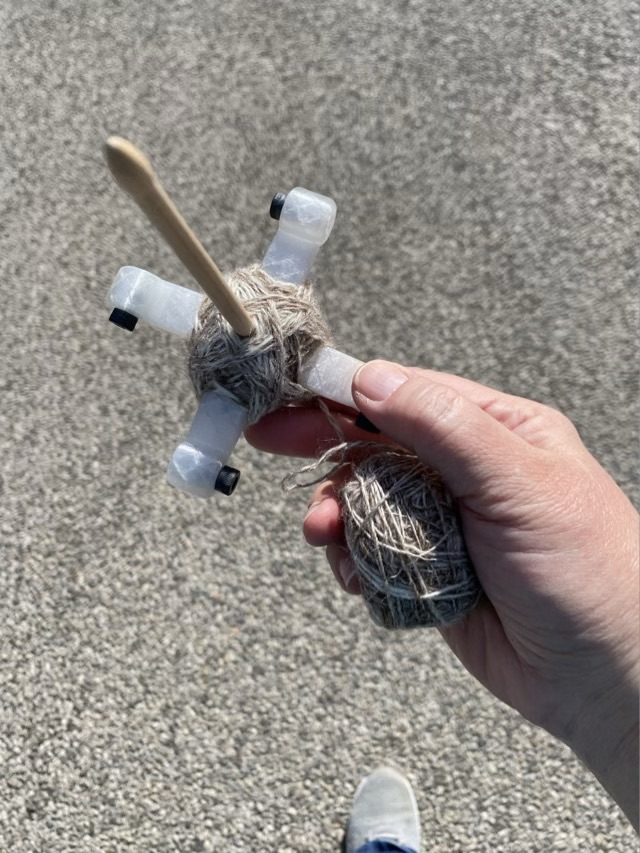
Turkish spindle yarn wrapping finally clicked with me. I’ve been following the “over two, under one” guidance for wrapping the turtle of yarn around the arms of the spindle, and I finally saw the pattern begin to emerge and was then able to follow along.

Photo description: 3D printed Turkish style spindle with a geometrically wrapped turtle of yarn, with a center-pull turtle in the palm of my hand as I walk the neighborhood.

The key, for me, was on which side of the previous wrap of yarn to put the new wrap of yarn. To start a new layer, the “two over” strand goes right next to the shaft, and the “one under” goes on the outside of the yarn under the spindle arm. As I wrap, the yarn goes outside the wraps next to the shaft, but inside the wrap under the arm. Ah ha. This method is slow, but satisfying; a good meditative practice.

Even though my previous attempts at a geometrically balanced turtle were not successful, they still worked beautifully as center-pull balls of yarn. In the picture above I was making a two-ply yarn from the center and outside strand of one turtle. So whether or not the ball of yarn is messy, it still does its job.

Spin, spun

I have finished single spinning the bonus box of blended fiber from Anniewhere. I put the box somewhere safe, forgot where that was, but found it before I made anything from the rest of the fiber; I’ll take that kind of luck.

Photo description: two haphazard turtle-style cops of single spun yarn next to a disassembled 3D printed Turkish spindle.

I really like this Turkish spindle. The arms were 3D printed with flexible filament, and I dropped it several times on my walk with no ill effects. It is not my design, but one I purchased at a fiber festival.

I’m still quite envious of the perfectly wrapped Turkish spindles I’ve seen on spinners’ posts. Mine look like birds nests. The advice I keep reading is to wrap the yarn over two arms, and under one. I did that. I’ll keep trying, though, maybe it will click.

Turtle nest cop

Turkish drop spindles are very clever, they go together in pieces, spin well, and come apart without disturbing the cop of yarn built up around the arms, but with a Turkish spindle, this bundle of spun yarn is called a turtle. I have seen pictures of some exquisitely wrapped turtles that are art forms in and of themselves. Mine looks more like a nest. I have goals.

Photo description: Squarish bundle of yarn surrounded by 3D printed Turkish spindle parts in the direction they were removed, a turned wooden shaft that was removed first, and a handkerchief with rope wrapped around a distaff.

I had trouble deciding the title for this post, so I combined all the words for maximum misdirection.