School is back in session, so I’ve started up my spin walks again. Really it is a matter of the temperature coming down and walks being pleasant in the morning, instead of a hot sticky mess.
Photo description: spinning Southdown wool on a 3D printed Turkish style spindle while walking a city park
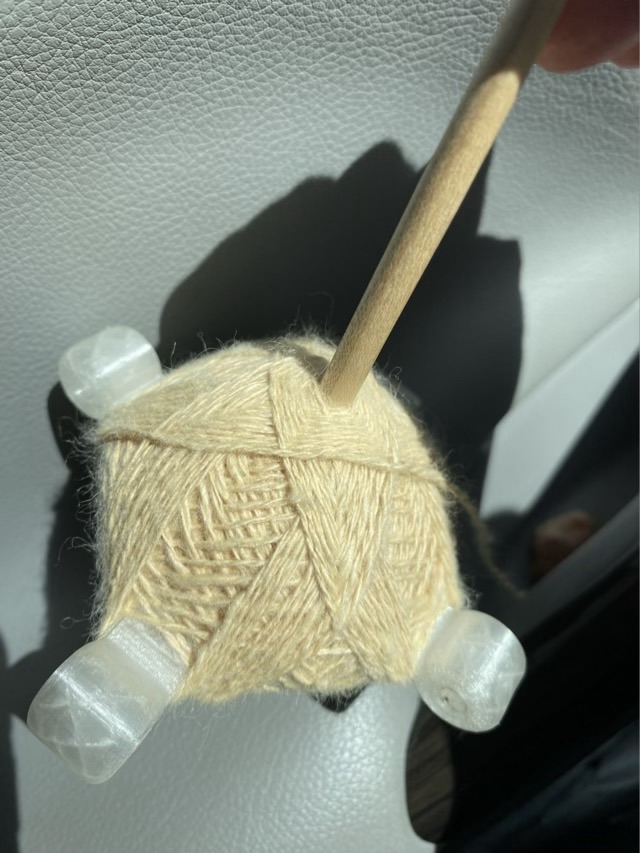
I found two drop spindle projects in progress when I went to pick up my spindle. Hm. I decided to start with the Southdown, because this little Turkish style spindle is one of my favorites. If I drop it, the rubberized arms bounce, and the yarn is protected from contact with the ground due to the jacks like shape of the arms and shaft.
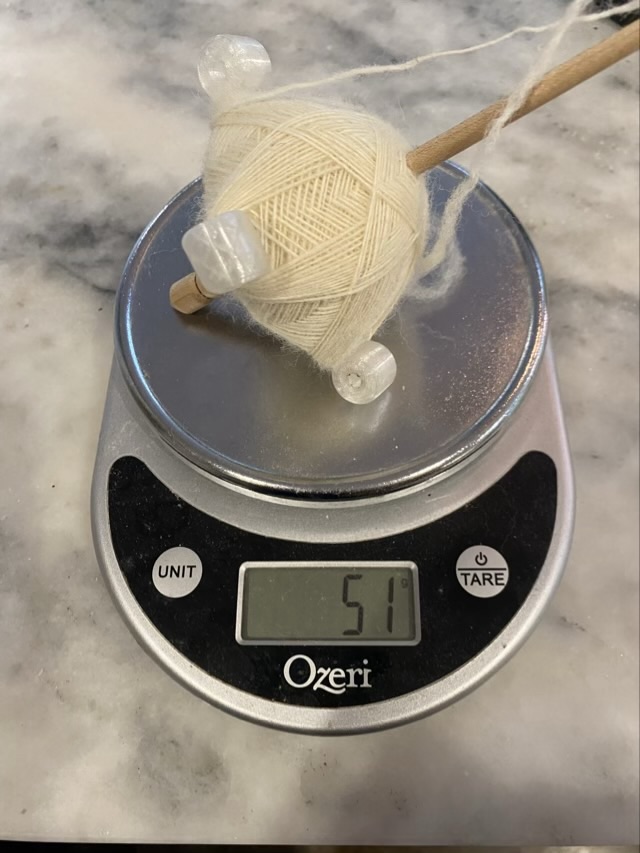
I’m spinning Southdown wool on a 3D printed Turkish style spindle. I decided to weigh my yarn turtles so I can match them (as much as possible) to make plying easier. I started with the weight of the spindle and the single spun yarn.
Photo description: Ozeri digital scale reading 51 grams with a spindle full of yarn on the plate
Then I removed the yarn and weighed the spindle for reference.
Photo description: Ozeri digital scale reading 23 grams with a broken down Turkish style spindle
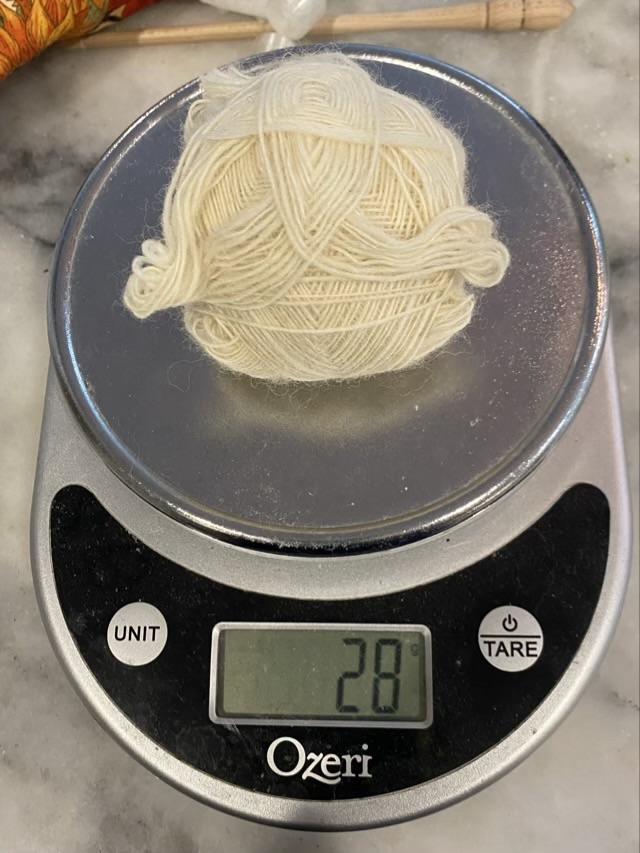
Then I weighed the yarn turtle.
Photo description: Ozeri digital scale reading 28 grams with a ball of yarn on the plate
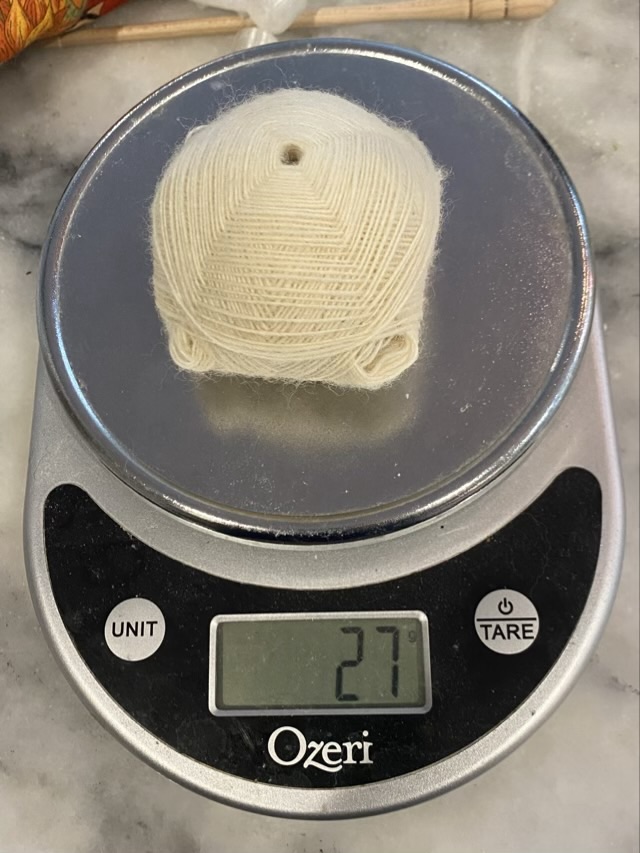
I forgot that if you stop winding part way through a layer on a yarn turtle, the layer peels up. It really needs a full wrap to stay neatly in place while in storage, so I removed the unruly layer, used it to start a new turtle, and weighed again.
Photo description: Ozeri digital scale reading 27 grams with a turtle of yarn on the plate
I have about 113 grams of Southdown roving, so I should get four turtles, if I track it carefully. It will take me awhile, I’m spinning during my walks, so only spin a bit at a time.
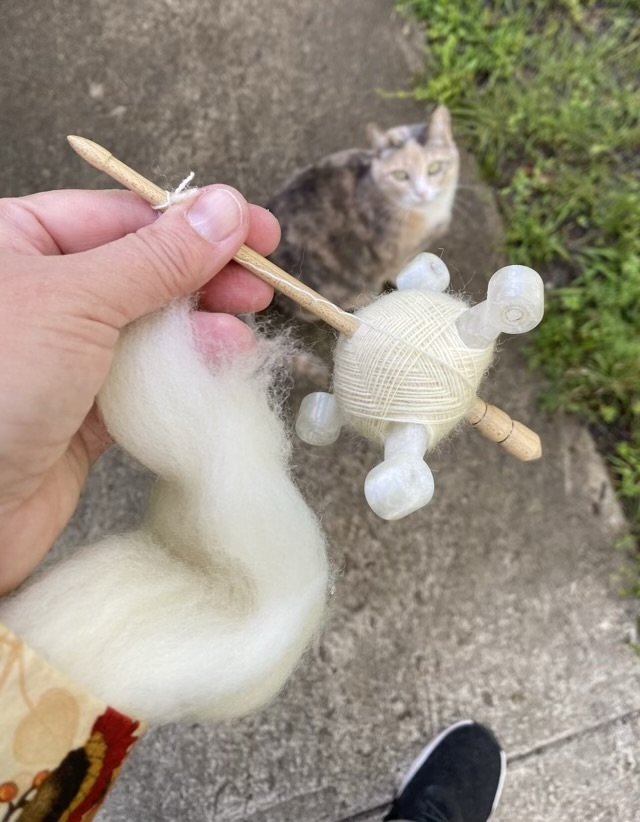
I have 4 ounces of Southdown top from Camaj fibers and it came with a Shave ‘Em to Save ‘Em sticker. Southdown is a heritage sheep that just came off the Conservation Priority list in 2024, which makes my sticker not count toward my threatened breeds list, but does show the power of the Shave ‘Em to Save ‘Em initiative and others like it. It is a British breed from the Chalk Hills near Sussex, England. You can read more about them here. I am spinning my portion of fiber with a 3D printed Turkish style drop spindle. The fiber drafts easily and spins fine. It takes me longer to do the geometric wrap around the spindle “turtle” than it does to spin the length of yarn, but the aesthetics of the winding has its own therapeutic reward.
Photo description: off white Southdown fiber spun fine and wrapped “under one, over two” on a Turkish style spindle. Calico cat sitting on the side walk in the background.
This spin is going to last me awhile between the amount of fiber, and the way I’ve chosen to spin it. 4 ounces doesn’t sound like much, but I’ll probably be walking with this fiber for months.
When spinning on a Turkish Spindle, the ball of yarn created on the arms of the spindle is called a turtle rather than a cop as it is for other drop spindles. My theory is that the ball of yarn looks like a turtle shell, complete with four leg holes, when the spindle shaft and arms are removed. The useful part as that the turtle is a center-pull ball, and doesn’t have to be rewound before it can be used. If you were ever curious on what a ball of yarn from a Turkish spindle looks like when it has been pulled from the center, I have provided catharsis below.
Photo description: hollowed out ball of yarn from a Turkish spindle.
The over two, under one wrapping used to make the turtle provides a surprisingly stable structure when a layer is complete. In the photo above, the inside of the turtle looks woven. I didn’t press my luck and the potential collapse of the turtle shell storing it with the middle missing, rather I rewrapped it nostepinne style before tucking it in my bag. This yarn was spun from soybean fiber, then 2 plied.
My wrapping on a Turkish drop spindle is getting better. This is two plied soy fiber on a flexible filament 3D printed Turkish spindle that I bought at a fiber festival.
Photo description: geometric patterns created by the over two, under one, wrapping pattern on the yarn “turtle” around the arms of the Turkish spindle.




 Critters and Craft