So excited! I met with someone who has been spinning for years! We sat and had coffee and talked and spun. It is so wonderful to watch and learn! She also brought me samples of wool from her stash (as had been done for her when she started spinning), all carefully labeled. Squee!
Samples of wool
I’m going to take the time to explore each fluff separately and carefully, and then spin it. Hm. I think I should start a spinning journal to record my observations. That is also an exciting prospect!
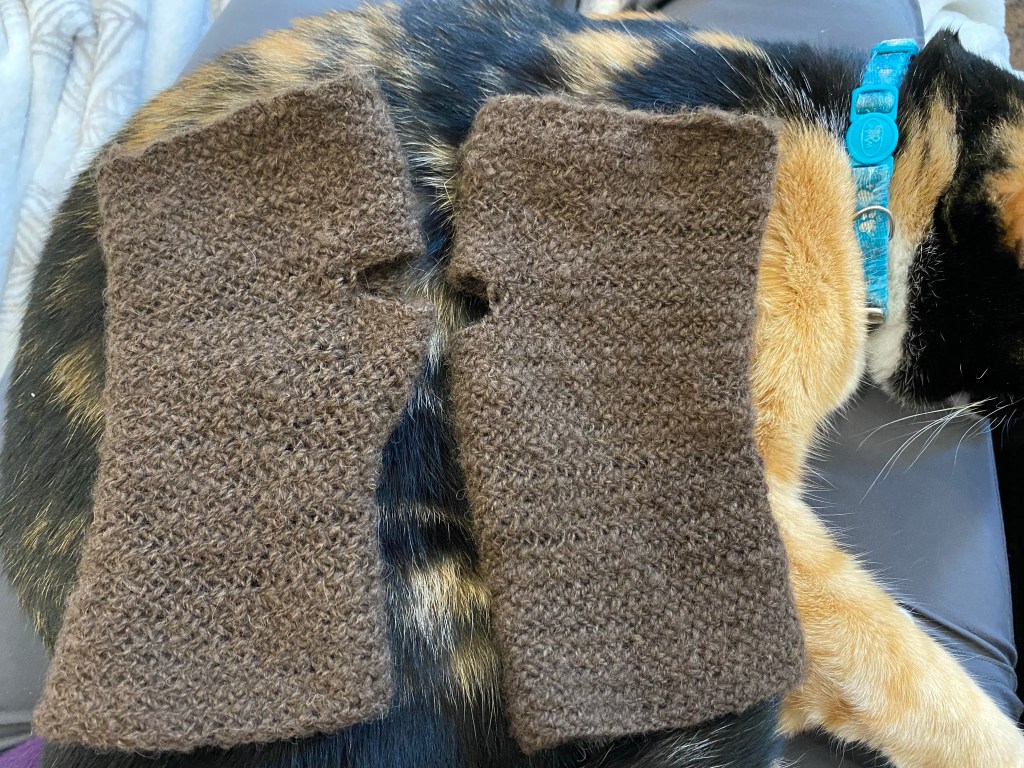
I finished my wrist warmers! I spun the yarn from prepared buffalo down from The Buffalo Wool Company using a tahkli spindle. I spun one cake sZ and the other zS to see if there was a difference when I nålbound them. As expected, there is. The fabric wants to roll in opposite directions, which is not a big deal on snug fitting items. I used the Dalarna stitch as described on this site. I like this stitch because the texture on one side looks almost woven, and doesn’t have the bold stripes of some other stitches (the inside is very ridged, though, which is interesting). I did some shaping under the thumb slit. The first warmer was a little loose, the second a little snug. They will still work well in the Texas cold (for northern climates I would use a thicker yarn and a thicker stitch!)
Buffalo down wrist warmers worked in Dalarna stitch
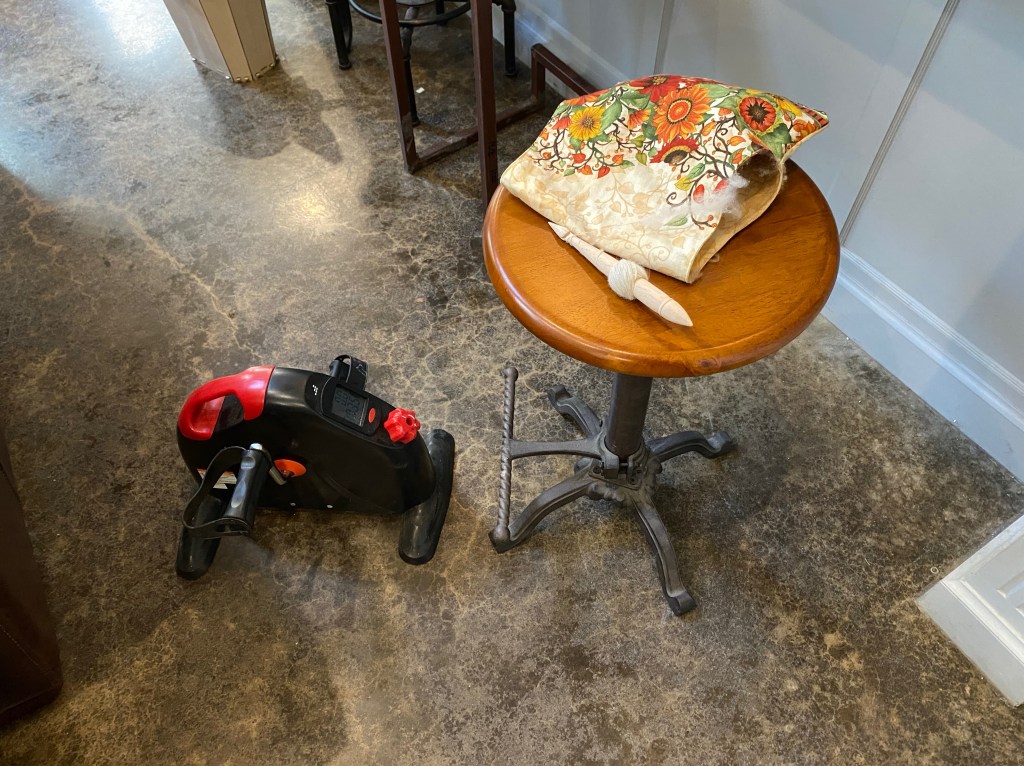
My podiatrist said that bicycling or using an elliptical would be acceptable for exercise while my tendon is healing. We have an old mini bike that I set up in front of a stool and I can pedal while leaving my hands free to spin yarn! Not as nice as walking outside, but a good podcast makes it a little better. I do switch sides where my drop spindle hangs to balance out, since I can’t hang it straight down. If left to my own devices I will craft and not exercise, so this gets me to actually get some workout in.
My mini bike set up with a stool on which I sit and spin
I’ve started to spin the Shetland wool batt on my walks. I gently separated narrow strips from the large batt, and loaded my arm bag with what I thought was enough to last me one or two walks. Five walks later, and I am still on the initial load of fiber. Granted, I am spinning it finer than I spin alpaca, but wow. Even though it is slow going, I really, really enjoy watching the twist move into the fiber, and the pleasant way the wool drafts out. The plan is still to make a two ply lace weight yarn. I’ll have to test the wraps per inch (wpi) after I ply to see just how fine (or not) I’m spinning. Lace weight measures at 30-40 wpi, while sock or fingering weight measures at 18-30 wpi. I suspect I will have a fingering weight when I ply, just looking at the singles on my spindle.
Spinning Shetland wool with a drop spindle
I could probably spin even finer, but I would probably have to use a supported spindle, which I have not figured out how to do while walking.
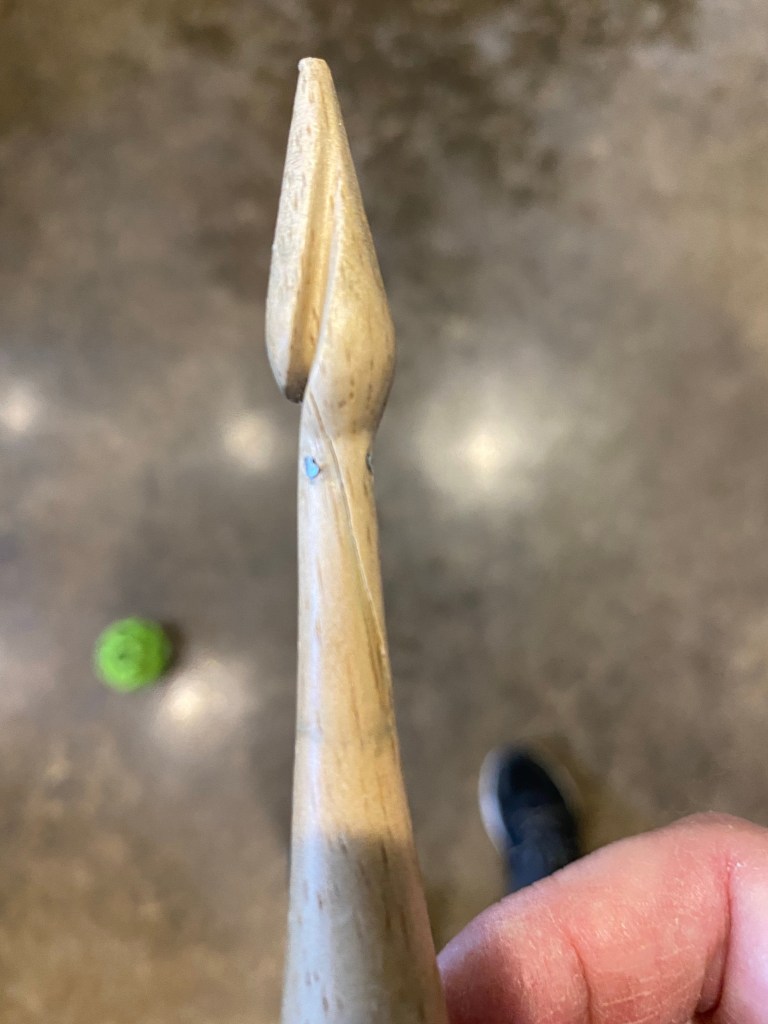
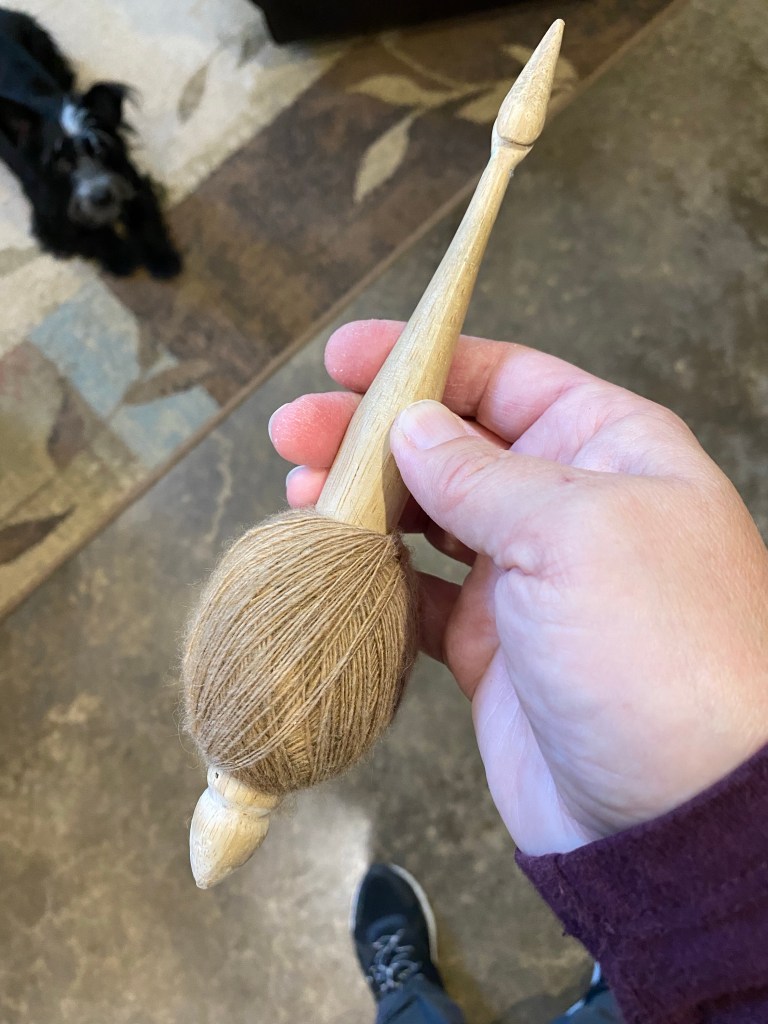
Riveting the head of my drop spindle worked. It took a dozen drops, but I eventually dropped the spindle on its head and cracked it again. The rivet held. I was able to continue spinning for the rest of my walk, then when I was home, I put a little glue in the crack and tightened up the rivet with a few careful hammer taps. In mitigation, I was pushing the amount of yarn I could load on the spindle, so it was heavy and starting to get unwieldy, so my lesson is to keep the cop of yarn smaller so I reduce the chance of another drop to the head.
Crack barely visible on the neck of the spindle Yarn cop that is too big for this spindle
Missy would really like for me to stop taking pictures and kick her ball already.



 Critters and Craft