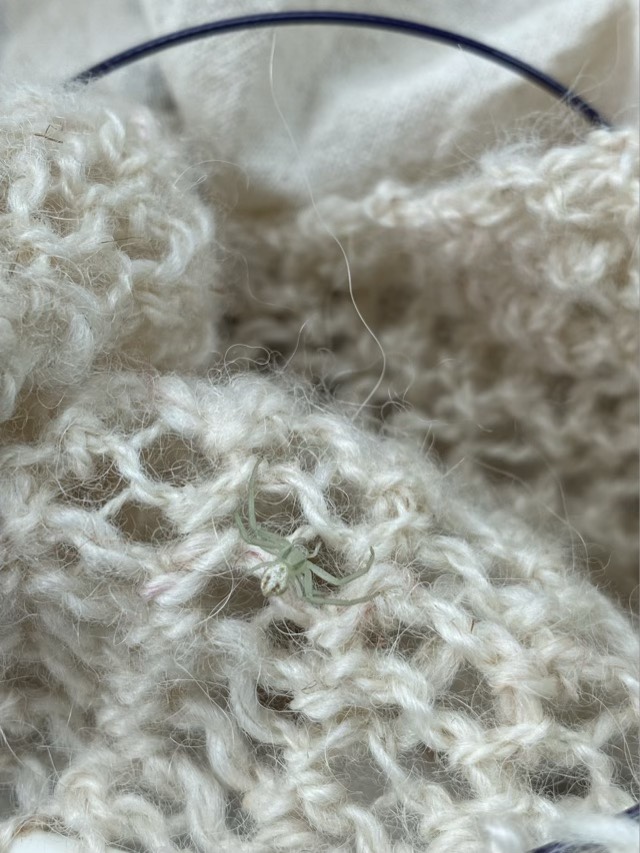
I usually have a project of some sort that hangs out in the car so I can work on it when I’m waiting. I opened the bag and there was a little something extra with my knitting. I have no idea how this little spider found its way into my bag, but I think it goes well with the yarn. I did not keep it (though it is cute), but set it free outside the vehicle. I may need to make a shawl pin or broach with that light green color.
My mini stationary bike’s tensioning system was no longer working, so I took it apart to see what was going on and to see if I could harness the turning power. Rather than spin with a drop spindle as I turned the pedals, I wondered if I could drive a spindle, essentially making a pedal driven spinning wheel. The short answer is yes, yes I can.
Mini stationary bicycle converted into a spinning wheel
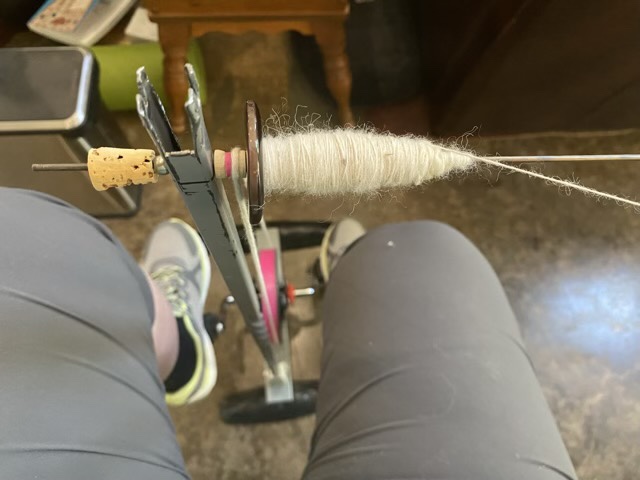
Once all the extraneous bits were removed from the mini bike (like the cover, tensioner, and monitor) I was left with a pedal driven wheel. I used an old metal baluster to hold a spindle above knee height and ran a piece of waxed woven cord (this worked better than string or chain) around the wheel and up to the spindle. Some silicone grip strip on the wheel and the custom wood hub on the spindle gave enough friction so the cord didn’t slide (it is pink because that is what I had on hand). I’m still adjusting the design as I go. Initially I had the spindle resting in slots at the top of the baluster, but it wobbled too much. My husband suggested using a sleeve and offsetting the spindle hub, so I drilled a hole to fit the spindle shaft, which works much better. A metal bead and a cork keep the spindle from flying out. I’m sure as I use it more, I will find other aspects to adjust.
Spindle set up with cork, metal bead, baluster, wooden hub, old button, and spun yarn (left to right)
The style of spinning wheel is not a typical English wheel, but more like a vertical charkha spinning wheel. There is no flyer assembly to automatically take up the yarn, Instead it is an adjustment of the angle of my arm to go from adding twist to loading spun yarn onto the spindle. I believe Great Wheels use similar mechanics, but the wheel is driven by hand in a standing position.
The best part of the spinning wheel? (Ok, the second best part, because spinning wheel!!) The only thing I bought was the cork. Everything else was repurposed. The baluster was left over when my husband built a new closet upstairs, the spindle was an old glass bead mandrel, the wooden hub was a bit of dowel that I drilled and shaped and glued, the silicone wrap was left over from wrapping kayak handles, the cord, wax and the metal bead came from my stash, the whorl on the spindle is an old shanked button that I drilled a hole through.
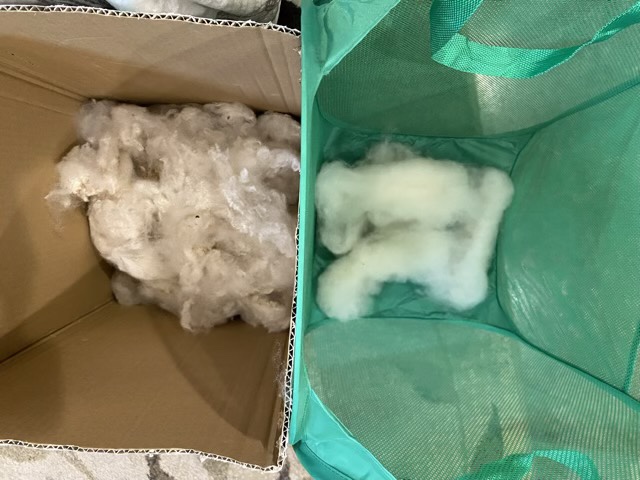
I felt the need to card my washed cream alpaca fiber. All of it. I don’t usually do it all at once, but go as needed because the rolags are the most airy and open right after carding, which makes spinning easier.
Washed alpaca fiber (left) and carded alpaca fiber (right)
It is therapeutic to turn the chaotic mass into fluffy white clouds. Even though I washed the fiber, it still has a significant amount of dirt and vegetable matter, most of which comes out as I card it.
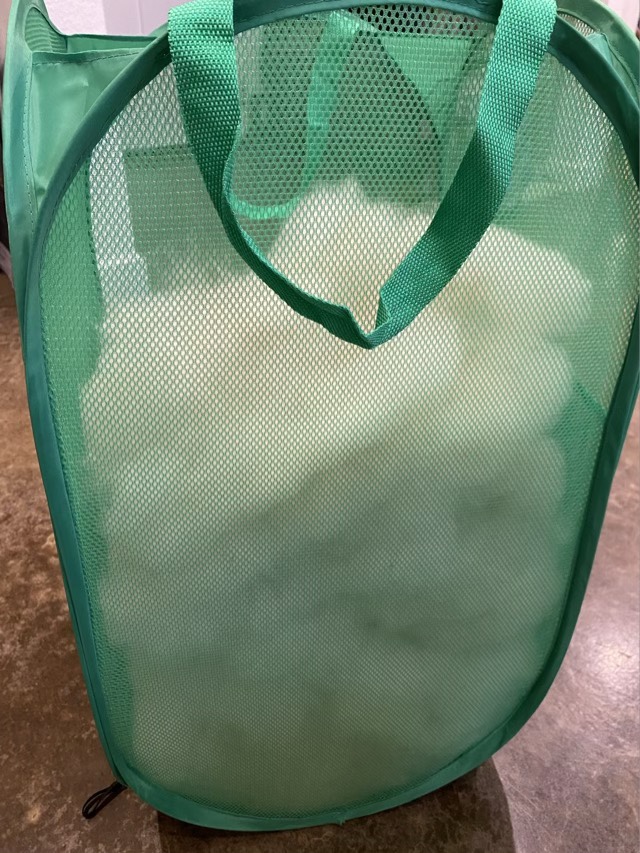
Carded alpaca fiber in a laundry hamper
Carding also increases the volume of the fiber because the clumps and locks are opened up. The mass of fiber about tripled in size with carding.
Now to figure out a good way to get to spinning all these lovely little clouds. Although I can’t go for spinning walks yet, I do get some reprieve from the boot, as long as I’m walking on smooth even surfaces. Standing for long periods is also still problematic. Hm.
Apparently, I didn’t clean out my fiber bag thoroughly before loading it with cream alpaca fiber. I have shadows of pink and green in the spun singles. Hm. It will be interesting to see if it shows up after plying or in the final piece.
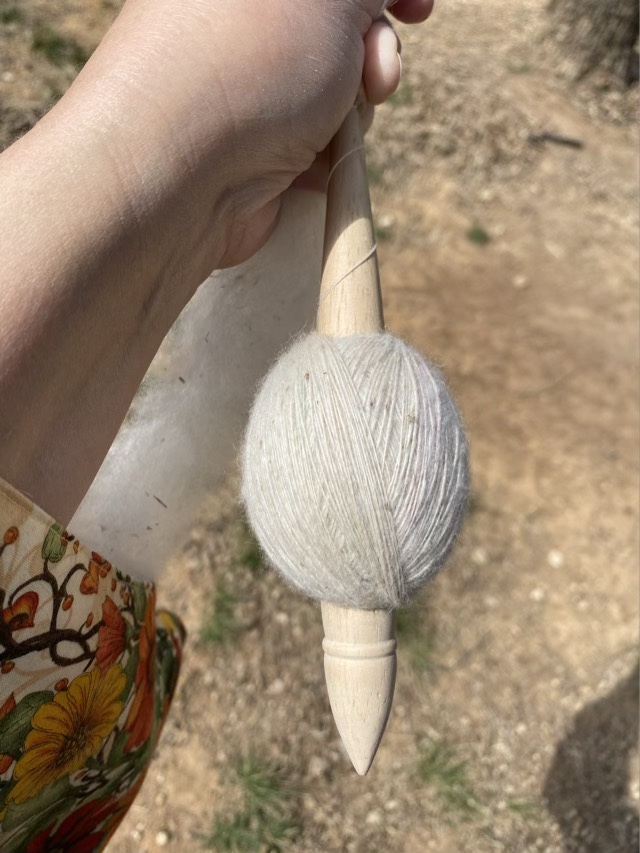
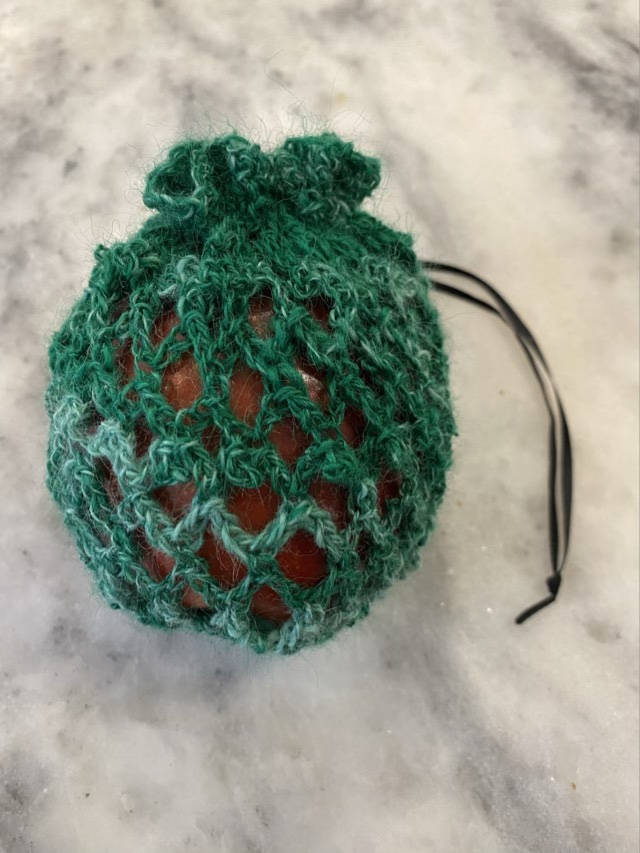
I finished the small bag I started. The initial ball of yarn was spun on a drop spindle using scraps of green colored roving from my Mom’s old stash. After spinning the single, I doubled it to make a 2-ply, fingering weight yarn (about 20 wraps per inch). I started with the opening using a single crochet, made ribbon holes by alternating single crochet and chain stitches, then the body of the bag is made of five chain lace with some picots. It only holds an apple, but its worth is more in the process, which showed me that my handspun, even with rougher wool, does fine as lace. And I still enjoy crochet.


 Critters and Craft