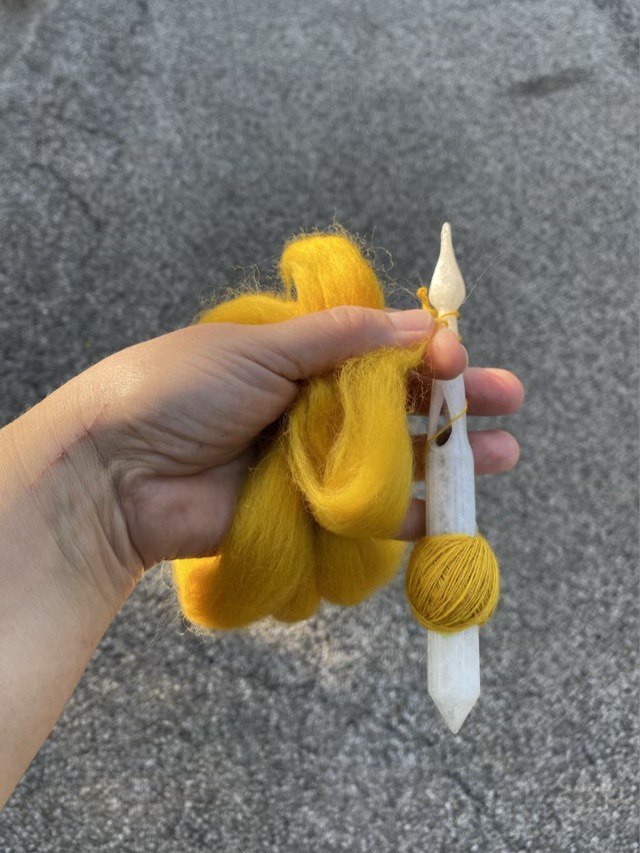
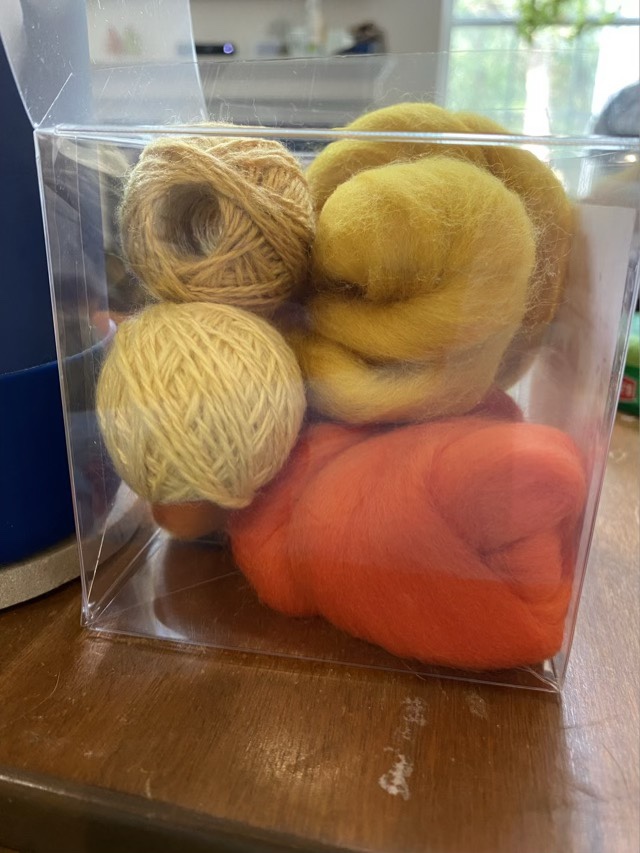
My youngest gave me a box of yellow to orange dyed merino wool and I decided to spin it up separately rather than blend it (so many choices with these bundles of colors!)
Spinning during a walk
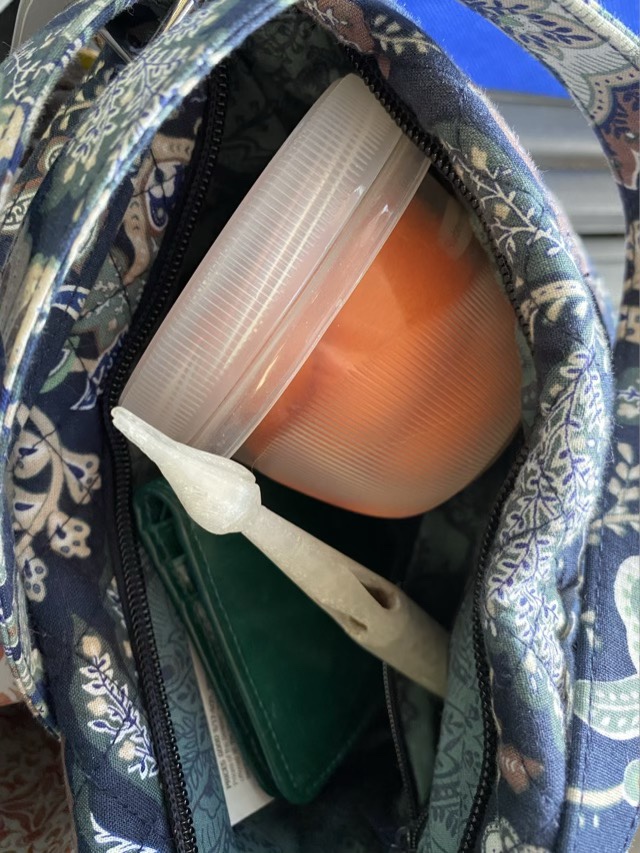
I like the small bundles of wool because they transport easily; I can walk with the roving loosely around my fiber hand, or I can pop the fiber into a container in my purse so I can spin while waiting.
Fiber and spindle stash in my purseSpun and unspun Merino wool
I am delving into the fiber samples my sister gave me, starting with hemp. I tried spinning the hemp as I would wool, with a drop spindle and dry. The fly aways were epic. Since I had luck spinning flax roving using a bit of moisture from a sponge, I tried that method with the hemp. It meant I had to transfer what I had spun to a long shaft drop spindle (wrapping the yarn along the shaft at a low angle reduces the stress on the fibers).
Moving the spinning operation from a single spindle to a spindle and distaff setup
Rather than spinning directly from the roving, I separated bits of roving and laid them on a rectangle of fabric (all those old masks came in handy), taking care to lay them in the same orientation. I then rolled the fabric around the distaff and tied it loosely with some cord.
Dressing the distaff with hemp by laying down the fiber on a clothSponge bracelet, dressed distaff, top whorl drop spindle
As I spin, I wet my fingers on the sponge before gripping the fibers to draft. It helped tame the fly aways and gave me a smoother spin.
I have finally finished spinning the flax singles from my flax roving. Flax prepared as a roving is not the traditional form, but I didn’t know this when I made the purchase. It has been a challenge to spin, but I’ve learned new techniques and have produced a yarn.
Dressed distaff and drop spindle
I wound off my singles nostepinne style into two center pull balls.
Center pull balls of flax singles
I plied the two balls together to even out the thickness differences. Despite weighing out the roving, the balls were different weights, but I solved the excess issue by doubling up the leftover. I plied using my spinning wheel. Flax when spun is called linen. I suppose I should use that term for my yarn!
Two-ply linen on a spinning wheel bobbin
I wound off the two-ply yarn onto a niddy noddy, to make a skein.
Two-ply linen skein
My book tells me that the next step is to boil the skein. I’m going to have to work up my courage for that, so I will share in a future post.
Oh dear. I decided to see what my WIP (work in progress) count was up to. Hm. I’ll share them here as a kind of accountability, although I’m not counting the ball of napkin twine in the glove compartment of my car that is for emergency craft use (that project doesn’t need an end). Nor am I including the fiber survey that also ongoing.
Spindle development
Developing a 3D printed spindle is my oldest WIP. I’m still working on the head breaking issue, but with the help of the printer, I feel we are nearer the end than to the beginning of this project.
Spinning alpaca fleece on a Befra Wily spinning wheel
My sit and spin project on my vintage wheel is also nearing completion. I have a few hours worth of alpaca fiber left in the basket (the fiber in the blue bin is waste from combing). I have another portion of washed alpaca in queue.
Spinning flax roving
My walking spinning project involves my first taste of flax spinning. The roving preparation is an odd one, but I’m finally getting the trick of it. I maybe have two or three walks left to finish the singles, then I still need to ply and finish the yarn.
Brioche rainbow scarf
My rainbow scarf knitted with the Brioche method became a car project a while back. This was the best thing for this work, as I regularly knit for about an hour on it many times a week as I sit in the car rider line. I still have many hours left to go.
Newly cast on cardigan project
My newest WIP is a blue and yellow light-weight cardigan. This is a big step for me in knitting. I have made a couple of sleeved garments (as opposed to vests, scarves, hats, and gloves), but not many and they all have had sizing issues. I’m making the attempt again because I have grown as a knitter and am hoping the new skills will help. I have been planning this knit for months, but I hadn’t cast on yet, so it wasn’t an official WIP. It sits next to my chair at home.
I’m still working on the design of my 3D printed spindle. I’ve now had a local printer make up three sizes, and have tested them all with the same fiber blend.
Three spindle sizes with corresponding cops of single spun yarn
We aren’t there quite yet. I need some input from other spinners, and we need to change the printing density to reinforce the neck. The smallest version has never broken, but the hole in the yarn ball is too small. The largest has a great diameter hole in the cop of yarn, but is unwieldy. The middle one is the closest to feeling right, but still needs some adjustments.