Long alpaca spin

I finally combed and single spun the last of an alpaca fleece that I purchased and washed in 2020, and started spinning on my Befra Willy Spinning Wheel in 2022. I haven’t been spinning consistently over the last two years; there were many months that the fleece and the wheel were tucked away out of sight and definitely out of mind.

Photo description: Befra Willy Spinning Wheel with a bobbin full of single spun fawn colored alpaca fiber

To free up my bobbin, because the next step is to give the wheel some TLC, I wound the yarn into a cake using my wool winder. I ended up with 196g of spun alpaca (the cardboard tube in the middle weighs 4g).
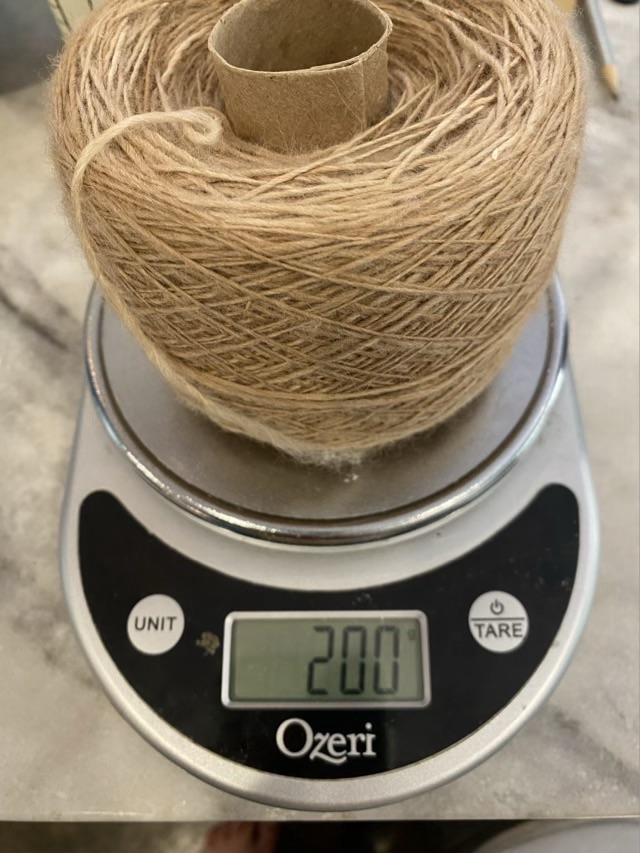
Photo description: cake of single spun alpaca fiber sitting on a scale reading 200g

I put the cardboard tube in to keep the yarn under more tension. Single spun yarn is not balanced, and I wanted to reduce the chance of kinks and tangles. I’m not sure how I want to ply this fiber, so it will sit until I have an idea. I did pull the start of the yarn and the end to compare thickness, and I did a fair job keeping a consistent spin over the two year span. There are some thinner and thicker sections, but not a wide spread.

Photo description: yarn pulled from the center (newest) and the outside (oldest) showing very similar thicknesses

This definitely counts as a forever project. I’m really getting my crafting money’s worth from this alpaca fleece.
Spinning Tencel

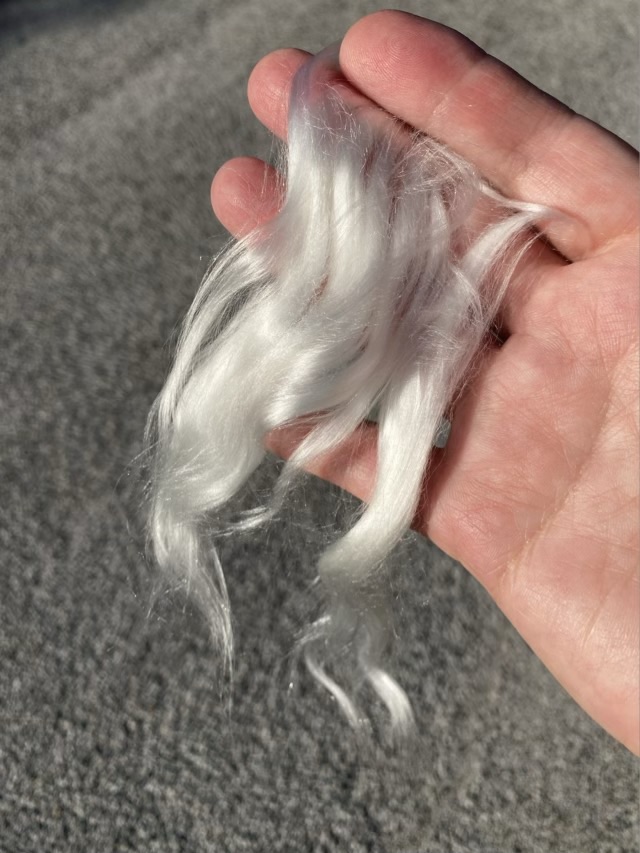
I started on a new fiber sample from my stash: Tencel. Tencel is derived from wood pulp, and the manufacture is reported as an “environmentally friendly closed loop process”. To save you some googling, I looked up what closed loop manufacturing means, and it is essentially that an item can be recycled over and over again. The Tencel sample I have from Hearthside Fibers has a long staple length and a high luster.

Photo description: unspun Tencel fiber held fanned out in my hand in the sun showing a high shine

The fibers are almost slippery, and I’m having trouble spinning consistently. I’m dropping the spindle even more than usual.

Photo description: the beginning of a cop of Tencel single spun yarn on a drop spindle held in the sun to show off the sheen

This sample is going to take me awhile to spin. Not only is it tricky, it is horribly hot outside still, with highs over 100 all week and lows over 80. Yuck.

Oh and yeah, the hook came off my spindle again. Next step is to epoxy the thing in.

Chain plying Ramie

I like chain plying single spun yarn because I don’t need three bobbins and a Lazy Kate to get a three ply yarn. I use a center pull ball and make a crochet chain with really long loops. I was unsure about chain plying my Ramie fiber because I’ve read that it isn’t a good technique for bast fibers like flax because flax doesn’t like the sharp bends which happen at the ends of the loops. Flax is not as flexible as wool. Ramie is also a bast fiber, taken from the stem of the plant, but it chained plied quite well; the chain loop ends disappeared into the ply twist without little stubborn loops.

Photo description: three ply yarn (chain plied) on the left, four ply yarn (not chain plied) on the right

For chain plying with a drop spindle, I prefer to sit and park my spindle by my leg, then pull a loop as long as my arm. I keep the end of the loop open with a finger and the yarn ball in the same hand, then I can suspend the spindle and give it a spin in the opposite direction of the single.

Plying ball

I finished spinning a single of my Ramie fiber sample. The long staple bast fiber was easy to spin fine, and was enjoyable to work with.

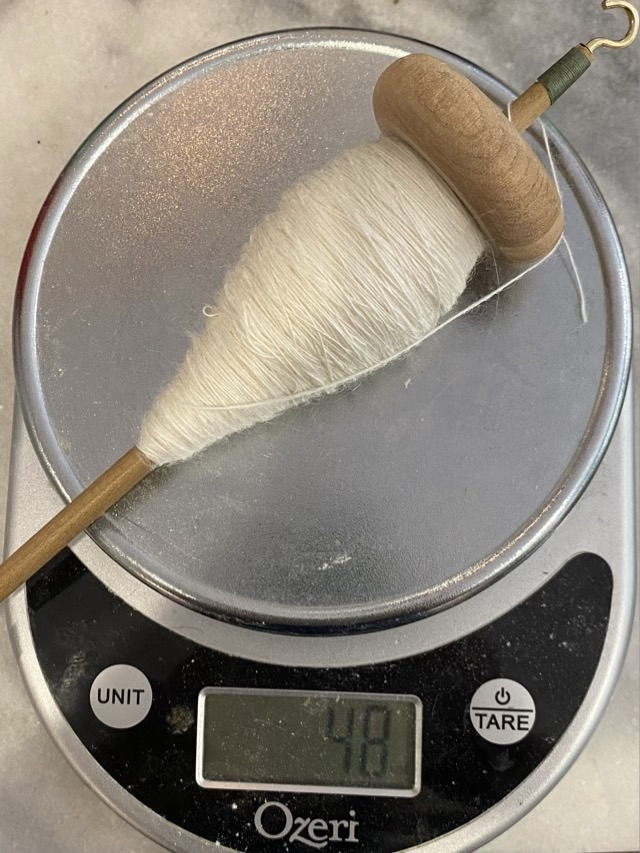
Photo description: Drop spindle with single spun Ramie fiber on a scale registering 48g

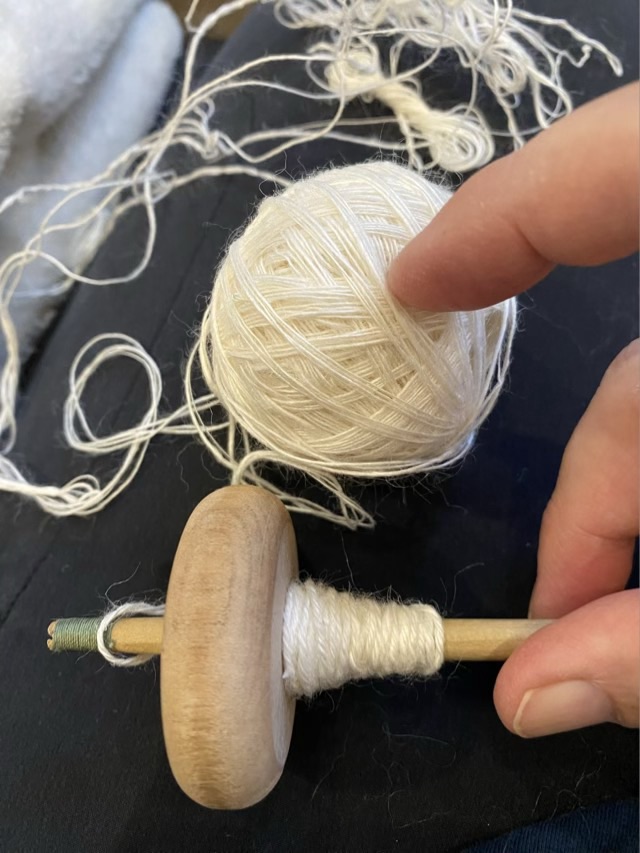
It is so fine that I decided to divide the yarn and make multi ply yarn. I weighed my full spindle, and since I had the spindle weight marked on the whorl (22g), I knew I had 26g of yarn. I wrapped a center pull ball of yarn that weighed 12g and set it aside to try chain plying, which results in a three ply yarn. I then wrapped two 4g balls and a 10 gram ball. Oops. No worries, I decided to do a four ply by using both small balls, and taking from the inside and the outside of the larger ball. It was tricky to handle, so I made a plying ball, which means I wrapped the four strands of yarn together, without twist, into a center pull ball. There were still some tangles, but they were manageable. I could then add twist as I pulled the four strands from the middle of the ball.

Photo description: bottom: spindle with plied four strand yarn, middle: plying ball with four strands, top: bit of tangle at the ends, which I was able to sort out once the rest of the yarn was plied
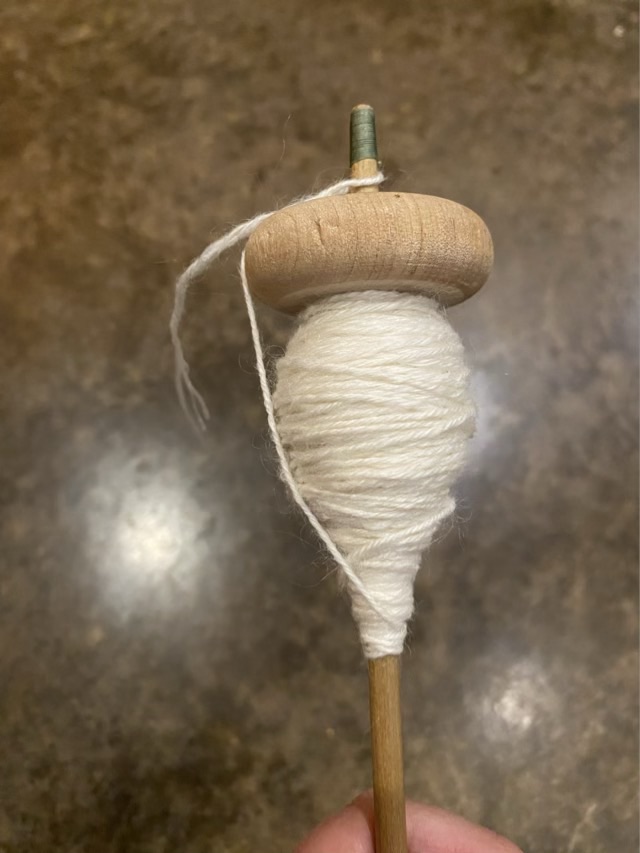
Photo description: four ply Ramie yarn on a drop spindle

The rather rough single spun yarn felt much softer once it was plied into a multi-strand yarn.

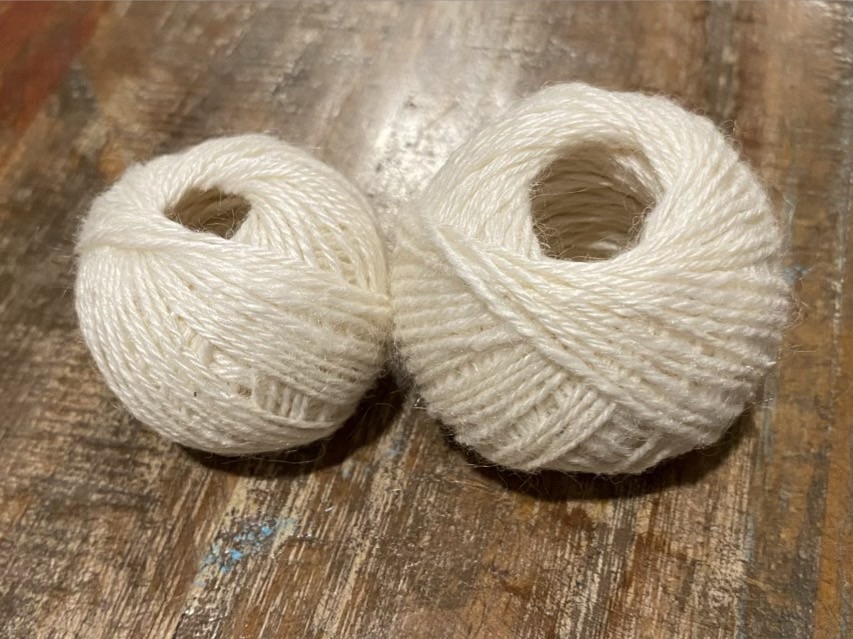
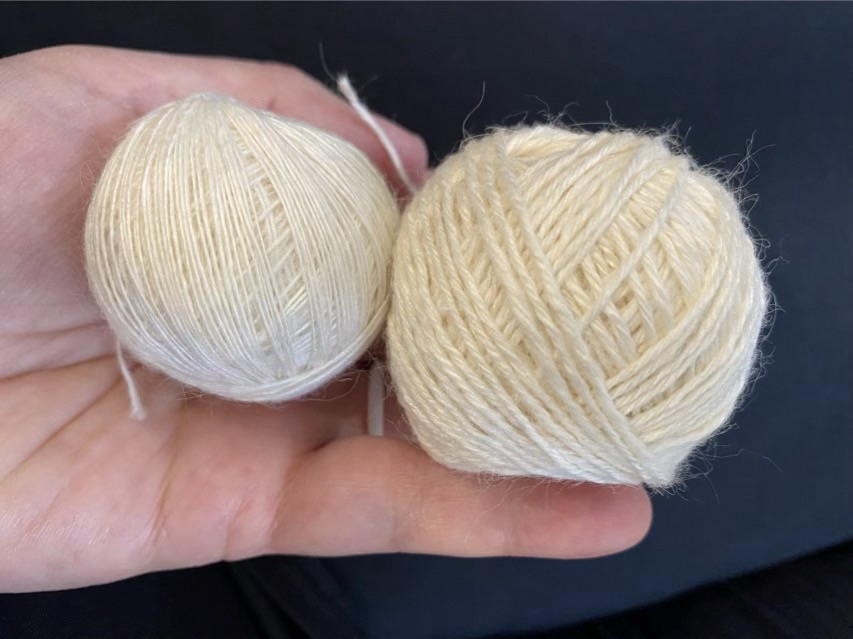
Photo description: two balls of Ramie yarn, left one is single spun, right one is four ply.

Return of the hook

I finally did reunite a metal hook to my favorite drop spindle. I’m currently spinning Ramie combed top from Hearthside fibers. Ramie is a thornless member of the nettle family, and the fibers harvested from the stems are long, strong, and fine.

Photo description: lock of Ramie showing the long fine fibers, held in my hand, asphalt road in the background

I allowed myself to spin fine with this fiber, since on my last fiber I spun thick. I did not try to spin as fine as I could, that will be a later challenge, but just to spin a nice comfortable single.

Photo description: single spun Ramie fiber on a drop spindle, asphalt road in the background

I remembered to grab a cup hook and screw it into the top of the spindle, eventually. It really does make a difference in the spin of the spindle, because the arch of the hook allows the spindle to hang closer to its center of gravity, giving a smoother longer rotation.

Photo description: drop spindle with no hook, hanging from yarn secured with a half hitch, showing the point of suspension at the side of the shaft
Photo description: drop spindle with a hook, with the yarn secured by wrapping a couple times around the hook, showing the point of suspension centered on the shaft

It also helps that I am spinning clockwise again, which does not unscrew the hook. I will have to think on a way to add a hook that is secured without a screw or just glue, that can spin either way with ease.