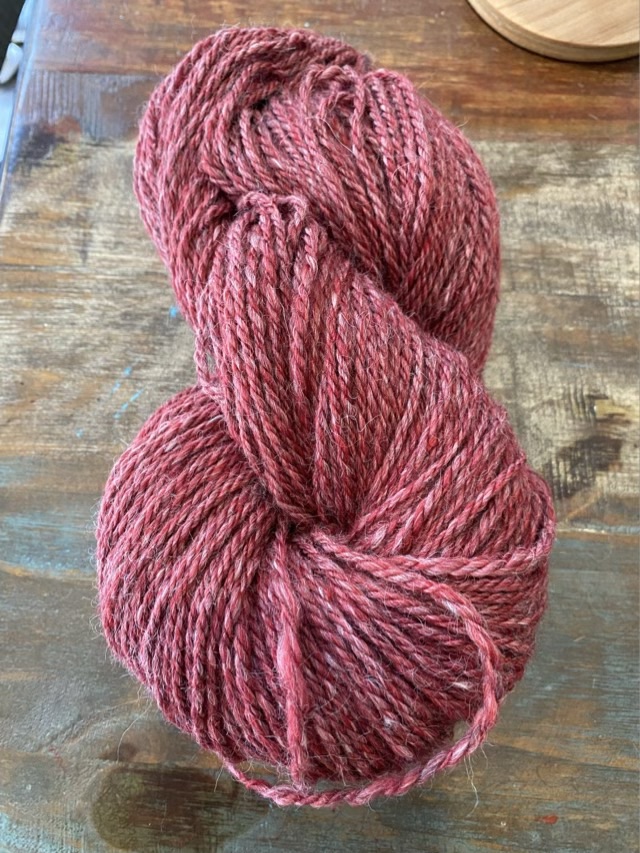
Egyptian cotton 3-ply

I finished spinning Egyptian cotton single spun yarn onto three bobbins on an Ashford Traveller spinning wheel (Yes! I spun cotton on a wheel using a high speed whorl.) I found the largest diameter on the high speed whorl, the one that matches the bobbin end diameter, worked best for me. The smaller diameter gears went too fast and I over spun. I also had the wheel set up with Scottish tension with a very light take up on the bobbin. I prefer to dictate the amount of spin in my yarn rather than have it controlled by the wheel.
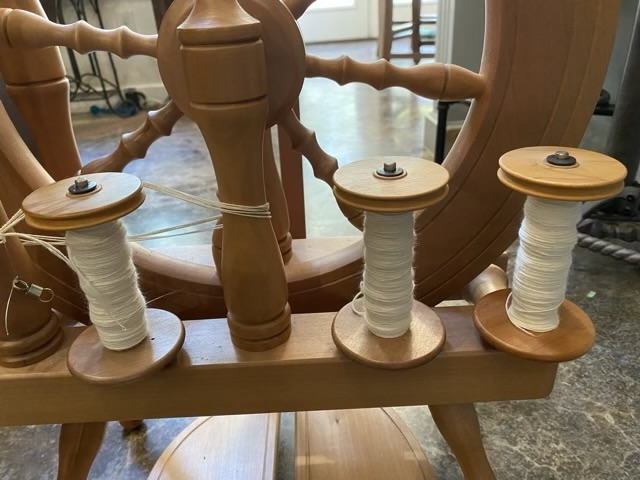
Photo description: three wood bobbins with cotton singles on the lazy Kate built in to the Ashford Traveller

The next task was to ply the cotton. I was nervous about this because the singles had a high degree of twist, and liked to kink up. If a strand broke I would also be dealing with the rapid unwinding of the single, which results in a whole sale unbinding of a large section of yarn (ask me how I know). I did let the singles sit on the bobbin for a few days to set the twist a little. Remarkably, I was able to ply the yarn from the three bobbins with no breakage and only a few missed kinked knots.
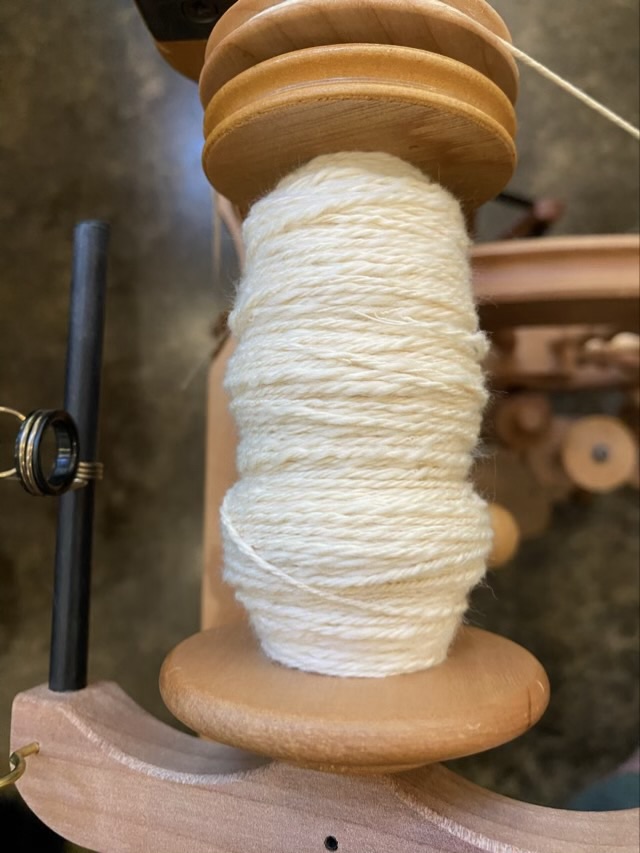
Photo description: three ply Egyptian cotton yarn on a wood bobbin of an Ashford Traveller spinning wheel

My spinning definitely looks like homespun, but as I practiced, my technique improved and there were some sections of smooth and even spun yarn.

Spinning cotton

Since I purchased a high speed whorl for the Ashford Traveller spinning wheel, I thought I would see if I could spin cotton. Cotton has a short staple length and needs a high degree of twist to hold together.

Photo description: Egyptian cotton top spun on an Ashford Traveller with a high speed whorl

I’m definitely still working on my learning curve, but I’ve been getting sections that are even and not over spun. There are still lumps and bumps, and sometimes I’ll under spin and have several bits let go before I get back to stable yarn. I’ve divided my fiber into three sections to spin on three bobbins to make a three ply later. I hope.

One of these things is not like the others

When I switched to the jumbo flyer on my new-to-me Ashford Traveller spinning wheel I noticed the spin was much smoother and quieter, and the flyer fit better. Some further investigation revealed that the socket in the jumbo whorl was different than the socket in the other whorl. Hm. I ordered a high speed whorl that is supposed to fit the Ashford Traveller, and it had the same socket as the jumbo, which leads me to believe that the whorl that was on the spinning wheel when I received it was not original. I ordered a regular whorl, and it fit! I know the previous owner used it as-is, and was frustrated trying to learn to spin on it, and I wonder if the owner before also bought it second hand and gave it up because it was difficult to spin. How many people give up on something they want to learn because the tool is difficult, and because they are beginners, they can’t spot what’s wrong and they think it is their own inability?

Photo description: collection of spinning wheel whorls, clockwise from the bottom left: Ashford high speed whorl, Ashford regular whorl, Ashford jumbo whorl, mystery whorl
Photo description: underside of the same whorls with the mystery whorl on the bottom right with a subtly different socket

I do have to admit that I love spinning for the joy and quiet of it. It is not a fast craft, and there are small moments of immediate gratification (when the fiber takes up the twist), but it is making a supply, rather than a finished wearable or gift-able object. Not everyone loves it. Everyone is different. I’m glad I learned on drop spindles, because it made learning to spin on a wheel easier for me.

Caking yarn

Because of the bulk and quantity of yarn I produced on the Ashford Traveller spinning wheel, I decided to let time set the twist rather than do a wet block. Setting the twist in freshly spun yarn gives a more balanced yarn which doesn’t kink up when slack, making it easier to work with be it knitting, crochet, or weaving. A quick way to set to twist is to get the yarn wet and let it dry (there are many variations, but it boils down to this). Time will also set the twist; sitting under tension for a while lets the fibers relax and accept their formation.

Photo description: three-ply bulky alpaca merino blended yarn wrapped on a niddy noddy
Photo description: very thick skein of bulky yarn

I did not have to transfer the yarn to a niddy noddy, I could have wound it directly to a cake, but I wanted to see it in skein form. It was an overfull skein, though, so wasn’t as pretty, but I wasn’t willing to cut the yarn, or make a bigger skein. Oh well. I wound it all into cakes using a Royal New Wool Winder.

Photo description: four cakes of bulky yarn

I have many projects that need completing before I can get to this yarn, so it has some time to sit and settle. It is all queued up though, with the needles and the knitting plan in the bag with the yarn cakes.

Dividing the last

I spun up nearly a whole bag of alpaca/merino roving, filled up six small bobbins of singles, and two large bobbins of three ply yarn. The roving that remained was not enough to fill three more small bobbins, so I weighed it and divided by three.

Photo description: “rose hip” dyed alpaca and merino roving divided up into three roughly equal parts and put back in the bag, separated by clips. Ashford Traveller spinning wheel in the background with left over single spun yarn on the bobbins.

Dividing the roving worked well, but I still had one bobbin run out of single spun before the other two when I was plying. To use up all the singles, I chain plied the last bits. Since chain plying creates a slightly different yarn than plying from three bobbins (there are U bends in the yarn, but it is still three ply), I knit up my swatch with this last bit of yarn. So I didn’t loose track of which part was chain plied, I knit straight off the spinning wheel. The yarn was nicely balanced, so this wasn’t difficult.

Photo description: knitting a moss stitch swatch straight off the spinning wheel

My spinning and plying created a “bulky” yarn, about 8 wraps per inch (wpi), so I knit with size 11 needles by Prym.