I have finished a new fiber page for my spinning book! I mounted all my samples from hand spinning soybean top (top is the description of the fiber preparation, involves combing, and produces parallel fibers) on prepped black card stock. I would definitely use this fiber again, it is very strong, yet so soft.
Photo description: Soybean top fiber page. Clockwise from top left: original card from Hearthside Fibers reading “Soybean Top Developed in the USA in the 1930s by Henry Ford Used in Ford car upholstery pre-1940”, single spun, 2-ply, and 4 ply yarn samples, woven swatch, nålbinding swatch, crochet swatch, knit swatch, combed fiber.Photo description: same page with swatches flipped up to show the writing underneath: plain weave on Clover mini loom, nålbinding Dalarna O/U O:U O, crochet 1.75mm hook, Stiockinet size 2 needle knit.
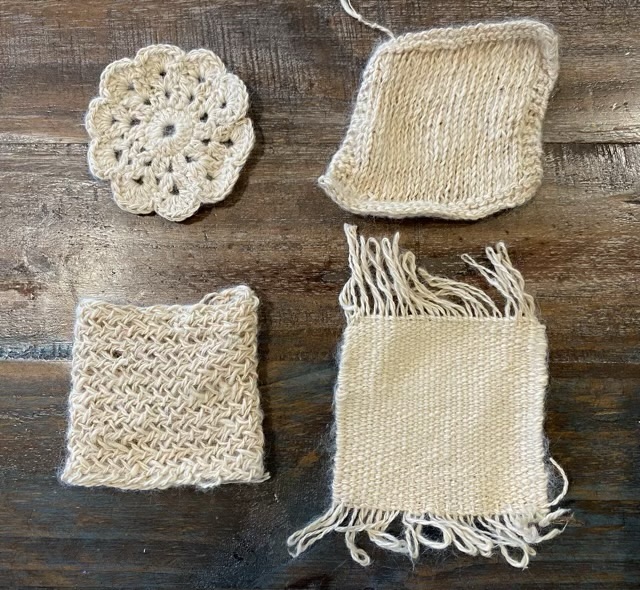
I made four example swatches from my spun soybean fiber: knitting, crochet, weaving, and nålbinding.
Photo description: swatches before blocking, clockwise from top right: stockinette knitting, plain weave, nålbinding Dalarna stitch, and crocheted lace round
The knitting swatch tells the most about the yarn, the obvious skew is because my singles have more twist than my ply. This bias does not have a significant impact on the other swatches. The nålbinding has several small knots because I could not get the fiber to felt together. I used a 1.75mm hook for the crocheted coaster, which was on the small side because the stitching is dense and stiff. The soy yarn is incredibly strong; I can’t break a single strand with my hands, but it is also incredibly soft even with the amount of twist I put in the single. There is good reason that it also carries the name vegetable cashmere. It also blocks well. It was very easy to shape when wet, and kept that shape when dry.
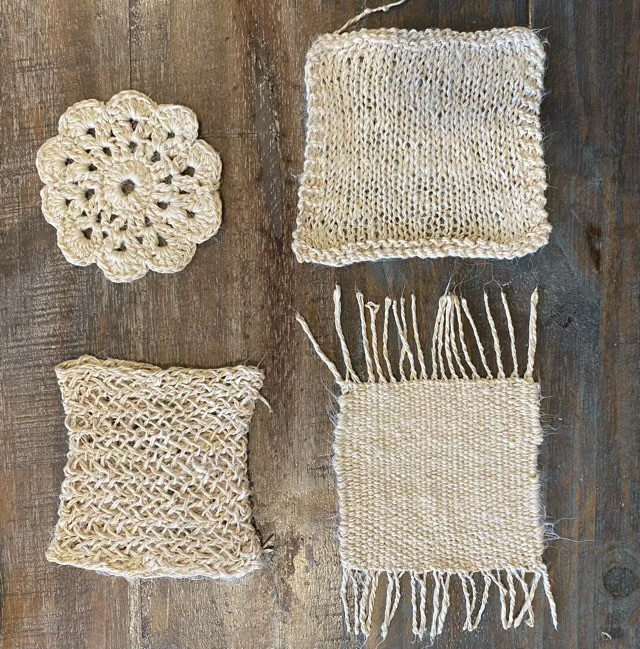
Photo description: same swatches after blocking
I was able to square up the knitting, and give the woven swatch some more twist in the fringe. The nålbinding swatch stitches opened up, but the crochet didn’t have much change, probably due to the density of the stitches.
The next step is to mount the swatches in my fiber book.
When spinning on a Turkish Spindle, the ball of yarn created on the arms of the spindle is called a turtle rather than a cop as it is for other drop spindles. My theory is that the ball of yarn looks like a turtle shell, complete with four leg holes, when the spindle shaft and arms are removed. The useful part as that the turtle is a center-pull ball, and doesn’t have to be rewound before it can be used. If you were ever curious on what a ball of yarn from a Turkish spindle looks like when it has been pulled from the center, I have provided catharsis below.
Photo description: hollowed out ball of yarn from a Turkish spindle.
The over two, under one wrapping used to make the turtle provides a surprisingly stable structure when a layer is complete. In the photo above, the inside of the turtle looks woven. I didn’t press my luck and the potential collapse of the turtle shell storing it with the middle missing, rather I rewrapped it nostepinne style before tucking it in my bag. This yarn was spun from soybean fiber, then 2 plied.
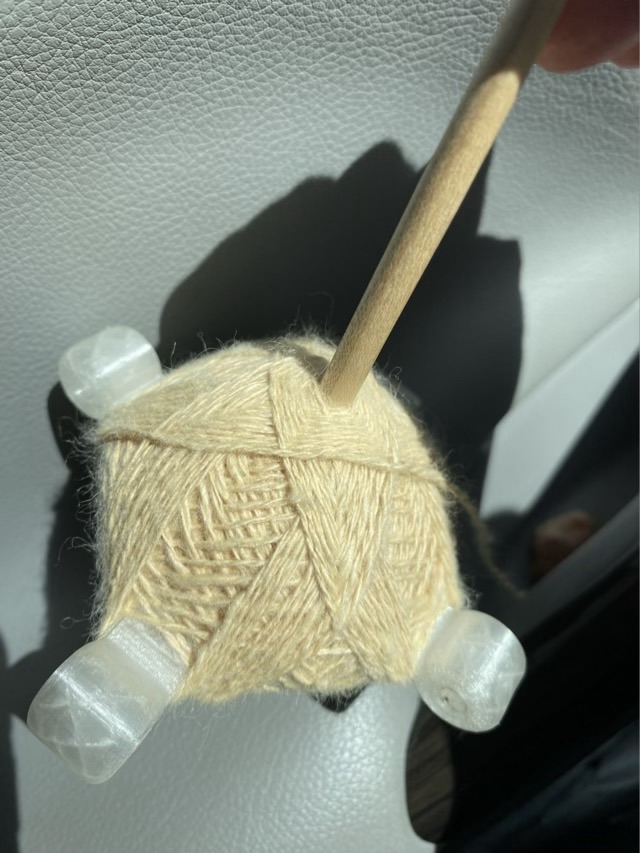
My wrapping on a Turkish drop spindle is getting better. This is two plied soy fiber on a flexible filament 3D printed Turkish spindle that I bought at a fiber festival.
Photo description: geometric patterns created by the over two, under one, wrapping pattern on the yarn “turtle” around the arms of the Turkish spindle.



 Critters and Craft