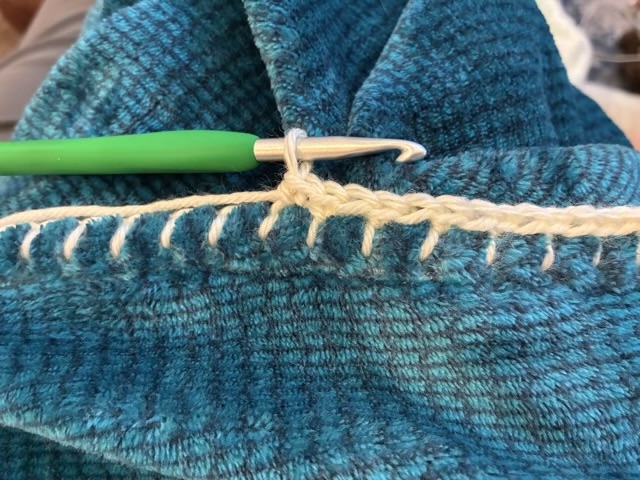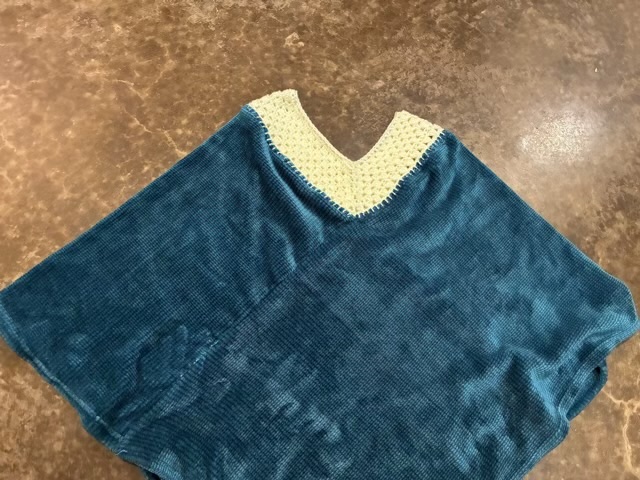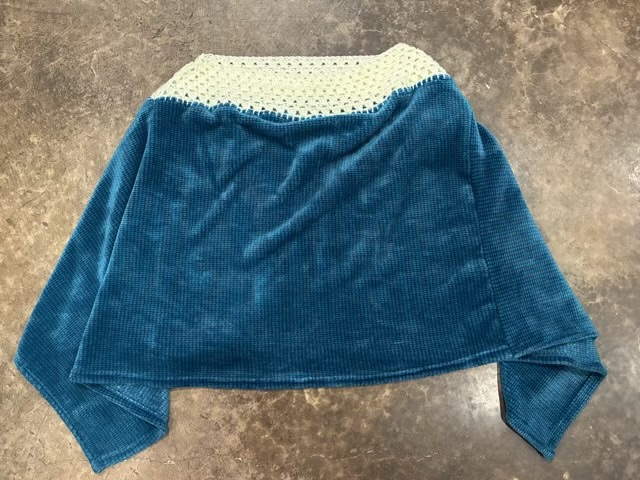
To make the poncho that I made from a free blanket wearable, I used inexpensive acrylic yarn to do a blanket stitch around the neckline, then crocheted into the blanket stitch.
Photo description: single crochet into a blanket stitch, video here
I then alternated rows of shell stitches, 3 on the first row, two on the second, and decreased at the V on each side.
Photo description: crochet added to the neckline of a 2 rectangle poncho
I don’t know why one side has more stitches than the other, but I didn’t count, so that is probably the cause of the error. The crochet did help keep the poncho on, but I still hate wearing it. I even tried wearing it sideways with a “V” on each shoulder. That was better, but the corners on my hands were annoying.
Photo description: same poncho, but turned 90 degrees with the V neck on the shoulders
I’m very glad I did this trial with inexpensive materials, and did not put in hours knitting something that I would hate wearing.
The idea of making a poncho with two rectangles intrigues me. I like the pictures I’ve been seeing on online searches and I wanted to give it a go without a big investment of time, so I cut up a free plush blanket.
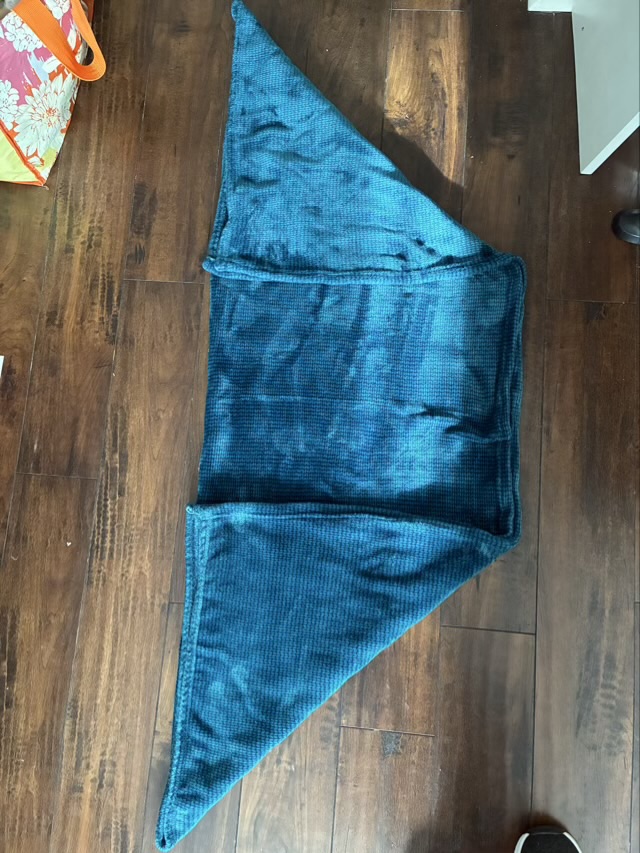
Photo description: plush blanket on the floor folded in half lengthwise, then the corners folded in to assess appropriate length
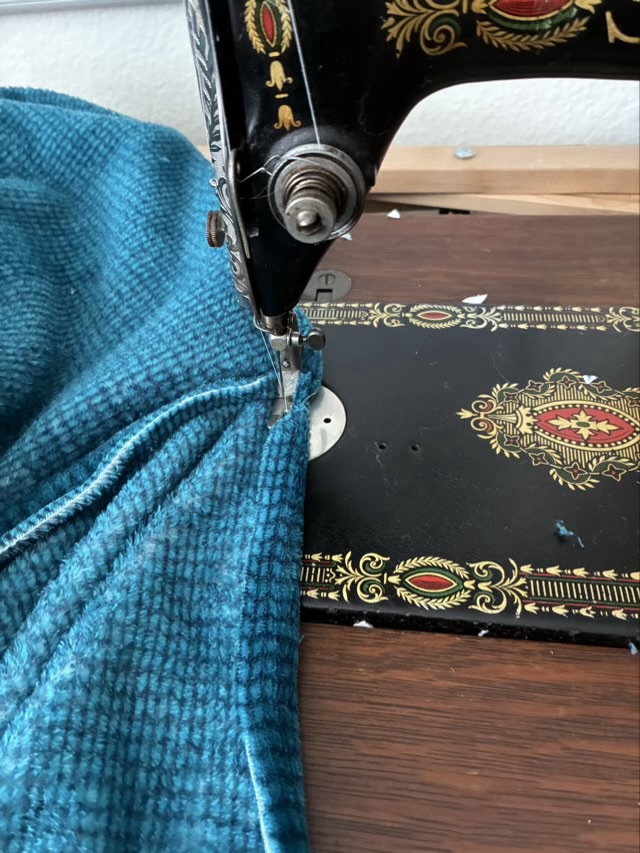
I cut the freebie blanket in half lengthwise. After consulting several measurements in different instructions, which say to take the length from shoulder to wrist and add the neck length for the long edge of the rectangle, I cut the blanket and sewed one short edge to the other long edge.
Photo description: sewing plush material with a model 66 Singer sewing machine
The internet lies. Not that this is a surprise, and after as many times as I’ve seen the same wording repeated across multiple sites you would think I’d be prepared for “tutorials” that are parroted from other “tutorials” and never actually tested, but it still made me mad. I have at least learned to be cautious. Rather than sewing the final seam, I pinned it and tried it on. Massive fail. The neck hole was big enough to completely step through. I looked closer at the pictures I was seeing and noticed that the ponchos on the models were pulled up in the front to give the illusion that the neck-hole wasn’t a gaping chasm. Humph. I cut some of the length off my rectangles until I had a two to one ratio: the long side was twice as long as the short side. The neck hole still seemed big, but I decided to sew. I finished the second seam, and hemmed all the raw edges and wore it around the house. I hate it. The opening for my head is still way too big and it is awkward to wear. What is going on?
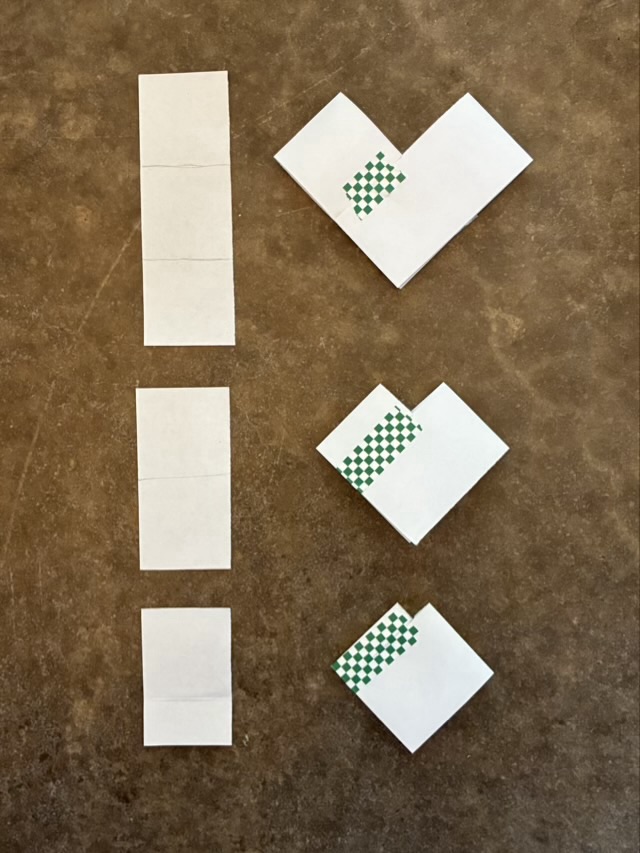
I decided to go smaller and make some paper models.
Photo description: paper models of two rectangle ponchos showing a 3:1 ratio (top), 2:1 ratio (middle), and a 1.5:1 ratio (bottom)
After doing the paper models, I believe a rectangle that is 1.5 times longer than it is wide will give a head opening that is more reasonable, especially with stretchy fabric, like a knit. The next step is to test this to scale. Stay tuned!
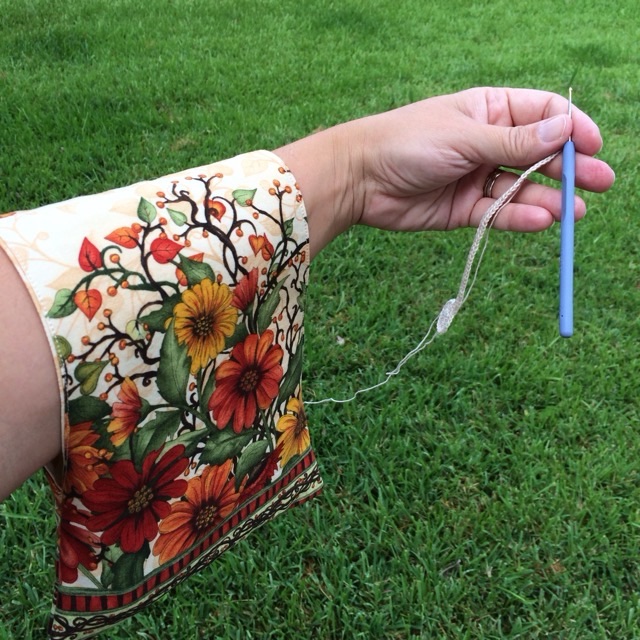
In July 2016 I made my first arm bag using my favorite fabric.
Photo description: vines and floral fabric bag with very wide “handle” that fits over the forearm and can hold a small skein of yarn
I have made many of these bags, and I love them. It is a way to keep my yarn close and still allow me to move around. I first needed it following kids around the house and playground, later I found it worked well for walks, and travel, and waiting rooms. I make mine reversible, and have added small pockets in later versions.
I designed a couple variations of minimal wallets by starting with paper mock ups.
Photo description: paper mock ups for two wallet designs, the bottom left has an angle access and a traditional quarter fold insert, the bottom right has a scoop access and an accordion fold insert, top middle is a credit card mock up
After getting my dimensions figured out with paper, I designed the leather cut out in Adobe Illustrator, and used a blue diode laser cutter to cut and emboss vegetable tanned tooling leather.
Photo description: leather with embossed design after cutting with a laser and rinsing with water, the folding
I stained the leather and let it dry, then applied a coat of resolene, which will make it water resistant.
I wanted the insert to have RFID blocking capabilities, so I used spray glue to adhere cotton quilting fabric to faraday fabric.
Photo description: cut cotton fabric glued to faraday fabric using spray glue on the back of the cotton
My favorite part of this project was learning a new-to-me edge stitch: triple loop lacing. It took a few tries on scrap leather to get the hang of it, but it was worth it. I love the braided edge look with the heavy waxed thread.
Photo description: using an awl to poke through the fabric using the precut leather holes as guides, the leather is secured in a book clampPhoto description: close up of the edge stitching on two leather and cloth minimalist walletsPhoto description: finished wallets with gift cards in the center pocket. Each wallet has three pockets: front, middle, back
I’ve finished my Bucilla felt wreath kit with a final deviation from instructions. I was supposed to cut out a donut shape of cardboard to go between layers of quilting batting. Instead, I bought a wire wreath support. The cardboard would have worked fine, but the wire makes me feel better. The wreath is 16” in diameter, but a 14” wire support fit better.
Photo description: wreath parts laid out before sewing: green felt back, quilt batting, wire wreath support, quilt batting, decorated felt wreath topPhoto description: my signature mark and the year stitched in yellow embroidery thread on the back of the wreath prior to sewing all the layers togetherPhoto description: finished Bucilla felt House Cat Wreath with deviations hanging on an interior door
I also used a bit of wire attached to the wire frame through the felt for the hanger.
I have done a felt kit now, I don’t think I will do another. I did get lots of interesting ideas while completing the project, though.