
The Rose Top fiber sample was nice to spin, and working up the swatch projects was satisfying. Even though this fiber is produced in a similar way to Tencel, only using rose stems and leaves rather than wood pulp, I found this easier to handle.

The Rose Top fiber sample was nice to spin, and working up the swatch projects was satisfying. Even though this fiber is produced in a similar way to Tencel, only using rose stems and leaves rather than wood pulp, I found this easier to handle.
I was struggling with the sides of my twined weaving coming in and not staying straight. My neighbor, who is an accomplished Cherokee weaver, and who taught me how to twine bags, suggested that I flip the work for each row. I had been working from just one side, going right to left, then left to right. For my rose fiber swatch I followed her advice.
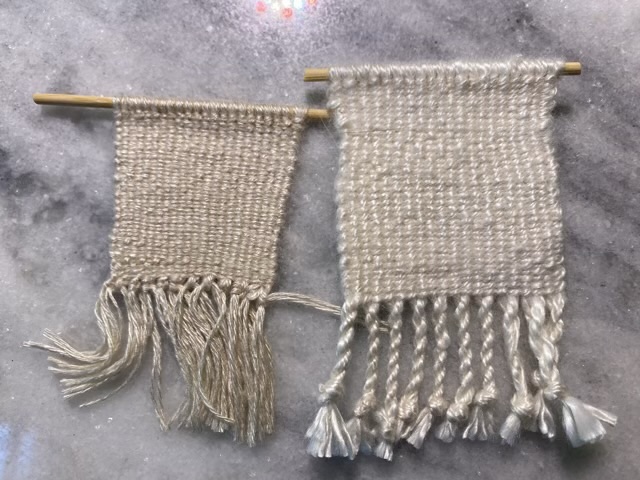
Flipping the fabric worked, the sides of my swatch are better than my previous attempts. They aren’t perfect, but my skills are improving. It is those little tips and insights that make learning from accomplished crafters so valuable. YouTube is great for general knowledge and diving down rabbit holes, but the knowledge we can gain when working with another crafter is invaluable.
Crochet cables are an entirely different beast than knit cables. Rather than just switching the order of a few stitches, it involves at minimum three different stitches, and different placement. I ripped out my swatch twice trying to get my brain wrapped around the technique. I finally made myself a rough chart, which helped, and religiously counted stitches on each row.

I used a combination of single crochet, double crochet in the front post, and treble crochet in the front post. I have not puzzled out how to reverse the cable twist, although I suspect it involves some pretzel like moves.
When I went to swatch my hand spun rose fiber yarn I had an urge to cable, so I did. Cables in knitting look fancy but are not technically difficult. The stitches get a little tight in the twist, so take a little longer, but the concept is just to put one side of the cable on a cable needle, put the extra needle to the front or back, knit the other side of the cable, put the first side back on the knitting needle, then knit them. Honestly the words took longer to type. There are brave souls who can cable without the extra needle to hold the loose stitches, but I haven’t worked up the courage yet.

The direction of twist depends on if the skipped stitches are moved to the front or back of the work. Since I was swatching, I did one of each.
I finished plying the rose combed top fiber, wound it onto my PVC niddy noddy, and gave it a rinse. When it was dry, I took the skein and hung it over the back of a chair, but I went to wind it into a ball, and couldn’t find my nostepinne, or the rolled card stock I had been using. Hm. Then I noticed the PVC pipe is about the right size. Perfect.
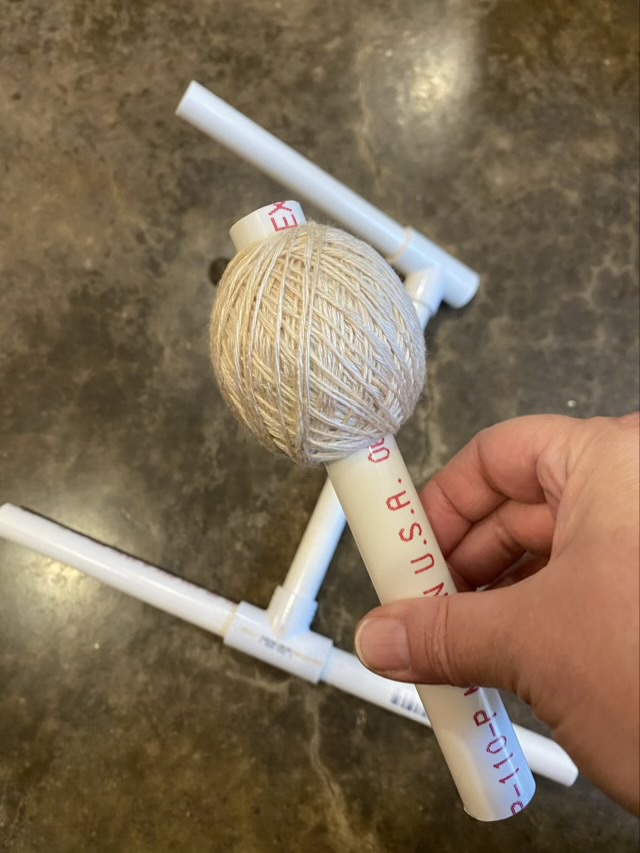
Are swifts and ball winders and wooden niddy noddys nice? Yes, of course. Are they necessary to the yarn making process? Nope. The back of a chair, or an extra pair of hands, and a rolled paper or a length of pipe will do.
 Critters and Craft