Fiber Study: Banana

I assembled my banana fiber study page with yarn made from the stems of banana plants and purchased as combed top from Hearthside fibers.
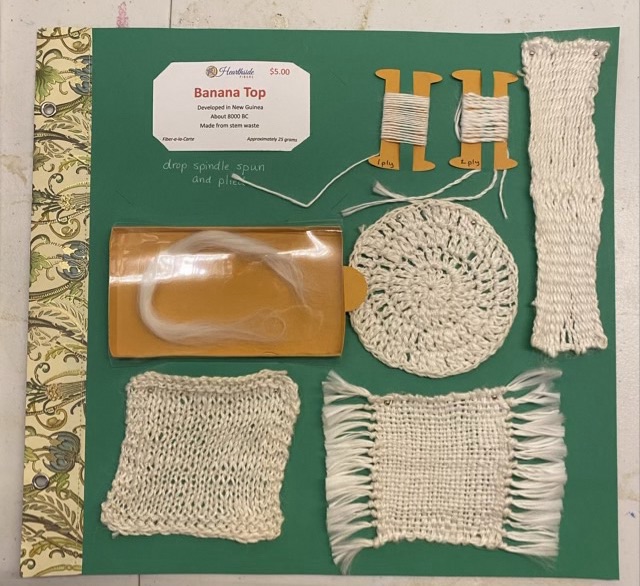
Photo description: counterclockwise from top left: card from Hearthside fibers that reads “Banana top, Developed in New Guinea, about 8,000 BC, made from stem waste”, unspun fiber, knit swatch, woven swatch, crocheted swatch, sprang swatch, two ply yarn, and single ply yarn

Bananas are believed to have been first cultivated in New Guinea around 8,000 years ago and used for both fruit and fiber. The staple length of the combed top is long, about 8 inches, and the fiber is strong.

Photo description: banana combed top next to a ruler showing around an eight inch length

The fiber was pleasant to spin. I did challenge myself to spin thicker than my default spin, which resulted in more thickness variation, and also subsequently less length. I used up all my two ply yarn in my swatches, and had to piece together bits for my bobbin on the page because I forgot to set aside some at the beginning.
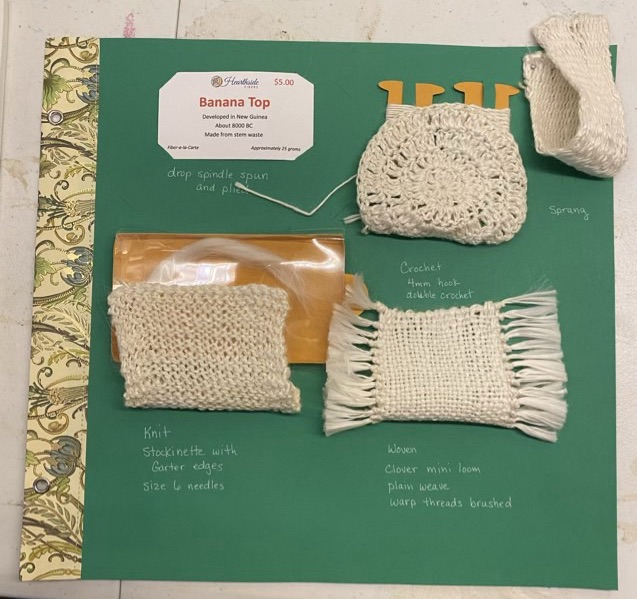
Photo description: same fiber page with the swatches flipped up to show the hand written descriptions

I made unadorned swatches to show the texture in the yarn that was also a result of the variations in thickness. My sprang swatch blocked well and has a lovely horizontal stretch.
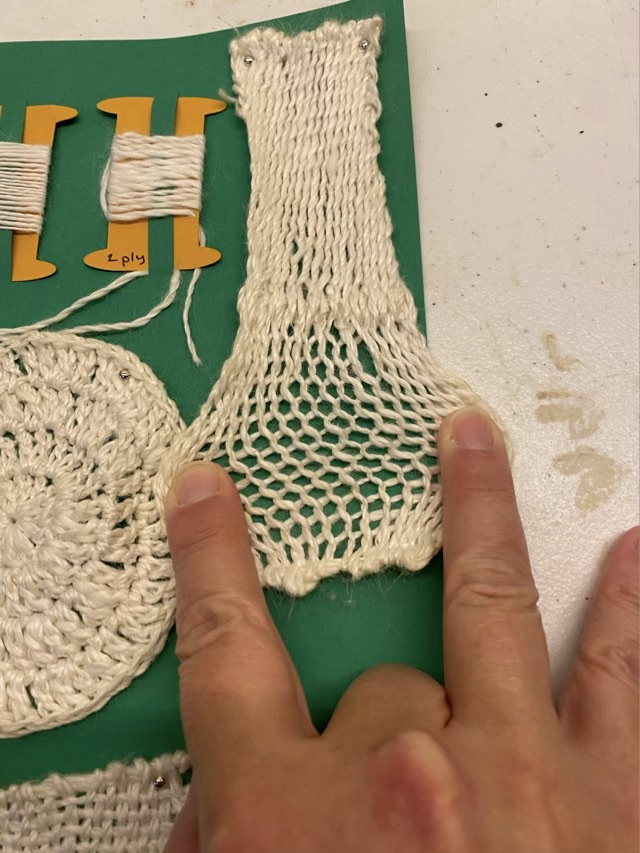
Photo description: sprang swatch held expanded with my fingers to show the interlinking between the strands

I would absolutely spin banana fiber again, but I think next time, I would spin thin.
Fiber Study: Camel roving

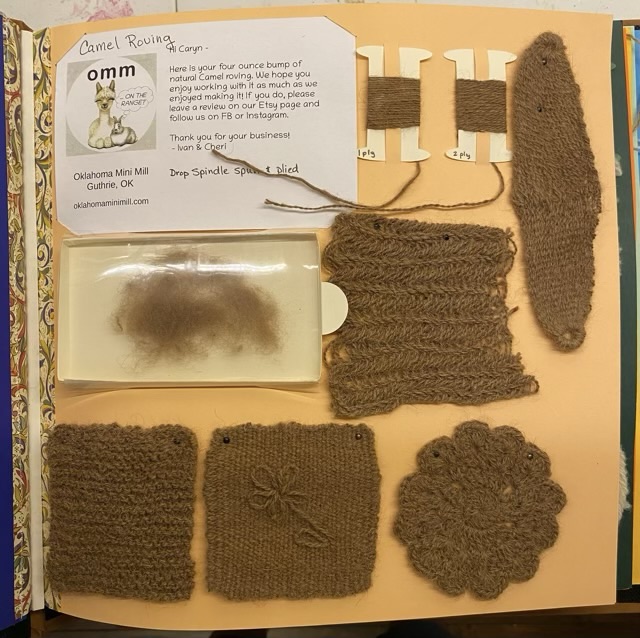
Photo description: fiber study page for camel roving from Oklahoma Mini Mill, (counterclockwise) with a card from the mill, a sample of roving, knit swatch, woven swatch with embroidery, crocheted round swatch, nålbound swatch, sprang swatch, two ply on a paper bobbin, and single ply on a paper bobbin

I assembled my camel roving fiber page! I quite like camel fiber; it is nice to spin, and soft. I would definitely work with the fiber again. In fact, I have two and a half balls of 2-ply yarn with which to plan a project. Exciting. I have also decided to add a synopsis of my blog posts about the fiber to the pages, so I can remember how I felt about the fiber. Now to figure out how to attach the printed pages. I tried some washi tape, which surprisingly doesn’t like card stock much. Hm.

Photo description: same page with the swatches lifted to reveal the hand written descriptions

The roving sample isn’t as perfect as it came from the mill; I liked spinning so much I forgot to leave a bit unspun. The fiber in the box was spun, and then I brushed it back open. Oops.

Fiber page: Pineapple fiber

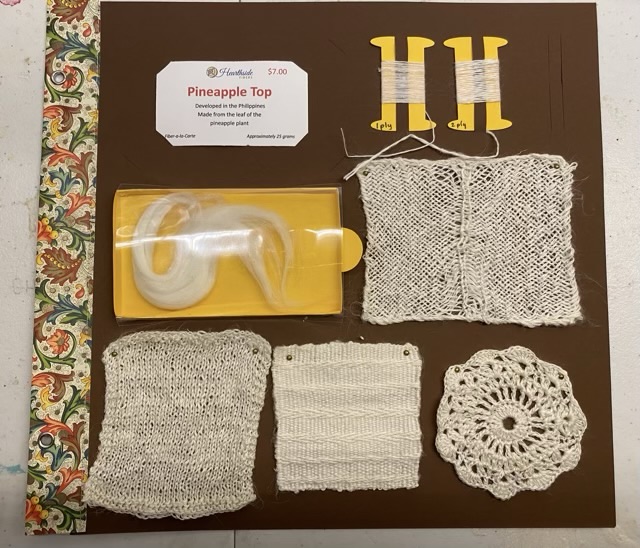
My fiber study page for my pineapple fiber sample is done!

Photo description: clockwise from top left: card from Hearthside fibers that says “Pineapple Top, Developed in the Philippines, Made from the leaf of the pineapple plant”, paper bobbins with single spun and 2-ply hand spun yarn, sprang swatch, crochet swatch, woven swatch, knit swatch, unspun fiber

The crochet round gave me fits with this fiber. I spun it so fine I was having trouble getting the right gauge for my regular coaster pattern. I think I ripped it apart three times. I ended up winging it, filling the space with stitches and numbers that fit.

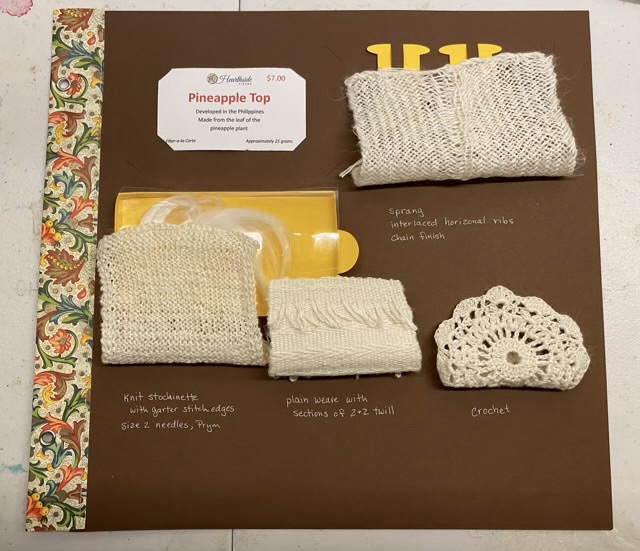
Photo description: same page with the swatches flipped up to show hand written descriptions: “Sprang interlaced horizontal ribs chain finished”, “crochet”, “plain weave with sections of 2×2 twill”, “knit stockinette with garter stitch edges size 2 needles, Prym”

Turns out I can

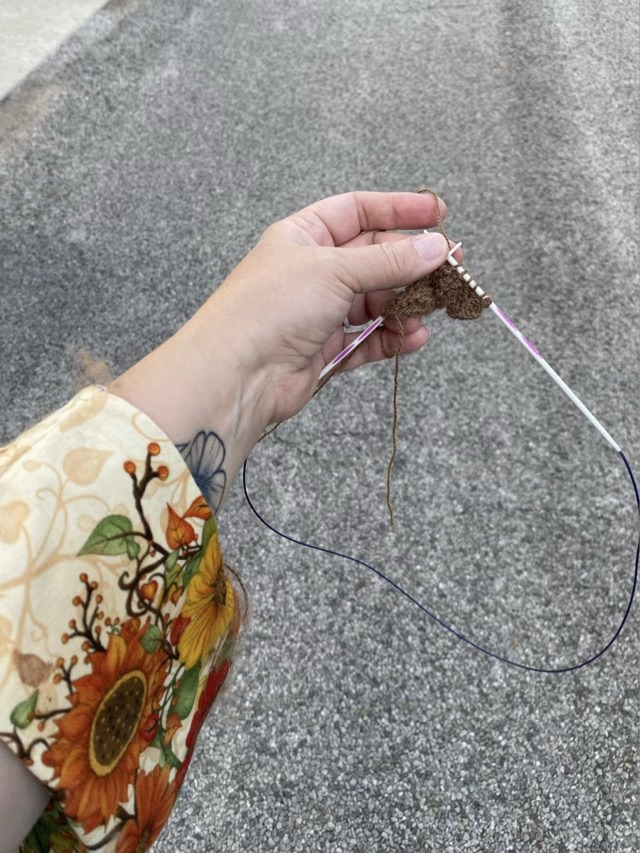
I’ve been spinning on my morning walks for some time. I finished spinning up some camel fiber, but forgot to bring down a more fiber. I didn’t want to clomp up the stairs and wake everyone up at 6am, so grabbed a ball of the plied camel fiber, a crochet hook, and circular knitting needles. It was experiment time. My intention was to make my fiber page swatches as I walked. I know the crochet pattern I use by memory, and I don’t need a pattern for my knit swatch. I think I have crocheted hats while walking before, so finishing up the crocheted camel swatch wasn’t pushing the limits really. I’m pretty sure I haven’t knit on the hoof, but with the circular needles, it wasn’t a problem. I don’t think I would take a large or fiddly project out for a stroll, because dropped stitches would be a nightmare, but a simple patch is easily done.

Photo description: asphalt background, size 2 circular knitting needles with hand spun camel fiber cast on and in progress knitting garter stitch. The ball of yarn is in the colorful bag hanging on my arm.

Things I can do while walking: spin yarn, ply yarn, crochet, knit, nålbind, chew gum. Just not all at the same time. (By the way, I really recommend not chewing gum while working with fiber, stray hairs get everywhere.)

Fiber page: Shetland lace

The Baize Shetland wool was the first Livestock Conservancy Shave ‘Em to Save ‘Em fiber I purchased. I bought a 13 oz batt, and have been spinning it at demonstrations and fair booths. I’ve been quite remiss in actually making a fiber page! That is now rectified, and this wonderful fiber has a page in my sampler book.

Photo description: Post card from the breeder (top left), single spun and two ply yarn (top right), unspun wool as purchased scoured and carded (middle left), crochet round (middle right), two Shetland lace knit samples (bottom left), nålbinding (bottom middle), and a woven swatch with combed fringe.
Photo description: same page, but with the samples folded up to show the descriptions

Shetland wool is a joy to spin, and is definitely on my “will purchase again” list.